

Therapy for Burnout and Emotional Exhaustion
Burnout can involve more than a busy week. Explore how therapy can help you understand exhaustion, boundaries and the demands that keep exceeding your capacity.
Young professional reviewing a weekly calendar during a video therapy appointment.
When pushing through becomes your default
You keep meeting deadlines and answering messages, but the effort required feels heavier than it used to. Small requests irritate you. Time off does not always feel restorative because you spend it catching up or anticipating what comes next. You may worry that slowing down will reveal how close to your limit you have been.
Therapy for burnout and emotional exhaustion can help you understand what is sustaining the overload. Your experience may involve work, relationships, financial pressure, caregiving or several demands at once. We can assess the pattern without assuming a weekend away or a better morning routine will solve it.
Exhaustion deserves a careful assessment
Feeling depleted can have many contributors. Sleep disruption, medical conditions, medications, anxiety and depression may affect energy and motivation. A therapy conversation cannot replace medical evaluation when symptoms suggest that additional assessment is needed. We can discuss those possibilities and coordinate with other care when appropriate.
We will also look at what burnout means in your own words. You may feel detached from work, unable to recover, less patient with people or uncertain whether anything you do is enough. The focus is on your symptoms, functioning and circumstances rather than attaching a label to every difficult week.
Looking at the load rather than only your coping
Coping strategies can help, but they do not make an unreasonable workload reasonable. We can examine the demands on you, the support available and the expectations you place on yourself. Some responsibilities may be negotiable; others may remain difficult for now. Naming that distinction helps us avoid a plan that adds another list of tasks to an already full life.
For a younger professional, the pressure may include proving yourself, paying bills and feeling that you should always be available. We can explore how those realities interact with perfectionism, people-pleasing, or fear of disappointing others. The aim is not to blame you for conditions you did not create.
How our sessions can translate into change
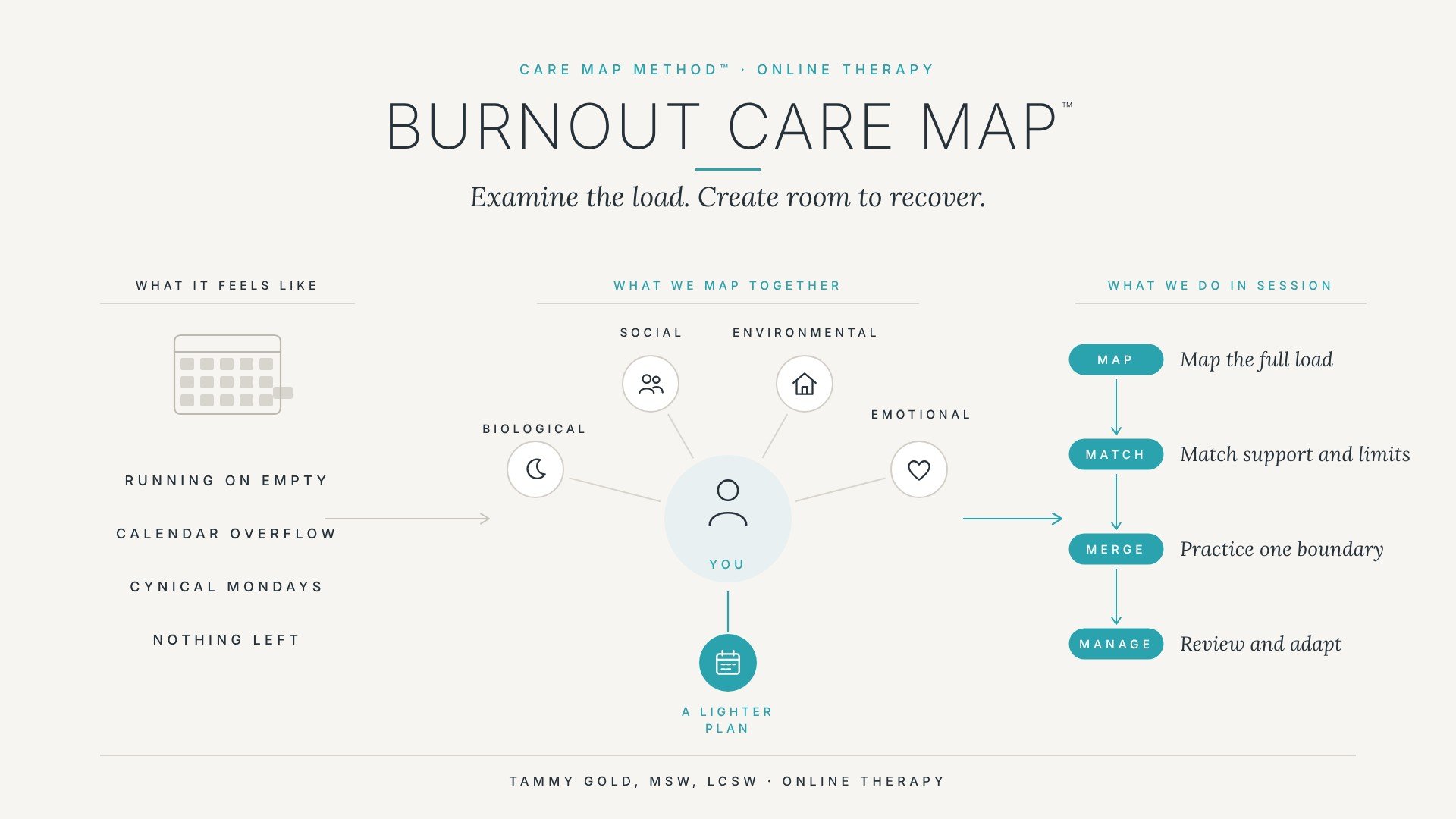
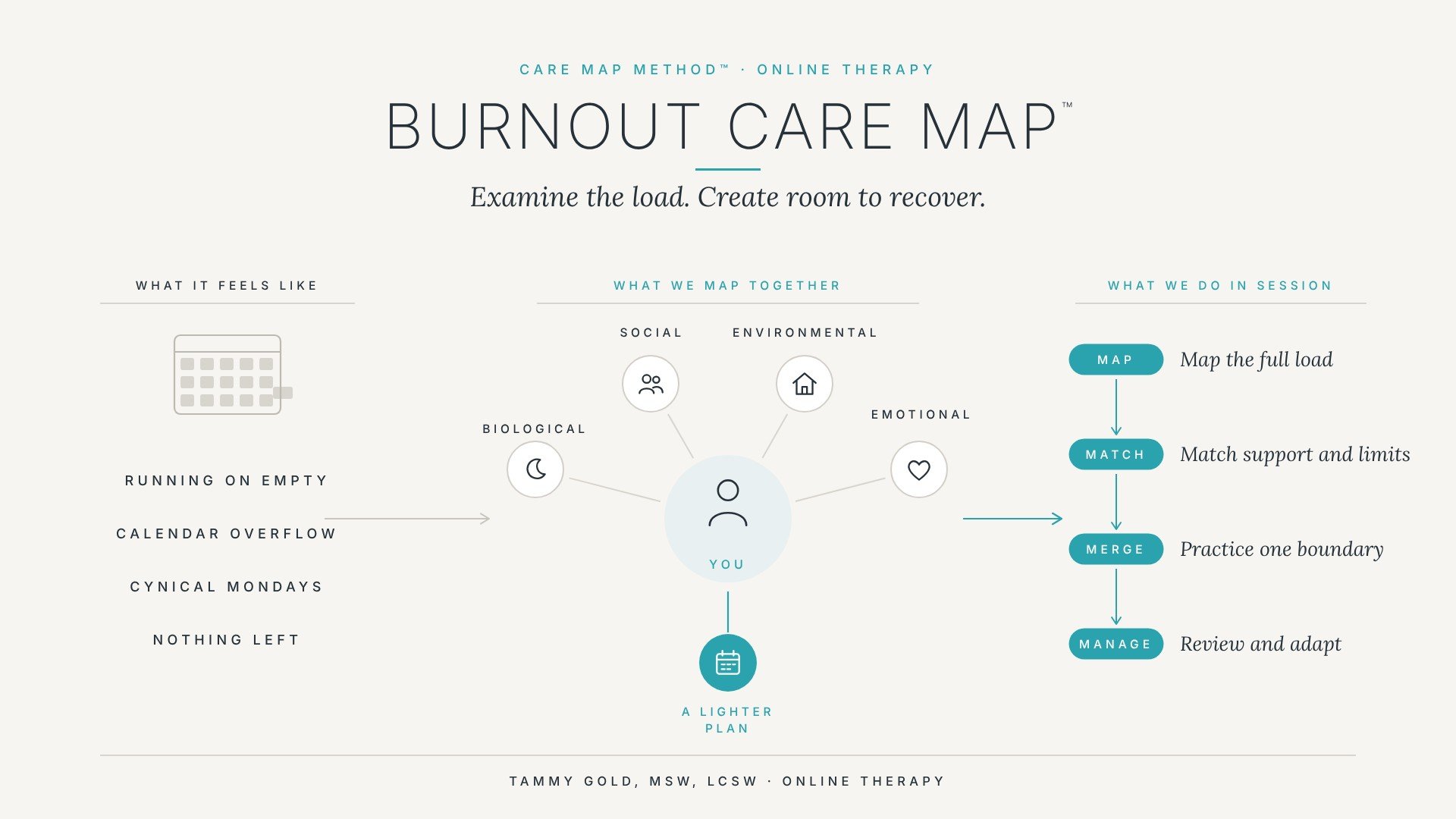
Using the Care Map Method™, we MAP where energy is going and which patterns keep repeating. We MATCH clinical strategies and practical changes to your needs. We MERGE those changes into work and home routines, then MANAGE the results as circumstances evolve. This framework helps organize the work within individualized psychotherapy.
An initial step might be discussing priorities with a supervisor, reducing an optional commitment or identifying a recurring interaction that consumes a disproportionate amount of energy. We can also address the emotions that make a change difficult. A boundary that looks sensible on paper may still bring fear, grief or guilt.
An example of sharing capacity more clearly
Suppose a manager assigns another project when your schedule is already full. You agree immediately, work late and become frustrated that nobody recognizes your effort. In therapy we might examine what prevented you from naming the conflict between the tasks. We can prepare language that reflects your role and actual constraints.
That could mean asking which deadline should move or clarifying what can reasonably be completed. It may not change the manager's response. We would then consider what the response tells you, how to protect your wellbeing and what additional options or professional advice you need.
A more sustainable definition of progress
Progress may mean recognizing overload earlier, spending less time recovering from ordinary interactions or making room for relationships that are not organized around performance. It can also mean acknowledging that a role or arrangement needs to change. We will consider both symptom relief and whether the overall demands are becoming more manageable.
You do not have to wait until you cannot function to seek support. At the same time, therapy should not promise a quick return to your previous output. We can develop goals that account for your health, values and responsibilities, and revisit those goals as we learn what helps.
About Tamara Gold
I am Tamara “Tammy” Gold, MSW, LCSW, CEC, a Columbia University-trained therapist, certified coach and author of Secrets of the Nanny Whisperer. My work with individuals and families informs a warm, collaborative approach that connects emotional understanding with practical next steps. Treatment is individualized to your needs; results and timelines vary.
Online appointments and insurance
Online appointments depend on your physical location at each session, clinical fit and current availability. Review my booking profiles to confirm whether I can serve you in your state. Selected insurance plans may be available through Headway or Alma. Coverage, medical-necessity requirements and your costs depend on your individual plan; a life problem alone does not establish insurance coverage.
Frequently asked questions
Is burnout the same as depression?
No. They can share features, but the terms are not interchangeable. A clinical assessment considers symptoms, duration, context and functioning. Persistent low mood, loss of interest or significant impairment deserves careful evaluation.
Can therapy help if I cannot leave my job?
We can work on coping, communication, limits and decision-making within your actual circumstances. The aim is not to require an immediate job change, nor to suggest that coping alone can fix every workplace condition.
What if rest does not restore my energy?
Persistent or unexplained fatigue can warrant medical assessment in addition to discussing stress and sleep. Therapy can address relevant emotional and behavioral factors while recognizing that exhaustion may have multiple causes.
Can young professionals experience burnout?
Yes. Workload, uncertainty, finances and pressure to prove yourself can be relevant at many career stages. We will focus on your particular experience rather than assume that age determines how much you should be able to handle.
Will therapy just give me more self-care tasks?
We can discuss what is realistic before adding any practice. Sometimes reducing demands, addressing an interaction or changing an expectation is more useful than adding another routine.
How will we know whether therapy is helping?
We can track the goals that matter to you, such as recovery time, sleep, boundaries or participation in relationships. We will review the pattern and adjust treatment or discuss additional care if progress is limited.
Take the next step
If this sounds like the kind of support you need, review current appointment options and check insurance eligibility through my Headway or Alma profile. You can bring questions about fit, fees and the process before scheduling. You do not need a perfect explanation of the problem to begin.