

Online Therapy for Anticipatory Grief in Oregon
Watching a parent’s health change can bring grief before a death has occurred. Online therapy in Oregon offers space for sadness, guilt and frustration, with practical support for identifying your limits and asking for help.
You may be grieving conversations you can no longer have, a role that has changed or a future that feels uncertain. When people focus only on what your parent needs, it can be difficult to explain what you are losing too.
I’m Tammy Gold. I offer individual online therapy for adults in Oregon, including adult children and caregivers dealing with family changes. We can explore the grief, worry and complicated feelings around a parent’s declining health.
Check Booking and Insurance Options
Make room for what is changing
Grief before an expected loss is sometimes described as anticipatory grief. It does not follow one required pattern. You may feel sadness, anger, numbness or guilt, and those feelings may change from day to day.
We can discuss what you are experiencing without treating love and frustration as incompatible. Assessment also helps clarify whether your symptoms and functioning call for additional support.
Distinguish caring from carrying everything
Perhaps every missed visit feels like a failure, even when work or health limits what you can do. We can examine the expectation you hold yourself to and what responsibilities are realistically yours.
A request for help might begin, “I need someone else to handle this appointment so I can keep managing the parts I already do.” We can explore the feelings attached to that request and how family responses affect you.
Find a way to be present that fits the relationship now
You may be trying to make every interaction meaningful or fearing the next change. Therapy can provide room to discuss those pressures and consider what connection means in your circumstances.
Medical decisions, prognosis and questions about the parent’s treatment remain with their health care team. This service focuses on the adult client’s mental health and choices, rather than treating the parent through someone else’s sessions.
What we can work on together in session
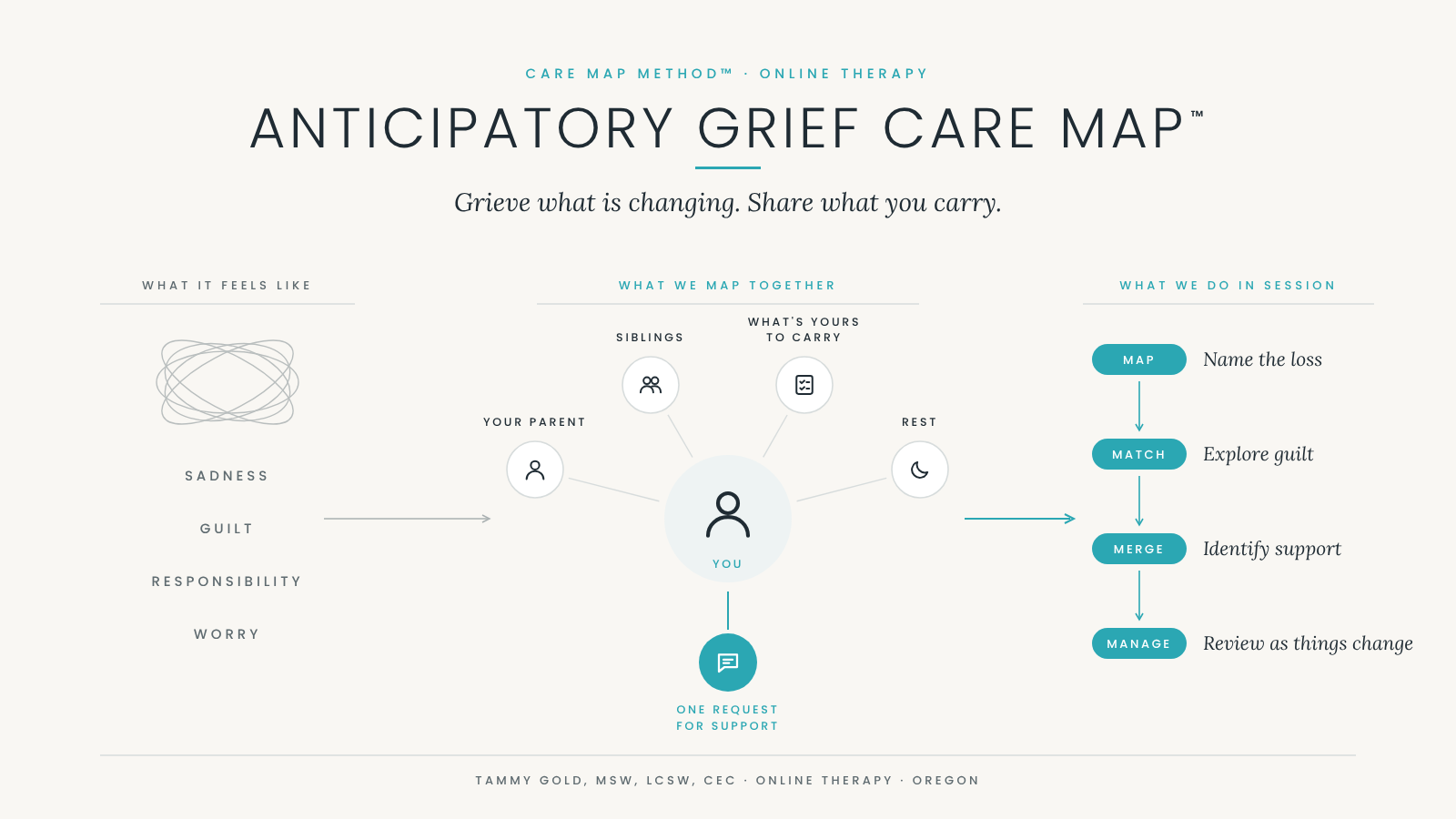
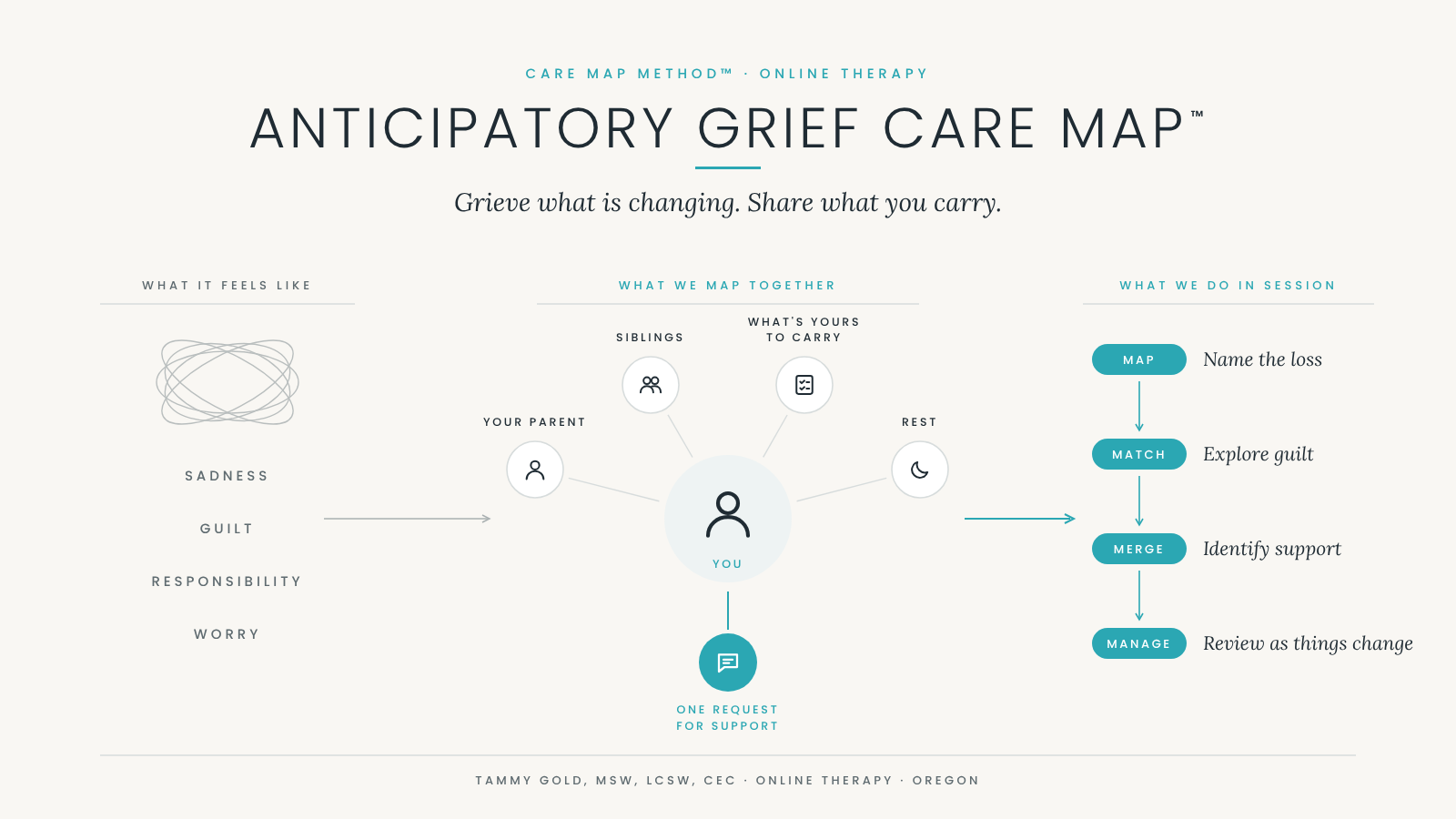
We can begin with one moment that has stayed with you: leaving a visit, receiving an update or feeling frustrated during a care task. We can name what you are grieving, explore the meaning of the guilt and look at the responsibilities you are carrying. There is room for love, anger, sadness and fatigue in the same conversation.
If you need practical support, we can rehearse a specific request to a relative, identify a limit around one responsibility or consider how you want to recover after a difficult visit. The next step should fit your time, resources and relationship with your parent. We can review what helped and what remains hard in a later session. Medical decisions and the parent's treatment remain with their care team; our work centers on your mental health.
When grief and ordinary responsibilities overlap
You may move from a difficult visit straight into a work meeting or return home to people who need you. The lack of space between roles can leave feelings unspoken. We can discuss what happens when you postpone your own reactions and what kind of support would fit the time and energy you actually have.
Sibling differences can add another layer. One relative may want more updates, another may avoid the situation and someone may question the choices being made. We can explore your part in these relationships without treating you as responsible for everyone’s agreement. Questions about legal authority or medical decisions need the appropriate professional guidance.
Start with what feels hardest to say
You might want to talk about anger, relief after leaving a visit or fear that you are already forgetting who your parent used to be. These feelings can be discussed with care. We can consider how they affect sleep, concentration and relationships, and what helps you feel less isolated. The work does not require a perfect visit or a particular way of grieving to count as caring.
A practical way to understand what is happening
My Care Map Method™ helps us look at Biological, Social, Environmental and Emotional factors alongside clinical assessment. We consider your health and energy, relationships, daily circumstances and emotional experience rather than isolate one difficult moment from the rest of your life. We MAP the need, MATCH appropriate support, MERGE that support into your circumstances and MANAGE the plan as we learn what is useful. This is an organizing framework within individualized therapy, not a promise of a particular result.
What your first session can include
You can bring one situation you want help understanding. We will discuss your concern, relevant history, symptoms, daily functioning and available support. You can tell me what has or has not helped before and what you need to feel comfortable talking. My aim is to offer empathy without judgment and begin exploring a practical next step, while allowing time for assessment. We will decide together whether my approach fits and which goals matter to you. You do not need to arrive knowing the right words or the solution.
About Tammy Gold
I’m Tamara “Tammy” Gold, MSW, LCSW, CEC. I earned my clinical MSW at Columbia University and my BA at the University of Pennsylvania. My work with families includes parenting, caregiving and difficult relationships. I bring empathy without judgment and a practical interest in helping you understand the problem and consider what comes next.
Frequently asked questions
Can grief begin before someone dies?
Yes. People can grieve anticipated loss and changes in a relationship. Your experience still needs individual attention rather than a fixed stage model.
Does feeling relief or frustration mean I do not care?
Those feelings do not provide a complete measure of your relationship. We can explore their context without judging you.
Are you treating my parent?
No. This page describes individual therapy for the adult seeking help.
Can you advise on dementia treatment?
No. Diagnosis, medical care and prognosis belong with the parent’s clinical team.
Is this the same as senior-care consulting?
No. Psychotherapy and care-selection consulting are separate services with different goals and payment arrangements.
Does insurance cover grief?
The loss situation alone does not establish coverage. Confirm assessed clinical needs, your Oregon plan and current participation before starting.
Can I come if I am not the main caregiver?
Yes. A parent’s health changes can affect you even when someone else provides most of the practical care. Assessment helps clarify your support needs.
Can I discuss guilt about taking a break?
Yes. We can explore the expectations behind the guilt and what rest or shared responsibility might mean in your actual circumstances.
Booking and profile options
Choose a platform that shows current appointments for your physical location in Oregon and your exact insurance plan. Availability and participation can differ across platforms.
Check availability and insurance on Grow Therapy
Check availability and insurance on Alma
Check availability and insurance on Headway
Read my profile or contact me on Psychology Today
Before confirming a visit, check the service, current provider participation, your exact benefits and estimated costs. Coverage depends on your plan and the assessed clinical service; a life event alone does not establish insurance eligibility. You must be physically located where I am authorized to provide care at each session.