Relationship Stress Therapy in California
Do you keep having the same argument, even when you promise yourself you will handle it differently? You may leave conversations feeling unheard, replay what you said, or stay quiet because another disagreement feels exhausting. In online individual therapy in California, we can look closely at one of those moments and understand what makes the pattern difficult to change. Together, we can identify the emotion underneath your reaction, clarify what you need, and practice a request that sounds like you. Using Care Map Method, we can also prepare for defensiveness, plan a pause, and explore boundaries you can follow through on. I’m Tammy Gold, LCSW. My approach makes room for the hurt behind the conflict while helping you develop responses you can use in everyday conversations. Your partner does not have to attend for us to begin working on your concerns.
Keep having the same argument and wishing you had handled it differently
You bring up something that matters, and the conversation quickly changes. You explain more. Your partner gets defensive or goes quiet. By the end, you feel farther apart and keep replaying what happened. Online individual therapy offers a place to understand that pattern and practice a response you can use when the next difficult moment arrives.
Maybe you rehearse conversations in your head, avoid asking for what you need, or feel responsible for keeping the peace. You may want to stay in the relationship while changing how you participate in it. We can work on your concerns even if your partner is not attending therapy with you.
Check benefits and availability
Understand what happens before the argument
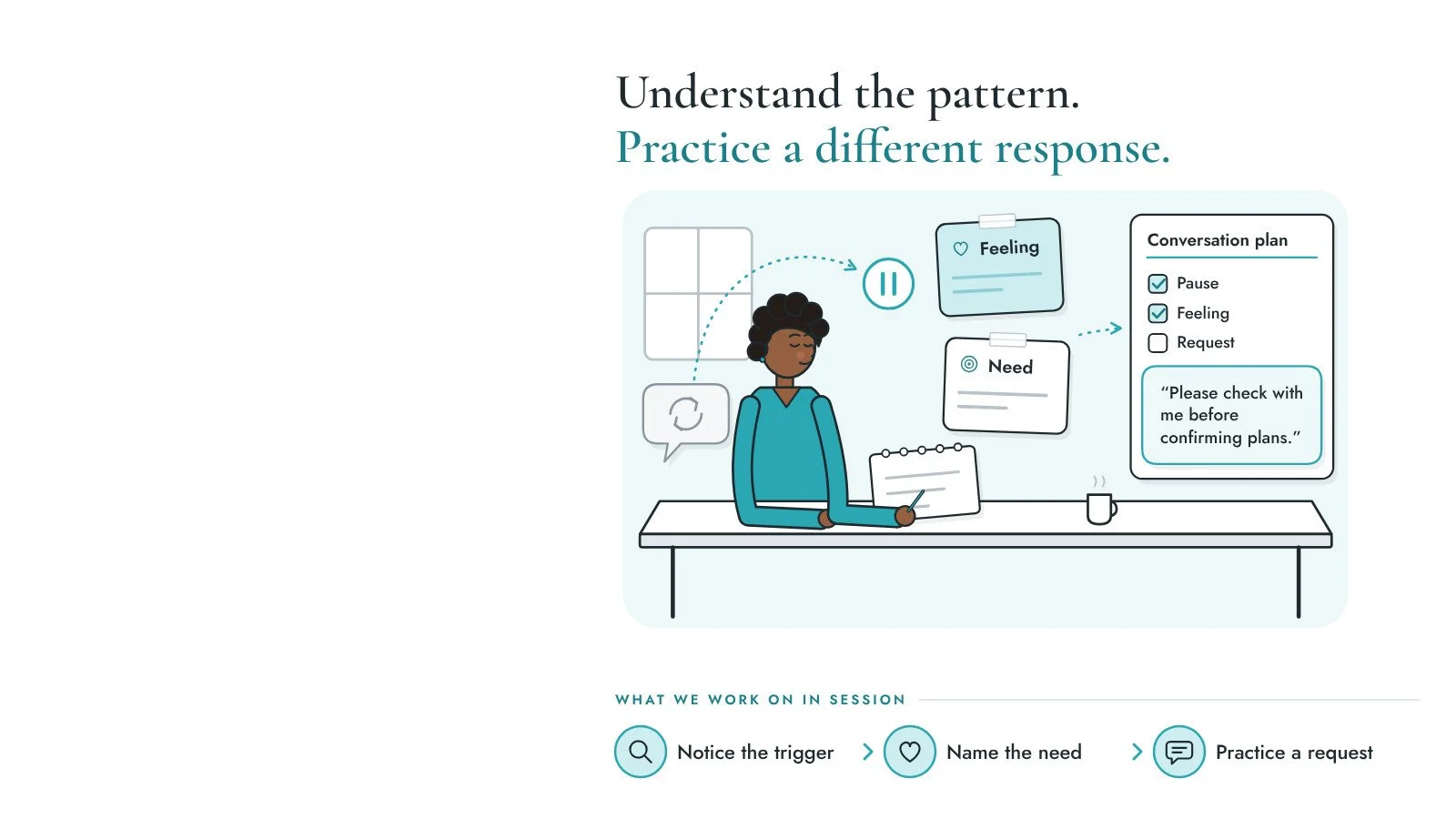
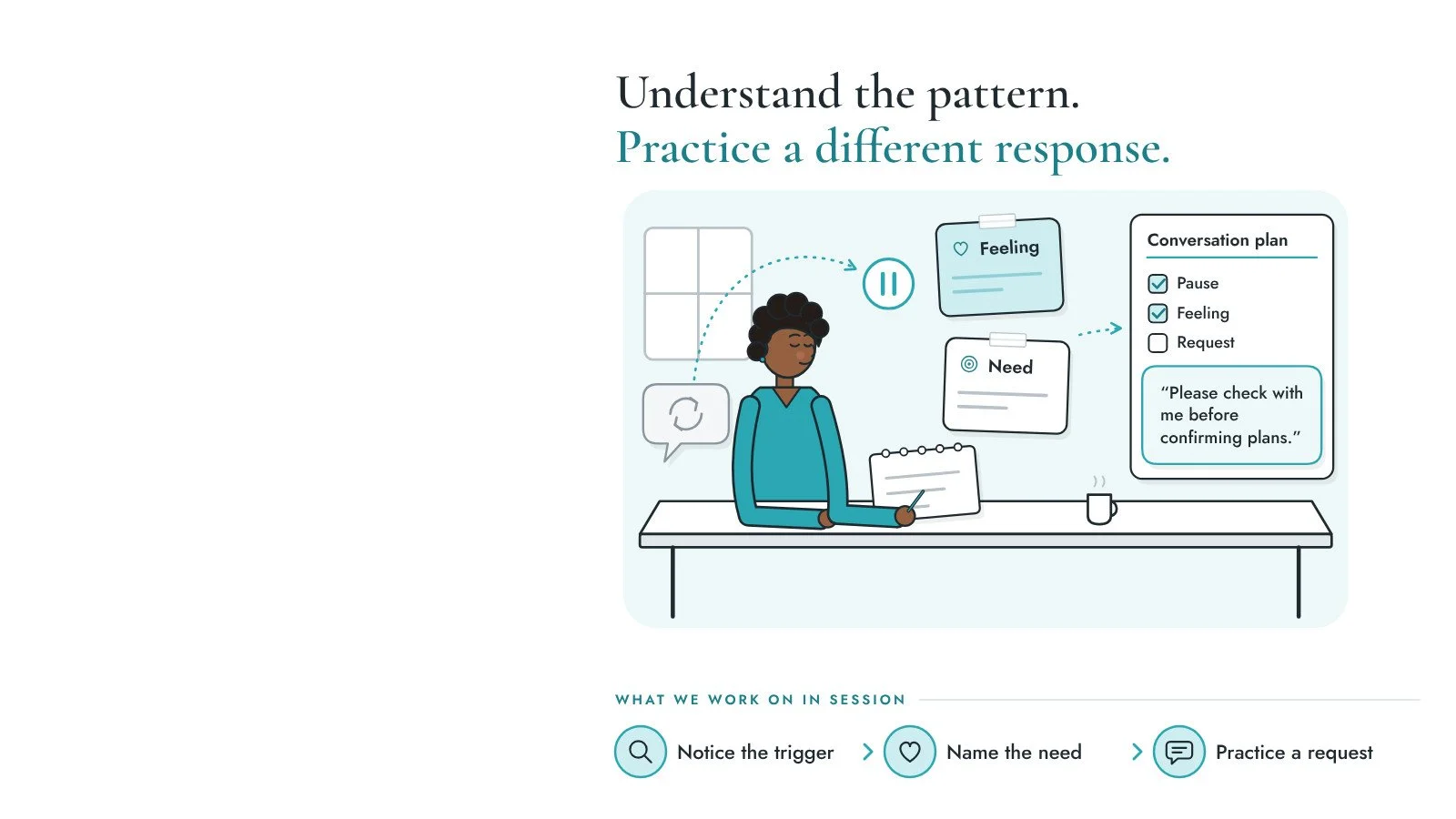
We can take one recent disagreement and slow it down. What was said? What did you hear it as meaning? What did you feel in your body, and what did you do next? This helps us identify the point where you become defensive, raise your voice, withdraw, or start trying harder to be understood. We also make room for hurt and experiences that may shape those reactions.
Practice a request that says what you need
Instead of stopping at “communicate better,” we can work on your actual words. You might practice describing one behavior, naming its effect, and making a specific request. For example: “When plans change without telling me, I feel left out. Please check with me before confirming.” We can explore how that wording feels and what makes it difficult to say.
Prepare for the response you cannot control
A clear request does not guarantee agreement. We can plan how you want to respond to defensiveness, decide when to pause, and consider what boundary you can follow through on. We can also explore whether the relationship is meeting your needs. Your goals and safety guide the work; responsibility for another person’s behavior does not fall on you.
An example of the work
For example, you might bring in a disagreement about household responsibilities. We could identify the hurt underneath “you never help,” practice a request about a specific task, and plan a time to revisit the conversation. Between sessions, you may choose to try that request and notice what happens.
What progress can look like
Progress might mean recognizing a trigger sooner, making a clear request, spending less time replaying an exchange, or understanding a boundary you need. We review what changes and adjust the approach together.
How Care Map Method supports our work
Map the emotion and trigger. We look at a recent moment and the biological, emotional, social, and environmental pressures around it. The aim is to understand your experience before choosing a response.
Match the need with a strategy. We identify what matters in that moment and select a skill or next step that fits. That might be a clearer request, a pause, a boundary, or space to process a loss.
Merge the skill into daily life. We can rehearse the words and decide when you might use them. Any practice between sessions is chosen together and adjusted to your circumstances.
Manage responses over time. We review what happened, what was difficult, and what needs to change. Therapy includes room for feelings and history as well as practical work.
About Tammy Gold
I’m Tamara “Tammy” Gold, MSW, LCSW, founder of Care Map Method™ and author of Secrets of the Nanny Whisperer. I earned my MSW at Columbia University and my BA at the University of Pennsylvania. My work with families informs a warm, active approach to therapy that makes room for your emotional experience and practical concerns.
Common questions
Can I attend without my partner? Yes. Individual therapy can focus on your feelings, choices, communication, and boundaries. We can work with your experience while recognizing that your partner has a perspective we have not assessed.
Is this couples counseling? This page describes individual therapy for relationship stress. If you want sessions together, ask about couples services, clinical fit, and payment arrangements before scheduling.
What if I shut down during arguments? We can explore what happens before you withdraw and practice ways to ask for a pause, settle enough to think, and return to a conversation when appropriate.
Will you tell me whether to leave? We can examine your needs, patterns, options, and concerns so you can make an informed decision. Therapy does not require you to arrive with a decision already made.
Can I use Anthem Blue Cross? Use my Headway profile to check your specific Anthem Blue Cross plan and California network eligibility. Coverage, deductible, and cost sharing depend on your benefits and the service provided.
What should I bring to the first session? Bring one recent example and what you wish had gone differently. We will also discuss your history, current concerns, goals, and whether this approach is a good fit.
Take the next step
If this sounds familiar, you can explore online therapy with me while located in California. Open my Headway profile to check your exact insurance benefits and appointment options. We will discuss your concerns, clinical needs, and goals to determine fit.

Aetna Couples Counseling in California for Repeated Arguments and Communication Problems
Online relationship therapy in California for repeated arguments, marriage stress, and communication problems. Verify Aetna benefits and book through Headway.
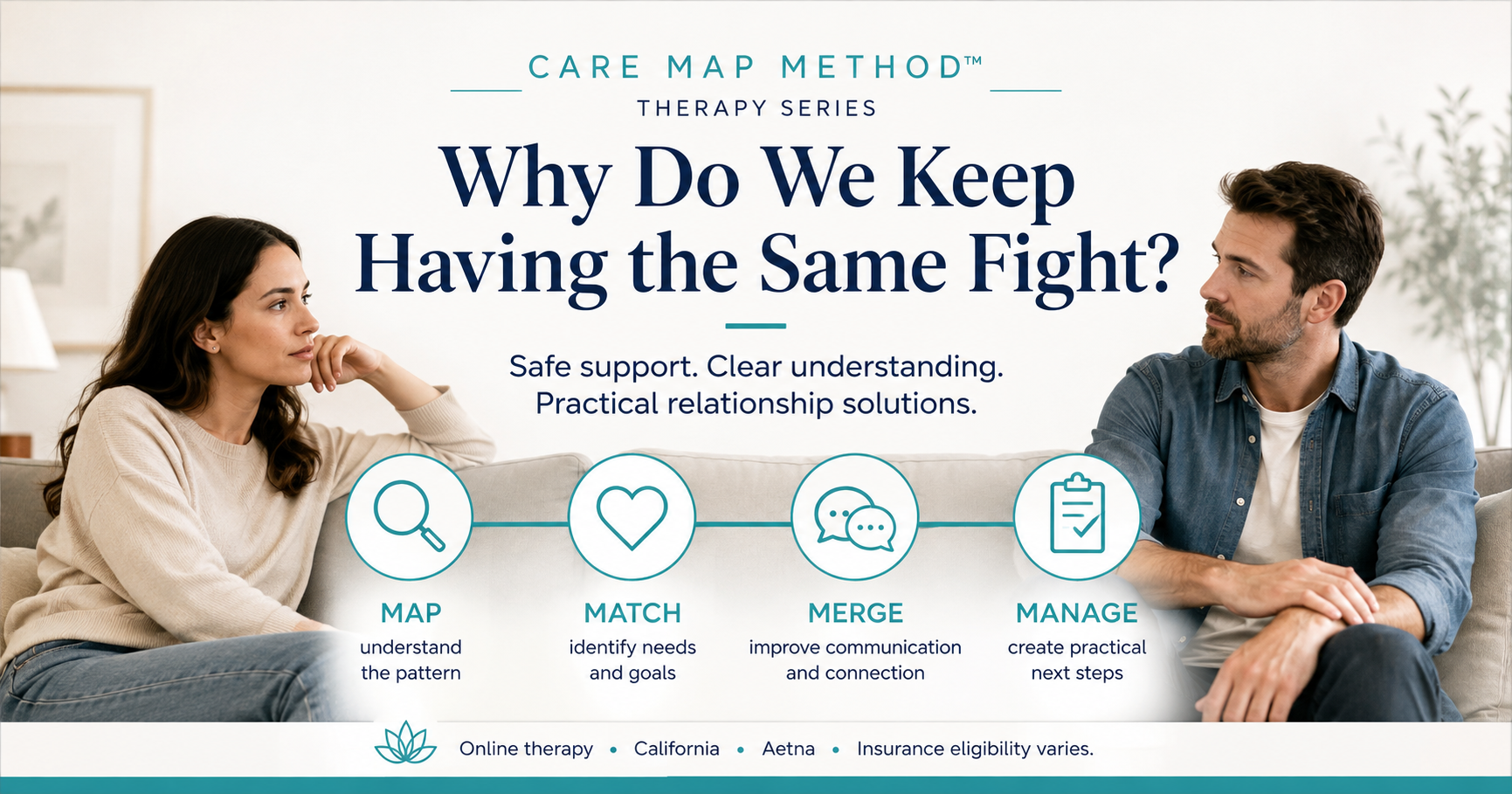
Aetna Couples Counseling in California for Repeated Arguments and Communication Problems
You may love your partner and still feel trapped in the same argument. One person pushes for answers while the other withdraws. A discussion about money, parenting, family, intimacy, or household responsibilities quickly becomes criticism, defensiveness, silence, or resentment. The surface topic changes, but the emotional cycle stays the same.
You do not have to carry this alone. My goal is to provide a warm, confidential, and nonjudgmental space where you can unpack what is happening without shame, blame, or pressure. Therapy can offer emotional support and practical direction at the same time.
Relationship therapy creates a structured place to slow the cycle down. We identify the trigger, the protective reaction, the unmet need underneath it, and the point where communication breaks down. Each partner has room to be heard without the session becoming another argument. The purpose is not to decide who is right. It is to understand what keeps happening and practice safer, clearer ways to respond.
ONLINE THERAPY IN CALIFORNIA
Insurance may be available through Headway depending on your plan, eligibility, state, and session type. Verify benefits before booking.
How the Care Map Method™ helps
MAP
Identify the recurring conflict cycle, emotional triggers, physical stress, family pressures, and environmental demands affecting the relationship.
MATCH
Clarify each partner’s needs, fears, goals, communication style, and the tools most likely to fit the relationship.
MERGE
Practice listening, repair, boundary language, emotional regulation, and communication strategies that both partners can use outside therapy.
MANAGE
Create agreements, check-ins, conflict plans, and realistic next steps so progress continues between sessions.
What clients can work toward
Recognize the argument before it escalates
Communicate needs without blame or shame
Reduce defensiveness and emotional withdrawal
Rebuild teamwork, trust, and connection
Therapy is not only a place to talk about what went wrong. It is a place to feel heard, understand the pattern, practice healthier responses, and build a plan that can be used in daily life. Progress depends on the circumstances and cannot be guaranteed, but the work can become clearer, more intentional, and more supported.
Frequently asked questions
Does Aetna cover couples counseling in California?
Coverage depends on the specific plan, clinical eligibility, session type, and platform rules. Use the Headway insurance-verification process before scheduling and do not assume every Aetna plan covers couples or family sessions.
Can I attend alone if my partner will not come?
Yes. Individual relationship therapy can help you understand the cycle, regulate reactions, communicate differently, set boundaries, and make clearer decisions even when your partner does not attend.
Why do we keep having the same argument?
Repeated arguments are often maintained by emotional triggers, unmet needs, protective reactions, assumptions, and communication habits rather than the surface topic alone.
Will the therapist take sides?
The goal is not to label one partner right and the other wrong. The focus is understanding the relationship pattern and helping both people communicate more safely and effectively.
What happens in the first session?
We clarify the main concern, the conflict cycle, each person’s goals, and the emotional and practical factors affecting the relationship. We also identify initial tools and priorities.
Is online couples therapy appropriate?
Online therapy can be useful when both participants can join from a private, safe location in the state where the therapist is licensed. Suitability and insurance coverage should be confirmed before booking.
You deserve one place where you can be honest without worrying about judgment, shame, or blame. Together, we can understand what is happening, identify what needs to change, and create practical steps toward a healthier relationship and a more manageable life..