

Individual Therapy for Family Overwhelm in Rhode Island
When family requests fill every available space, your own needs can become difficult to hear. Read about individual therapy for family stress, clarifying responsibilities and practicing a request for support. Confirm Rhode Island availability before booking.
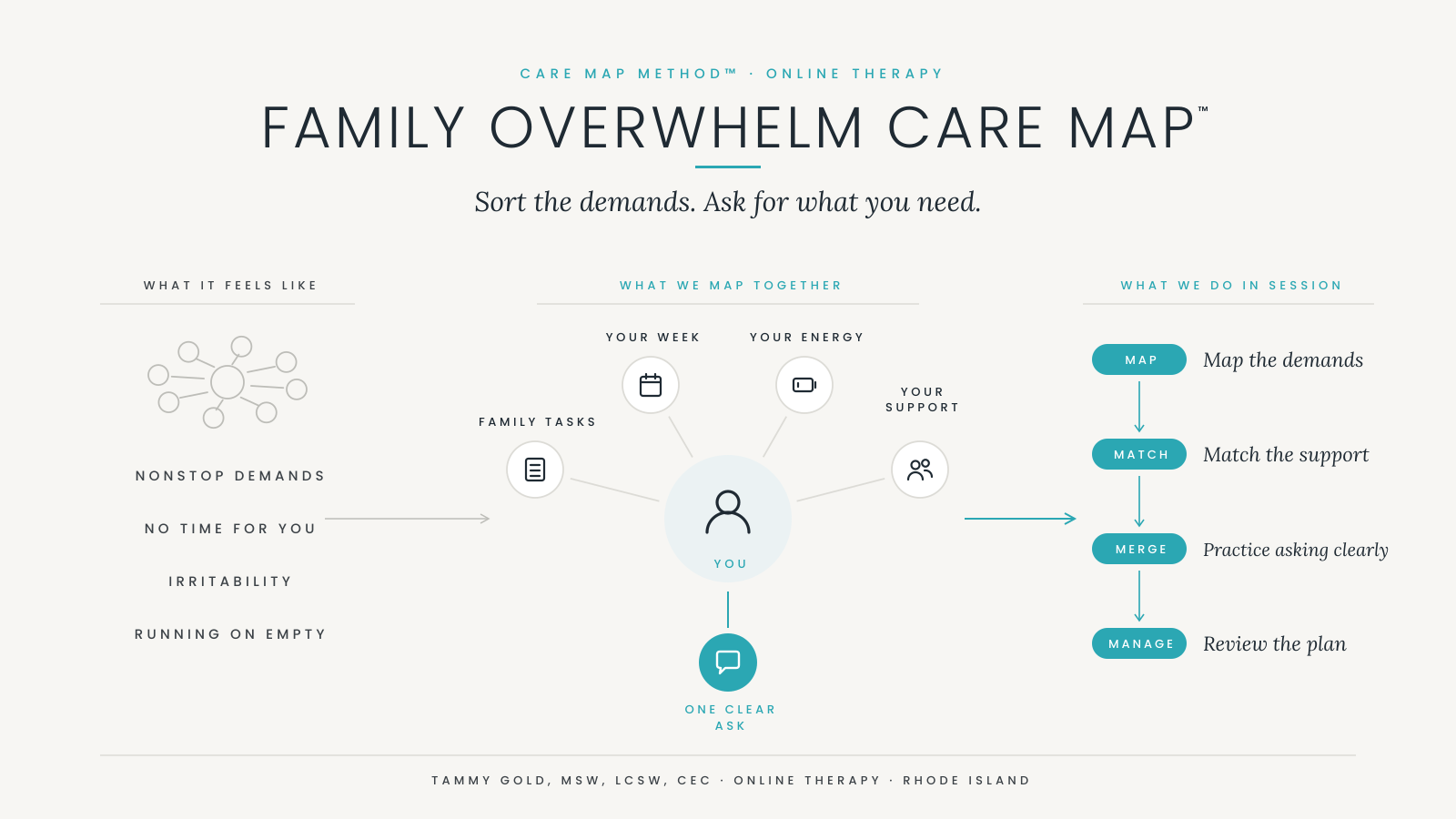
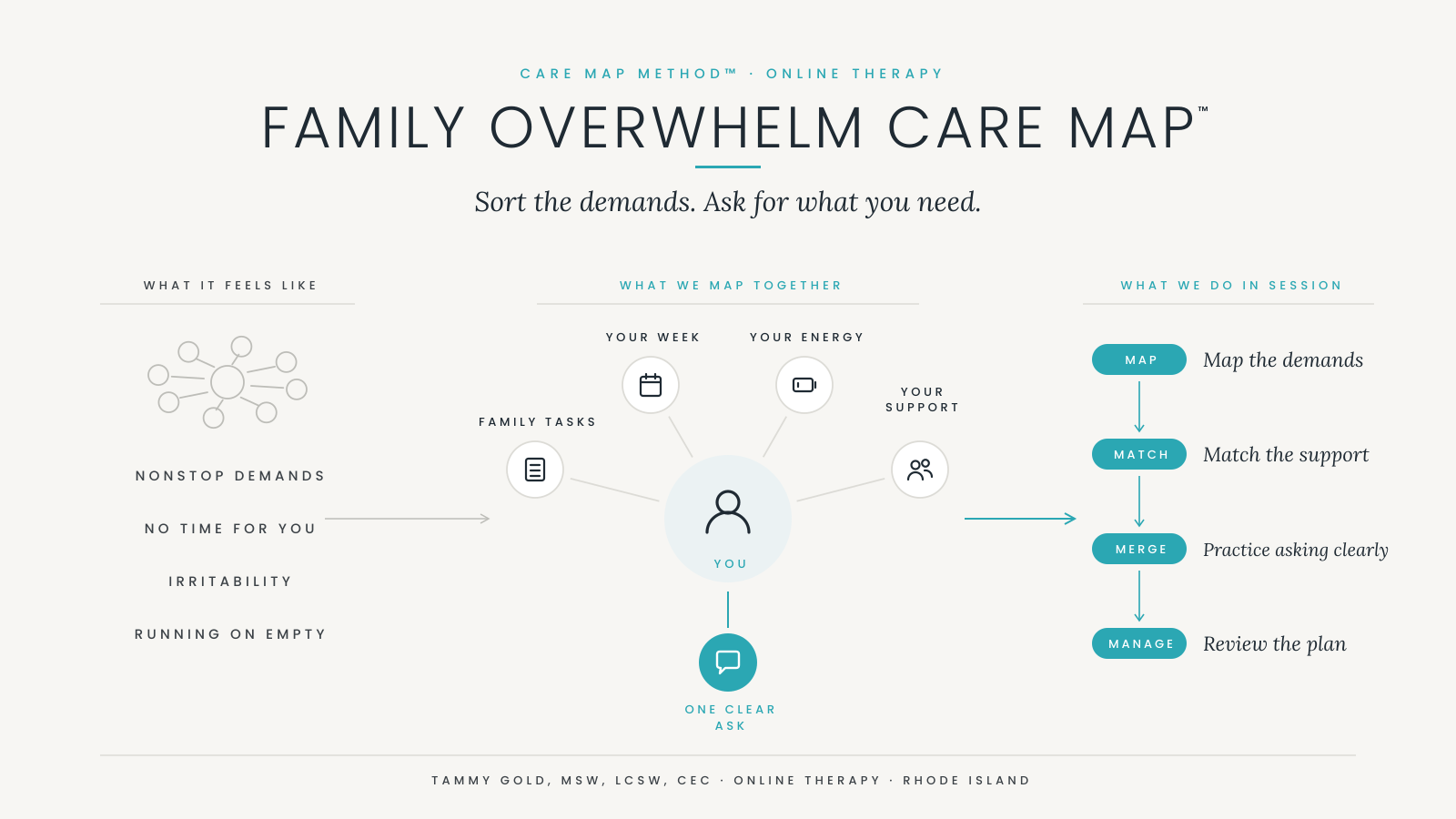
Four illustrated steps for exploring family demands and practicing a request for support.
Private instruction. Do not publish the following article or enable its booking links until Rhode Island independent clinical authorization, platform enrollment and availability have been confirmed. Copy the public article beginning with its main title only after this hold is resolved.
Individual Therapy for Family Overwhelm in Rhode Island
A partner needs something, a child has a problem and an aging parent calls with another concern. You agree to handle it all, then find yourself snapping, withdrawing or feeling that nobody notices how much you are carrying. There may be no single crisis, but little room to recover between demands.
I’m Tammy Gold, a licensed therapist, author and creator of Care Map Method™. My individual therapy work explores family stress, difficult relationships and emotional overwhelm. If you are seeking support in Rhode Island, the concerns below can help you consider the kind of care you want to discuss.
Check Rhode Island Insurance and Availability on Headway or Alma Therapy Platforms
When family demands fill the whole day
The visible tasks may be only part of the load. You might also be remembering appointments, anticipating reactions, keeping track of messages and deciding which problem needs attention first. Others may see the completed task without seeing the thought and worry around it.
We can explore the effect on your mood, concentration, rest and relationships. You may feel angry, anxious, numb or guilty for wanting time alone. Those feelings deserve context. Loving your family does not remove the emotional effect of competing responsibilities, and your experience does not need to look dramatic to be worth discussing.
How responsibility becomes difficult to share
You may have become the person who steps in because you notice what needs doing. Over time, family members may assume that you will keep handling it. You might want help while also worrying about what will happen if you stop overseeing everything.
In individual therapy, we can explore those expectations and the actual limits of your situation. Some responsibilities are not easy to delegate, and support may be uneven. We can still examine where a request, conversation or change is possible without treating you as responsible for creating a perfectly cooperative family.
What we might work on in a session
For example, we might discuss a day when several people asked for help and you accepted every request. Later, a small question led to an argument. We could look at the demands, what you were telling yourself about responsibility and which feeling had not had room to be expressed.
From there, we might identify one need you want another person to understand and practice asking for specific support. That could mean discussing a task, clarifying timing or explaining that you need time to consider a request. We would also explore what happens if help is unavailable. A later session can review the experience and adjust the plan. The work is collaborative and grounded in your circumstances.
Using Care Map Method for family overwhelm
Care Map Method™ helps organize Biological, Social, Environmental and Emotional factors alongside individual assessment. We may consider your health and energy, family relationships, the practical demands of daily life and the feelings attached to your role.
We MAP the demands and their impact. We MATCH support or strategies to the needs identified. We MERGE a chosen approach into daily life through rehearsal or a manageable adjustment. We MANAGE the plan by reviewing what happened and what remains difficult. The framework supports therapy without requiring you to turn every feeling into a task or control every family member's response.
Make room for your own experience
You may be so practiced at explaining everyone else's needs that your own are difficult to name. We can spend time understanding what feels hardest before trying to solve it. That might include resentment, fear of being unavailable or sadness about how a relationship has changed.
When you are ready, we can consider one conversation or choice. A goal might involve recognizing when you are near your limit, asking more directly or discussing expectations earlier. Those are possibilities to assess together. Progress may involve greater understanding as well as changes in behavior.
Choosing the type of support that fits
Individual psychotherapy focuses on the mental health and functioning of the person receiving care. Family sessions involve a different arrangement, and practical care-selection consulting has different goals. We can clarify which service you are looking for before you begin.
An initial clinical appointment can include your concerns, relevant history, current symptoms and the effect on daily life. We can discuss previous support, treatment fit and goals. You do not need to arrive knowing how to divide every responsibility or how to explain the whole family situation perfectly.
About Tammy Gold and Rhode Island inquiries
I’m Tammy Gold, MSW, LCSW, CEC. I earned my MSW at Columbia University and my BA at the University of Pennsylvania. My work includes relationships, parenting, caregiving and the emotional demands of family life.
For a Rhode Island inquiry, confirm current authorization, state-specific appointment availability and the service before scheduling. If using insurance, check your exact plan, provider participation and estimated costs through the appropriate platform. A provider profile or insurer name alone does not establish that a particular appointment is available.
Frequently asked questions
Can I seek individual therapy without bringing my family?
Individual therapy can focus on your distress, symptoms, needs and choices within family relationships. Other relatives do not have to attend. Before arranging care in Rhode Island, confirm current authorization, appointment availability and whether the offered service fits your needs.
What if I feel guilty asking for help?
We can explore what asking means to you, what you fear might happen and how responsibility has developed in your family. Guilt deserves attention in its context. It does not need to disappear before you can begin understanding your needs.
Can we work on irritability and resentment?
Those feelings can be discussed alongside the demands, relationships and symptoms you are experiencing. Assessment helps clarify treatment goals. We can explore what happens around a difficult moment and consider a response that fits your circumstances.
Will you tell my relatives what they must do?
Individual therapy centers on your care, not directing absent family members. We can explore requests, communication and choices within your control. We cannot guarantee another person's cooperation or make family decisions on everyone's behalf through your individual sessions.
Is this family therapy or individual therapy?
This page describes individual psychotherapy. Family treatment would require a separate discussion about participants, goals, clinical fit and payment. Practical care consulting is also a different service. Clarify the type of appointment before scheduling so the arrangement matches what you need.
What happens during a first appointment?
A first clinical session can include your concerns, history, symptoms, daily functioning and previous experiences with support. We would consider fit and goals together. For Rhode Island, confirm that a currently authorized and available appointment can be arranged before booking.
Can I use BCBS Massachusetts while in Rhode Island?
Do not assume coverage from the insurer name or a rate listing. Confirm current Rhode Island authorization, the offered appointment, exact-plan participation and estimated costs with the platform. Different Blue Cross products and networks are not automatically interchangeable.
Are Rhode Island appointments currently available?
Please confirm current Rhode Island availability and authorization before scheduling. The ability to view a general provider profile is not confirmation of an appointment in your state. Any insurance and service questions should be clarified before a visit is arranged.
Take the next step
Confirm current Rhode Island authorization, service availability and insurance details before arranging a visit. Once a suitable appointment is available, the first conversation can begin with the concern that led you to seek support.
Check Rhode Island Insurance and Availability on Headway or Alma Therapy Platforms
Individual Therapy When Family Disapproves of Your Partner in New Jersey
Sharing a home can bring unexpected tension about chores, privacy and responsibilities. Individual online therapy in Iowa can help you understand the feelings beneath recurring disagreements and practice clearer requests for what you need.
A conversation about your relationship can leave you feeling that you must defend your partner, reassure your family and somehow keep everyone close. You may feel guilty before you have even decided what you believe about their concerns.
I’m Tammy Gold. I offer individual online therapy for adults in New Jersey. We can explore your experience of the pressure and help you consider your own needs, observations and choices.
Separate the concerns from the pressure
Relatives may raise a specific behavior that deserves attention. They may also express expectations shaped by culture, religion or their own hopes for your life. Those are not automatically the same kind of concern.
We can examine what was said, what you have observed and what makes it difficult to think clearly. Therapy does not assume that the family is wrong or that the partner is right.
Give your own judgment room
Perhaps you want to say, “I am willing to discuss a specific concern, but repeated criticism is making it harder for me to hear you.” We can explore whether that request fits your circumstances and how you would respond if the conversation continues.
You may also need space to consider a concern privately rather than defend the relationship because you feel cornered. Understanding your response can help you make a choice you can stand behind.
Work on connection and limits together
We can discuss what you want to share, which conversations you will participate in and how the conflict affects your mental health. We will consider dependence on family resources, identity, cultural expectations and safety.
If there are threats, coercion or fear in either relationship, safety and appropriate support take priority. A generic communication script is not sufficient for every situation.
What we can work on together in session
We can take a recent family conversation and separate three things: what was actually said, what you believe about the concern and what you felt pressured to do. That distinction can create room to think when everyone seems to want an immediate answer. We can also consider the practical dependence, culture and relationship history shaping your options.
You might practice asking for a specific example, limiting repeated criticism or telling your partner you need time to consider a concern. We can discuss how you expect each person to respond and whether a conversation is safe and useful. A next step may be a boundary, a private reflection or a request for support. You remain the decision-maker; therapy does not require choosing a side to demonstrate progress.
When every gathering feels like a test
You may spend a family visit monitoring comments, preparing defenses or reassuring your partner afterward. Even an ordinary invitation can become a question about loyalty. We can explore the burden of managing everyone’s feelings and the assumptions that keep you in that role.
Sometimes the pressure comes from both directions. Your partner may want you to confront a relative immediately, while your family expects reassurance that nothing has changed. We can consider what you actually agree with, what you are still unsure about and what you need time to decide. Taking time to think can be meaningful when a conflict pushes you toward an instant answer.
Prepare for a conversation you choose
You might want to set a limit around criticism, ask for an example of a concern or tell your partner that a decision needs more discussion. We can explore the likely response and your practical options, including whether a conversation is safe and useful at all. The goal is to support your judgment and emotional well-being, rather than make you responsible for producing harmony among people with different wishes.
A practical way to understand what is happening
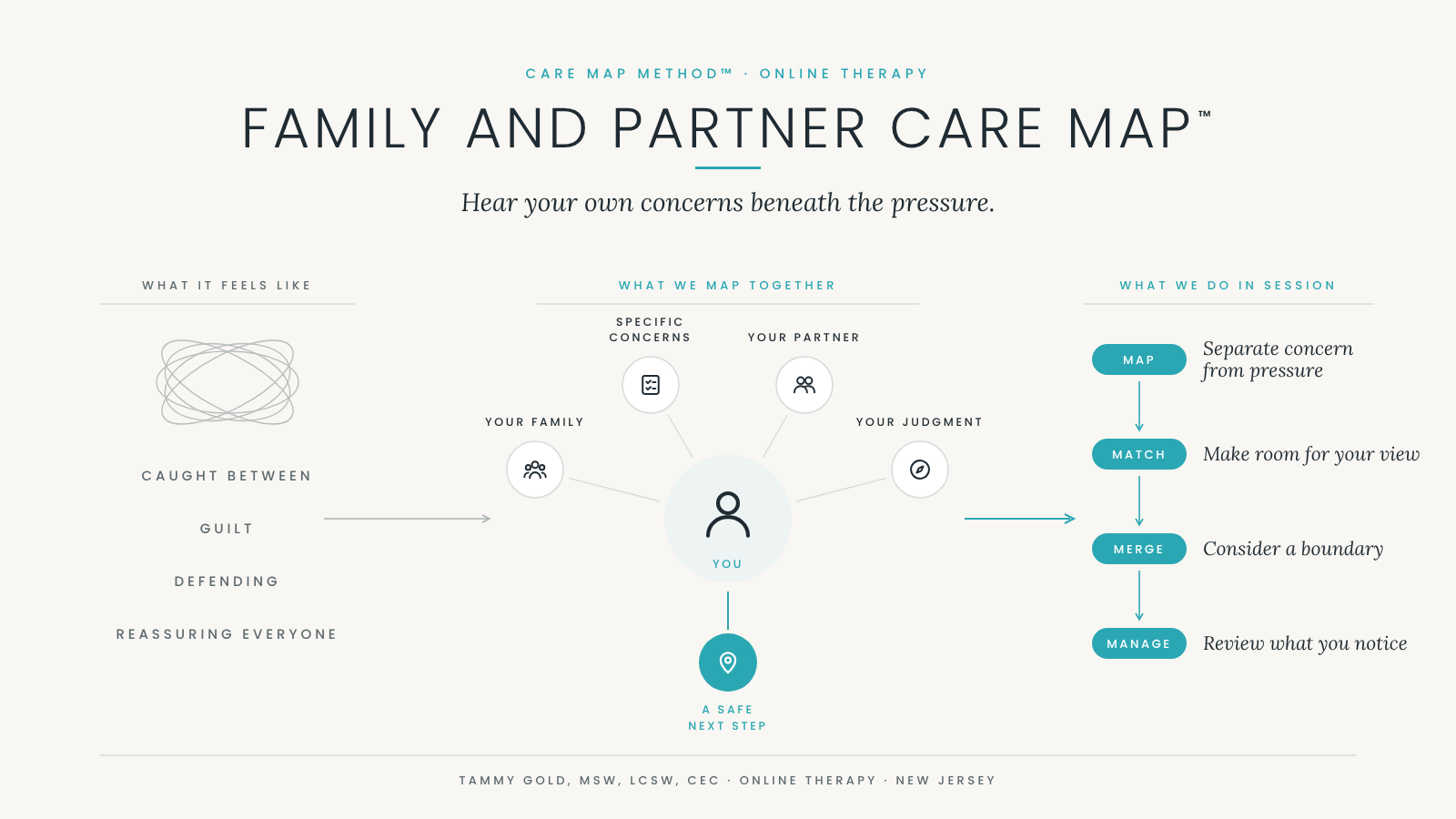
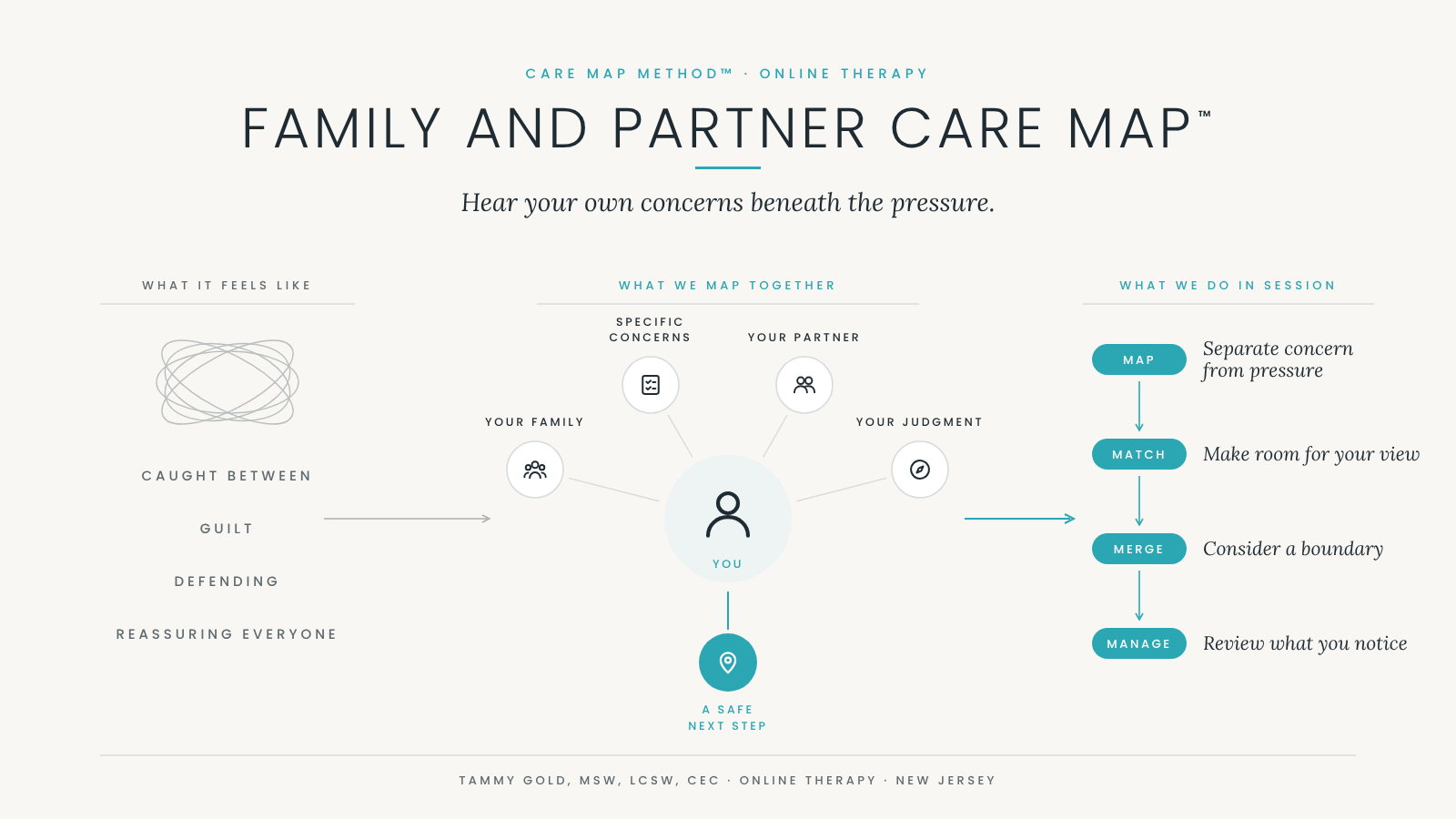
My Care Map Method™ helps us look at Biological, Social, Environmental and Emotional factors alongside clinical assessment. We consider your health and energy, relationships, daily circumstances and emotional experience rather than isolate one difficult moment from the rest of your life. We MAP the need, MATCH appropriate support, MERGE that support into your circumstances and MANAGE the plan as we learn what is useful. This is an organizing framework within individualized therapy, not a promise of a particular result.
What your first session can include
You can bring one situation you want help understanding. We will discuss your concern, relevant history, symptoms, daily functioning and available support. You can tell me what has or has not helped before and what you need to feel comfortable talking. My aim is to offer empathy without judgment and begin exploring a practical next step, while allowing time for assessment. We will decide together whether my approach fits and which goals matter to you. You do not need to arrive knowing the right words or the solution.
About Tammy Gold
I’m Tamara “Tammy” Gold, MSW, LCSW, CEC. I earned my clinical MSW at Columbia University and my BA at the University of Pennsylvania. My work with families includes parenting, caregiving and difficult relationships. I bring empathy without judgment and a practical interest in helping you understand the problem and consider what comes next.
Frequently asked questions
Will you tell me whether to choose my partner or family?
We can help you explore the decision without making it for you.
Can I come without either of them?
Yes. This page describes individual psychotherapy.
Can cultural or religious expectations be discussed?
Yes. We can explore their meaning for you without assuming that one approach fits every family.
What if my family has noticed something concerning?
We can examine specific observations seriously rather than automatically dismiss them as interference.
Is this mediation?
No. We are not negotiating a family agreement or evaluating people who are not clients.
Does insurance cover relationship pressure?
The situation alone does not determine coverage. Eligibility depends on assessed clinical needs, the service and your exact plan.
Can I set limits and still value my family?
We can explore what connection and limits mean in your family and culture. A limit does not have to begin with deciding that someone no longer matters.
What if I agree with part of their criticism?
You can discuss that uncertainty openly. Therapy can offer space to consider a concern without requiring you to defend or reject the entire relationship.
Booking and profile options
Choose a platform that shows current appointments for your physical location in New Jersey and your exact insurance plan. Availability and participation can differ across platforms.
Check availability and insurance on Grow Therapy
Check availability and insurance on Alma
Check availability and insurance on Headway
Read my profile or contact me on Psychology Today
Before confirming a visit, check the service, current provider participation, your exact benefits and estimated costs. Coverage depends on your plan and the assessed clinical service; a life event alone does not establish insurance eligibility. You must be physically located where I am authorized to provide care at each session.