

Individual Therapy for Money Arguments in California
Money disagreements can bring up deeper concerns about fairness, security and feeling valued. Individual online therapy in California can help you understand the emotional pattern, express your needs and prepare for a more focused conversation.
You may begin with a bill and end up arguing about fairness, trust or whether your contributions matter. Even when the numbers are clear, the emotional meaning can make the conversation hard to finish.
I’m Tammy Gold. I offer individual online therapy for adults in California. We can explore how financial conflict affects your mental health and prepare a clearer way to express the concern underneath it.
Look at what money represents to you
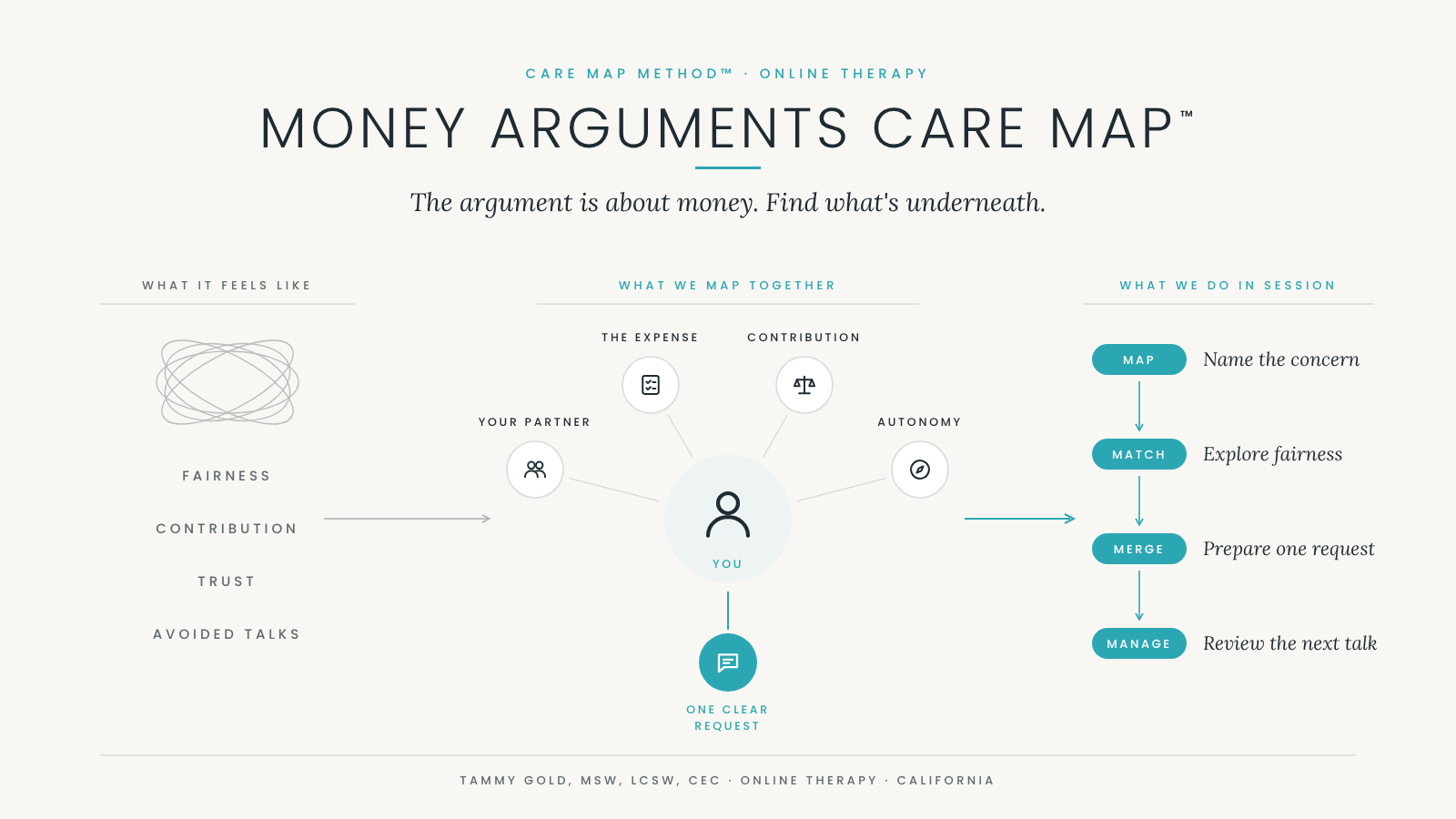
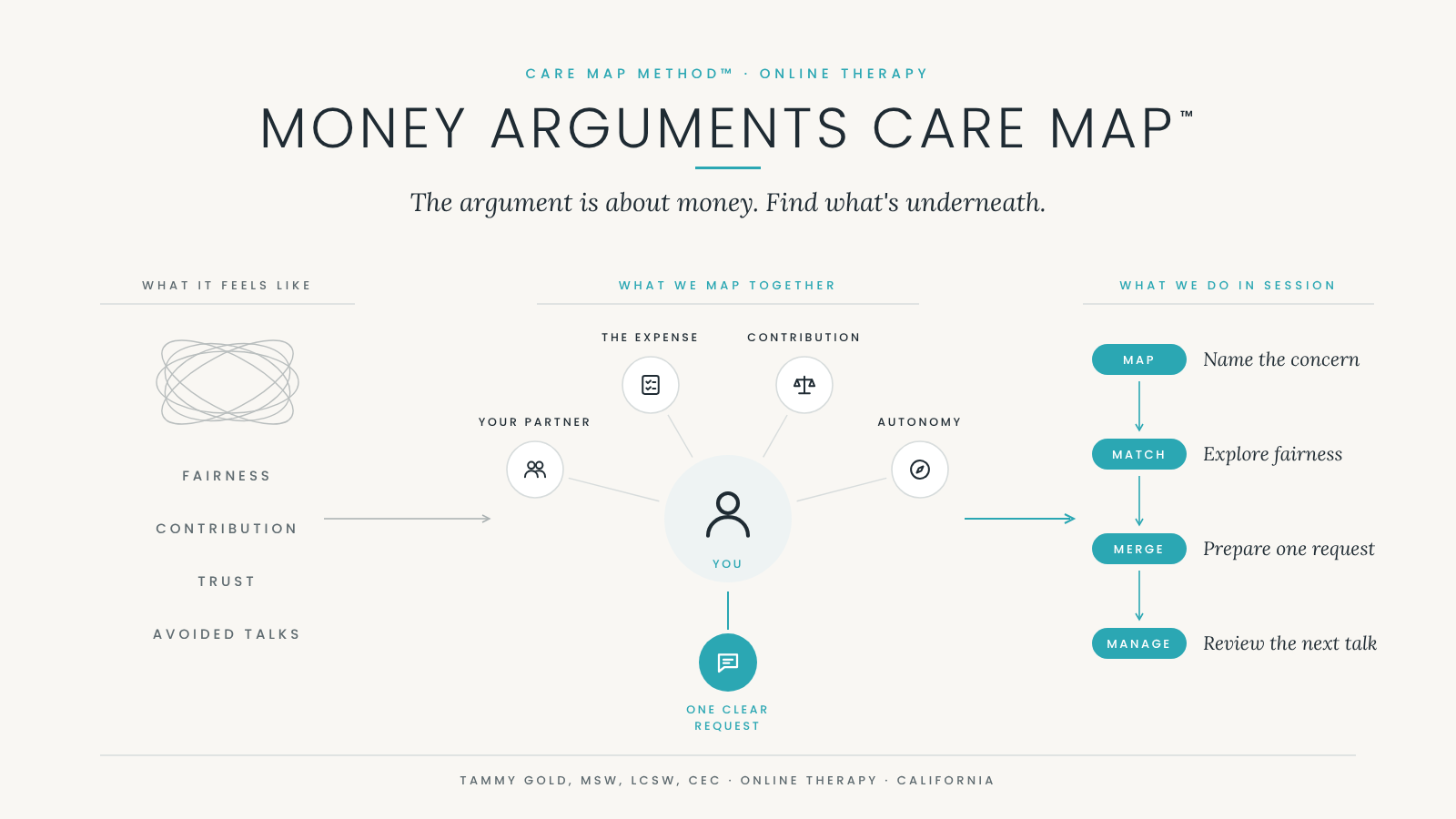
For one person, saving may mean safety. For another, being questioned about spending may feel like loss of autonomy. We can explore your history and the meanings attached to a recent disagreement without assuming everyone should have the same relationship with money.
Financial constraints are real. We will not treat practical hardship as something a different attitude alone can resolve.
Choose the part of the conversation you want to change
Perhaps you want to ask for a regular discussion rather than be questioned in the middle of a purchase. Perhaps you need to name the work you contribute that is not reflected in income.
An example might be, “When we discuss the expense, I also need us to discuss the responsibility and time around it.” We can explore what you want understood, how to state it and whether the setting supports a useful discussion.
Consider your response and your options
We can look at avoiding, overexplaining or becoming defensive, while taking the other person’s behavior seriously. Individual therapy cannot make a partner cooperate or settle a financial disagreement.
If money is being used to control access to necessities, restrict your choices or threaten you, tell your therapist. Safety and appropriate outside support may matter more than preparing another joint conversation. Investment, debt, tax and legal advice remain with qualified professionals.
What we can work on together in session
We can explore one money argument and identify the concern beneath it: security, fairness, independence, recognition or something else. We can map what you heard, what you felt and how the exchange escalated or shut down. We will also recognize practical financial pressures that cannot be resolved through communication alone.
If appropriate, we can rehearse a specific request, such as discussing a shared expense at an agreed time or including unpaid household work in a conversation about contribution. We can consider whether you feel able to disagree safely and what additional support may be needed. A next step could be preparing one question or identifying a boundary. We will review how it affects you without making your partner's cooperation the measure of whether your therapy is worthwhile.
When the same argument has several layers
You may be discussing a purchase while also feeling unseen as a caregiver, worried about debt or uncomfortable depending on someone else’s income. We can separate these concerns enough to understand them. A question about shared expenses may need a different response from a fear that you have no say in your own life.
Family experiences can shape what feels normal around saving, generosity, privacy and obligation. Exploring those experiences can help explain a reaction without excusing harmful behavior. We can also consider what happens before and after an argument: whether you avoid opening bills, repeatedly justify ordinary needs or lose sleep rehearsing the next discussion.
Find a useful starting point
Bring one recent exchange and the concern you wished you could express. We might work on naming the feeling, deciding what information you need or identifying a boundary that matters to you. If practical debt or budgeting help is needed, we can discuss the role of appropriate outside resources. Therapy supports your mental health alongside those practical needs; it does not replace the financial work or require you to minimize financial hardship.
A practical way to understand what is happening
My Care Map Method™ helps us look at Biological, Social, Environmental and Emotional factors alongside clinical assessment. We consider your health and energy, relationships, daily circumstances and emotional experience rather than isolate one difficult moment from the rest of your life. We MAP the need, MATCH appropriate support, MERGE that support into your circumstances and MANAGE the plan as we learn what is useful. This is an organizing framework within individualized therapy, not a promise of a particular result.
What your first session can include
You can bring one situation you want help understanding. We will discuss your concern, relevant history, symptoms, daily functioning and available support. You can tell me what has or has not helped before and what you need to feel comfortable talking. My aim is to offer empathy without judgment and begin exploring a practical next step, while allowing time for assessment. We will decide together whether my approach fits and which goals matter to you. You do not need to arrive knowing the right words or the solution.
About Tammy Gold
I’m Tamara “Tammy” Gold, MSW, LCSW, CEC. I earned my clinical MSW at Columbia University and my BA at the University of Pennsylvania. My work with families includes parenting, caregiving and difficult relationships. I bring empathy without judgment and a practical interest in helping you understand the problem and consider what comes next.
Frequently asked questions
Do you provide financial planning?
No. This page describes psychotherapy for emotional and relational distress, not financial advice.
Can I attend alone for money conflict?
Yes. You can work on your mental health, choices and communication individually.
Will you decide who spends too much?
No. We can examine your experience and its impact without becoming a financial arbitrator.
What if the problem is actual financial hardship?
We can support your mental health while recognizing practical needs may call for additional resources or professional advice.
Is this couples counseling?
No. Couples services and payment require a separate discussion. Relationship-only counseling is generally self-pay.
Can I use insurance?
Verify your California plan, active participation, estimated costs and the assessed clinical service before scheduling.
Can unequal income affect how I feel in the relationship?
Yes. We can explore feelings about contribution, dependence, power and autonomy while recognizing that income is only one part of a household’s responsibilities.
Can we discuss avoiding money conversations?
Yes. We can examine what makes them difficult, their effect on your well-being and what support you need before deciding whether and how to raise a concern.
Booking and profile options
Choose a platform that shows current appointments for your physical location in California and your exact insurance plan. Availability and participation can differ across platforms.
Check availability and insurance on Grow Therapy
Check availability and insurance on Alma
Check availability and insurance on Headway
Read my profile or contact me on Psychology Today
Before confirming a visit, check the service, current provider participation, your exact benefits and estimated costs. Coverage depends on your plan and the assessed clinical service; a life event alone does not establish insurance eligibility. You must be physically located where I am authorized to provide care at each session.