
Menopause, Mood Changes and Relationships: Why Everything Suddenly Feels Harder
Midlife may bring hormonal changes, relationship strain, caregiving, work pressure, and identity shifts at once. Therapy can help women understand the full picture and respond with greater clarity.
Many women enter perimenopause or menopause expecting physical changes such as hot flashes or disrupted sleep. They may be less prepared for the emotional and relational changes: feeling less patient, more reactive, unusually anxious, disconnected from a partner, uncertain about identity, or overwhelmed by responsibilities that were previously manageable.
It is tempting to reduce the entire experience to hormones or, in the opposite direction, to dismiss hormones and assume the problem is purely psychological. In practice, midlife distress is often created by several interacting factors.
Why midlife can feel emotionally crowded
Menopause often arrives during a period of intense relational and practical demands. A woman may be parenting teenagers, launching young adults, caring for aging parents, reassessing a marriage, managing workplace pressure, and noticing changes in her own health at the same time.
Sleep disruption can lower emotional tolerance. Physical symptoms may affect confidence and intimacy. Longstanding relationship patterns may become harder to ignore. A role that once provided meaning, such as active parenting, may be changing. The question is rarely only, “Are my hormones changing?” It is also, “What else in my life can no longer continue in the same way?”
Mood changes deserve a full assessment
Emotional changes during midlife can include irritability, anxiety, sadness, reduced motivation, difficulty concentrating, emotional sensitivity, or a sense of not feeling like oneself.
These experiences should not be minimized. They also should not automatically be attributed to one cause. A thoughtful evaluation considers physical health, sleep, medication, stress, relationships, caregiving responsibilities, work demands, previous mental health history, and major life transitions. Therapy can be one part of that broader support plan.
How menopause can affect relationships
Partners may misinterpret changes in energy, desire, patience, or emotional responsiveness. One person may feel rejected while the other feels pressured and misunderstood. Minor disagreements can begin to carry the weight of years of unresolved labor, unequal responsibility, or poor communication.
The goal is not to blame menopause for every relationship problem. Instead, it is to recognize that a biological transition can reduce the capacity to keep compensating for patterns that were already difficult. What appears to be a sudden relationship crisis may partly be the point at which an old system stops working.
Parenting during perimenopause and menopause
Parenting adolescents or young adults can be emotionally demanding. Children may be separating, challenging limits, or preparing to leave home just as a mother is experiencing her own changes in identity and regulation.
This combination can intensify conflict. A teenager's normal push for independence may feel more personal. A college departure may evoke grief, relief, pride, and uncertainty. Therapy can help distinguish the child's developmental task from the parent's emotional transition so that each can be addressed more clearly.
Caring for aging parents at the same time
Many midlife women become the default organizers of care for aging parents. They may manage appointments, communicate with siblings, and respond to crises while also working and parenting.
This is one reason a menopause-related emotional complaint should be understood in context. A woman may not need to become better at tolerating an unreasonable load. She may need help changing the load, setting boundaries, or obtaining additional care.
Identity after years of caring for others
Midlife can raise questions that were postponed during the busiest parenting and career years: What do I want now? Which relationships are reciprocal? What parts of my identity have been neglected? What do I want the next decade to look like?
These questions can feel destabilizing, but they can also mark a healthy developmental transition. Therapy provides space to explore them without requiring an immediate, dramatic life decision.
A relationship-centered approach
A relationship-centered therapy approach looks at symptoms within the systems surrounding the woman. It considers the relationship with a partner, children, parents, work, the body, and the self.
Using the Care Map Method™ lens, it can be helpful to map biological needs such as sleep and medical care; emotional needs such as grief, anger, or self-compassion; social needs such as partnership and friendship; and environmental needs such as workload, household roles, and privacy. This broader map often reveals practical changes that symptom-focused advice misses.
Practical ways to reduce pressure
The following steps may help create more stability:
Track mood, sleep, physical symptoms, and major stressors so patterns are easier to identify.
Discuss significant physical or mood changes with an appropriate medical professional.
Name the specific relationship pattern that is causing distress rather than describing the entire relationship as failing.
Reevaluate household and caregiving labor instead of assuming you must continue carrying the same responsibilities.
Protect time for friendships, movement, creativity, or interests that are not organized around serving others.
Delay major decisions made at the peak of exhaustion, while still taking persistent dissatisfaction seriously.
How therapy can help
Therapy can help women understand emotional changes without shame, improve communication, address burnout, grieve changing roles, and reconnect with a sense of agency.
It can be especially useful when midlife concerns are tied to relationships rather than a single isolated symptom. The work is not simply about reducing distress; it is about building a life structure and relationship pattern that fit the person you are becoming.
Midlife is not a personal failure
Feeling unsettled during menopause does not mean you are weak, ungrateful, or becoming someone unrecognizable. It may mean that your body, roles, and relationships are changing faster than your existing support system.
With thoughtful medical and psychological support, midlife can become a period of clearer boundaries, more honest relationships, and renewed direction.
Ready for support?
If menopause or midlife changes are affecting your mood, relationships, caregiving role, or sense of identity, therapy can help you understand the full picture and decide what needs to change. Tammy Gold, MSW, LCSW, CEC, provides confidential virtual therapy for adults located in California, New Jersey, and Oregon.
Book through Psychology Today: https://www.psychologytoday.com/us/therapists/tamara-jill-gold-los-angeles-ca/1713403
Learn more: CareMapMethod.com
About Tammy Gold
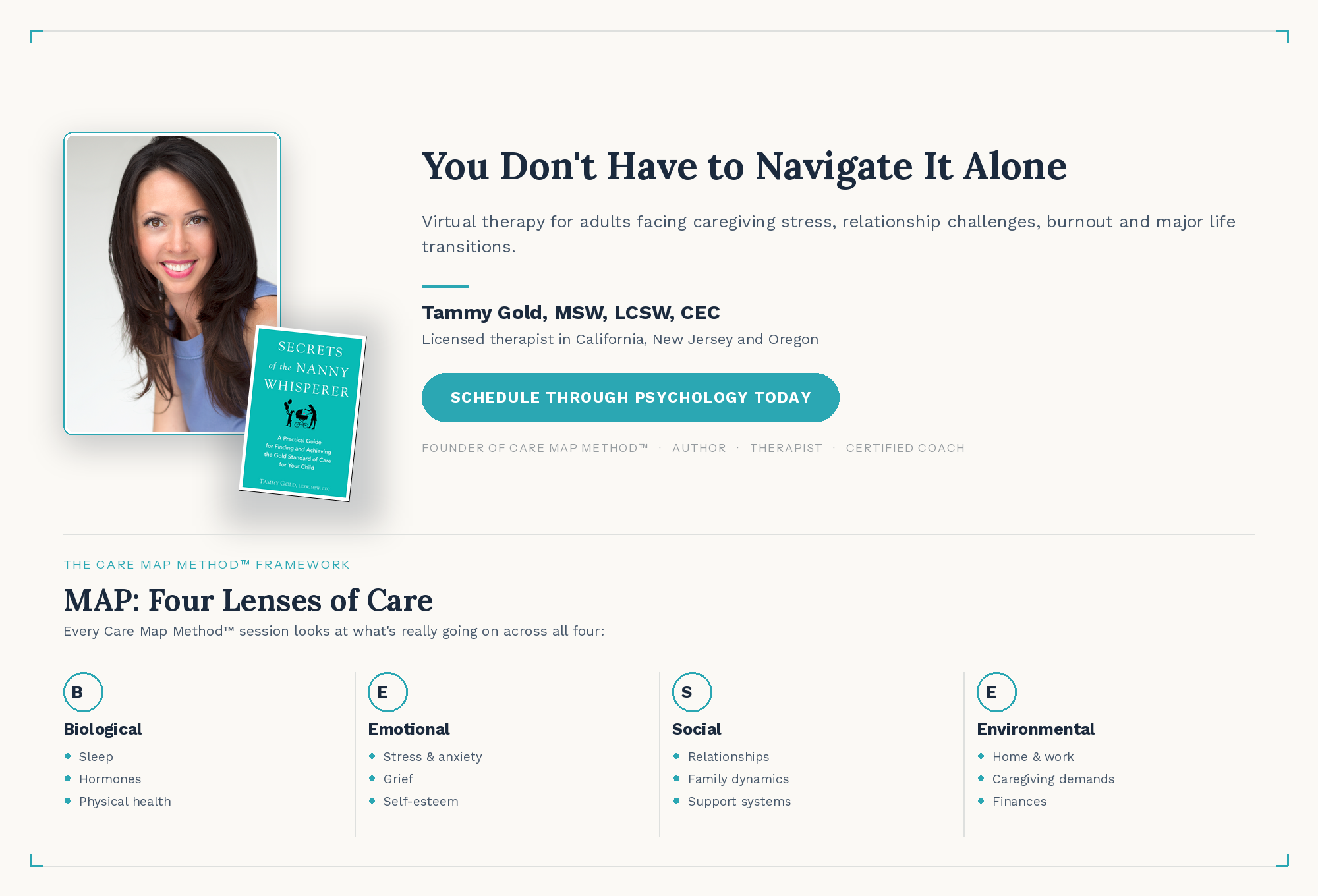
Tammy Gold, MSW, LCSW, CEC, is the founder of Care Map Method™, a licensed clinical social worker in California, New Jersey, and Oregon, a certified coach, and the author of Secrets of the Nanny Whisperer. Her work centers on relationships, caregiving, burnout, parenting transitions, workplace stress, women’s midlife concerns, and practical support during major life changes.
Educational notice: This article is for general educational purposes and is not a substitute for individualized medical or mental health care. If you are experiencing an emergency or immediate safety concern, contact emergency services or an appropriate crisis resource in your area.