Dating feels exhausting. Your needs still matter.
Dating apps, unanswered messages and repeated disappointment can leave you questioning yourself. Explore online therapy in Maine to understand relationship patterns, practice boundaries and take practical steps that keep your needs in the picture.
You may want a relationship while dreading another introduction, unanswered message or disappointing date. Perhaps you keep checking your phone, questioning what you said or trying to become the person you think someone else wants.
I’m Tammy Gold. I offer individual online therapy for adults physically located in Maine. We can explore the impact dating is having on your mental health and work toward choices that feel more consistent with your needs.
Check Maine Appointments on Alma
Understand the cycle around a disappointment
We might begin with one recent exchange. What happened? What did you conclude about yourself? What did you do to feel more certain afterward? Repeatedly reviewing a message can feel like problem-solving while leaving the same question unresolved.
We can examine your expectations, experiences and relationship patterns without assuming every disappointment has the same cause. Your circumstances and the behavior of the people you meet matter too.
Keep your preferences in the conversation
Perhaps you agree to plans you do not want because you fear losing the connection. We can explore that fear and practice a response such as, “I would like to see you again, but that time does not work for me.” The words should fit your situation rather than become another performance to get right.
Taking a break, changing how you participate or continuing with clearer limits are possibilities to explore. Therapy does not prescribe a particular relationship timeline.
Give the rest of your life room
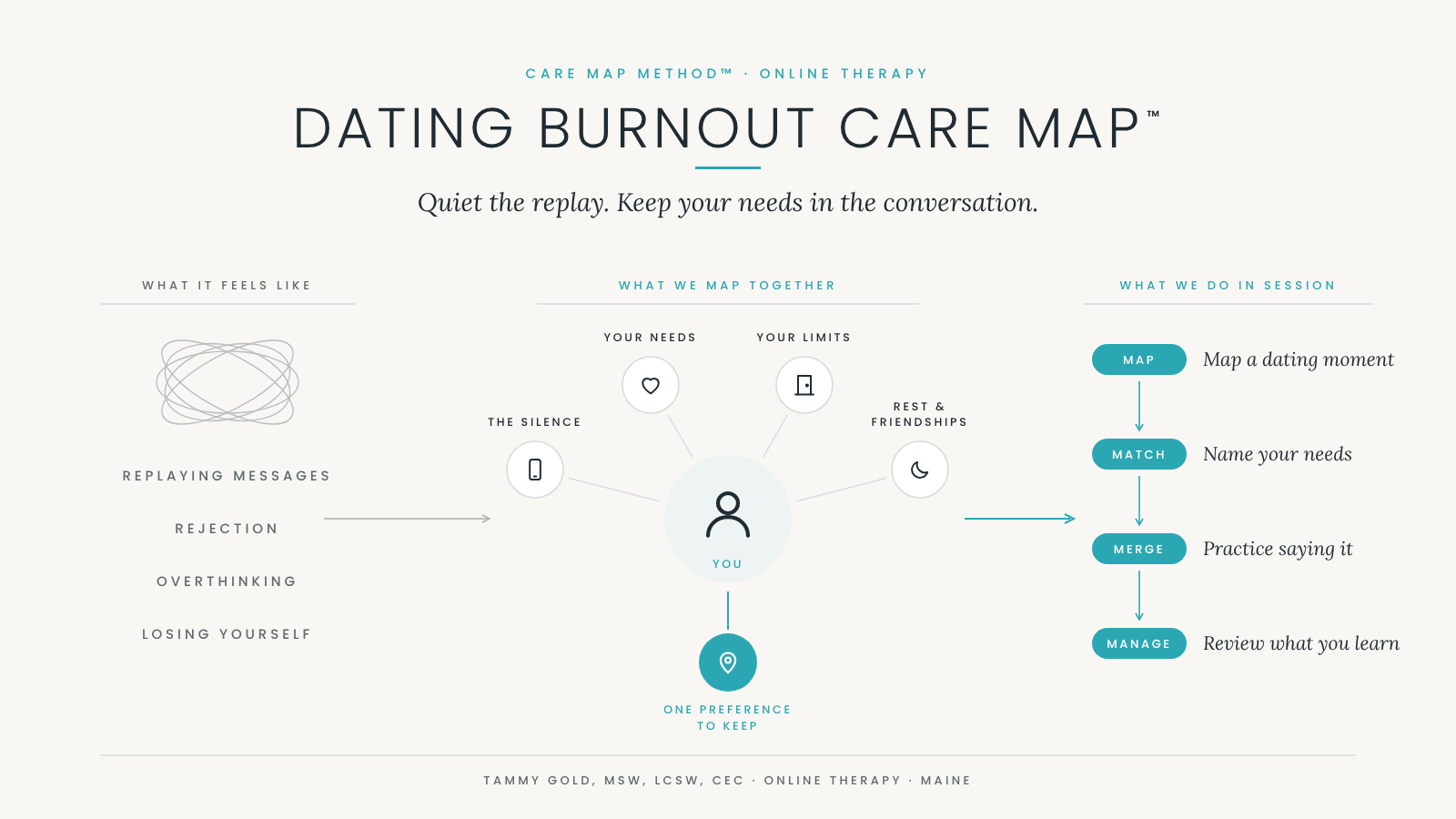
We can discuss how dating affects rest, friendships and concentration. An early goal might be recognizing when you are setting aside a preference or spending less time trying to interpret silence. Those goals concern your well-being; another person’s response remains outside your control.
What we can work on together in session
We can take one recent dating exchange and map the sequence: what happened, what you told yourself it meant, what you felt and what you did next. For example, an unanswered message may lead to self-criticism, repeated checking and canceling your own plans in case the person replies. We can explore where you have a choice in that sequence without dismissing the disappointment.
Then we can practice a response that reflects your needs, such as expressing a scheduling preference or choosing when to stop checking for the evening. If it fits, you might leave with one boundary or small experiment to try. In a later session, we can review what happened, what felt difficult and what needs adjusting. The work focuses on your well-being and participation in dating; it does not depend on securing a particular person's interest.
When dating stress turns into self-criticism
A disappointing exchange can quickly become a much larger story: “I am always too much,” “Nobody will choose me,” or “I should have known better.” We can slow down that story and consider what you actually know, what you are assuming and which older experiences make the moment especially painful. You do not need to become indifferent to wanting love to take your own feelings seriously.
We can also explore the difference between choosing connection and trying to earn reassurance. That might mean noticing when you cancel your own plans to remain available, ignore a preference or keep checking an app after you have stopped enjoying it. Rather than set a rule you must follow perfectly, we can choose one situation to understand and review what happens.
Bring the question you are already asking
You might begin with, “Why do I feel rejected before I know this person?” or “How can I take a break without feeling I am giving up?” You do not need a polished explanation. We can start with the conversation, feeling or pattern that brought you here and decide together what support would be useful.
A practical way to understand what is happening
My Care Map Method™ helps us look at Biological, Social, Environmental and Emotional factors alongside clinical assessment. We consider your health and energy, relationships, daily circumstances and emotional experience rather than isolate one difficult moment from the rest of your life. We MAP the need, MATCH appropriate support, MERGE that support into your circumstances and MANAGE the plan as we learn what is useful. This is an organizing framework within individualized therapy, not a promise of a particular result.
What your first session can include
You can bring one situation you want help understanding. We will discuss your concern, relevant history, symptoms, daily functioning and available support. You can tell me what has or has not helped before and what you need to feel comfortable talking. My aim is to offer empathy without judgment and begin exploring a practical next step, while allowing time for assessment. We will decide together whether my approach fits and which goals matter to you. You do not need to arrive knowing the right words or the solution.
About Tammy Gold
I’m Tammy Gold, MSW, LCSW, CEC. I earned my clinical MSW at Columbia University and my BA at the University of Pennsylvania. My work with families includes parenting, caregiving and difficult relationships. I bring empathy without judgment and a practical interest in helping you understand the problem and consider what comes next.
Frequently asked questions
Can I come even if I am single?
Yes. Individual therapy can address your distress, self-understanding and relationship choices without requiring a partner.
Will you tell me which dating app to use?
We can explore your experience of dating. This is psychotherapy, not a matchmaking or profile-management service.
Does rejection mean something is wrong with me?
One person’s response does not provide a complete explanation of you. We can examine what rejection brings up without dismissing its impact.
Will therapy help me find a partner?
We can work on your mental health and choices. We cannot guarantee attraction, compatibility or a relationship.
Can we discuss boundaries and intimacy?
Yes, within treatment fit, your comfort and the scope of individual care.
Can I use insurance in Maine and other states?
Check your exact plan and estimated costs through my active Alma profile. Coverage also depends on the assessed clinical service.
Can we work on overthinking after dates?
Yes. We can explore the thoughts, feelings and checking habits that follow a date, then consider responses that support your well-being.
Do I have to stop dating while in therapy?
No. We can discuss continuing, changing your approach or taking a break based on your circumstances and preferences.
Booking and profile options
For appointments while you are in Maine, please use Alma while enrollment on other platforms is pending. The other profiles below are available for reference; they do not confirm appointments or insurance participation in this state. Therapy on these platforms below
Check availability and insurance on Grow Therapy
Check availability and insurance on Alma
Check availability and insurance on Headway
Read my profile or contact me on Psychology Today
Before confirming a visit, check the service, current provider participation, your exact benefits and estimated costs. Coverage depends on your plan and the assessed clinical service; a life event alone does not establish insurance eligibility. You must be physically located where I am authorized to provide care at each session.