

Friendship pain deserves space in the conversation
Friendship changes can bring grief, anxiety and self-doubt. Individual therapy can help you understand the relationship, communicate needs and decide what boundaries fit.
A friendship can be one of the most important relationships in your life. When it changes, ends or becomes uncertain, the impact may be hard to explain to people who expect you to move on. You may miss daily contact, feel embarrassed about caring so much or wonder whether the change says something about your worth.
Therapy for friendship issues gives you space to take that experience seriously. You can bring a specific conflict, a friendship breakup or a repeated pattern of feeling left out. We can explore what happened, how it affected you and what you need now without deciding in advance who is entirely right or wrong.
The situations that can bring someone to therapy
Perhaps a close friend has become less available, a group makes plans without you or a conversation ended badly. You may feel responsible for initiating every interaction. You might also notice checking messages repeatedly, comparing friendships on social media or agreeing to things because you are afraid someone will leave.
Those experiences can have different meanings. A friend may be occupied by a life change, the relationship may have become unbalanced, or earlier experiences may be making uncertainty especially painful. We can examine the available information and your response without pretending we can know another person's intentions from a few texts.
How individual therapy can help
We can work on identifying your needs, communicating concerns, noticing assumptions and tolerating the uncertainty that relationships sometimes involve. Therapy may include practicing a conversation, exploring grief or recognizing a pattern of overgiving. We can also consider when seeking clarification is useful and when repeated reassurance leaves you feeling less secure.
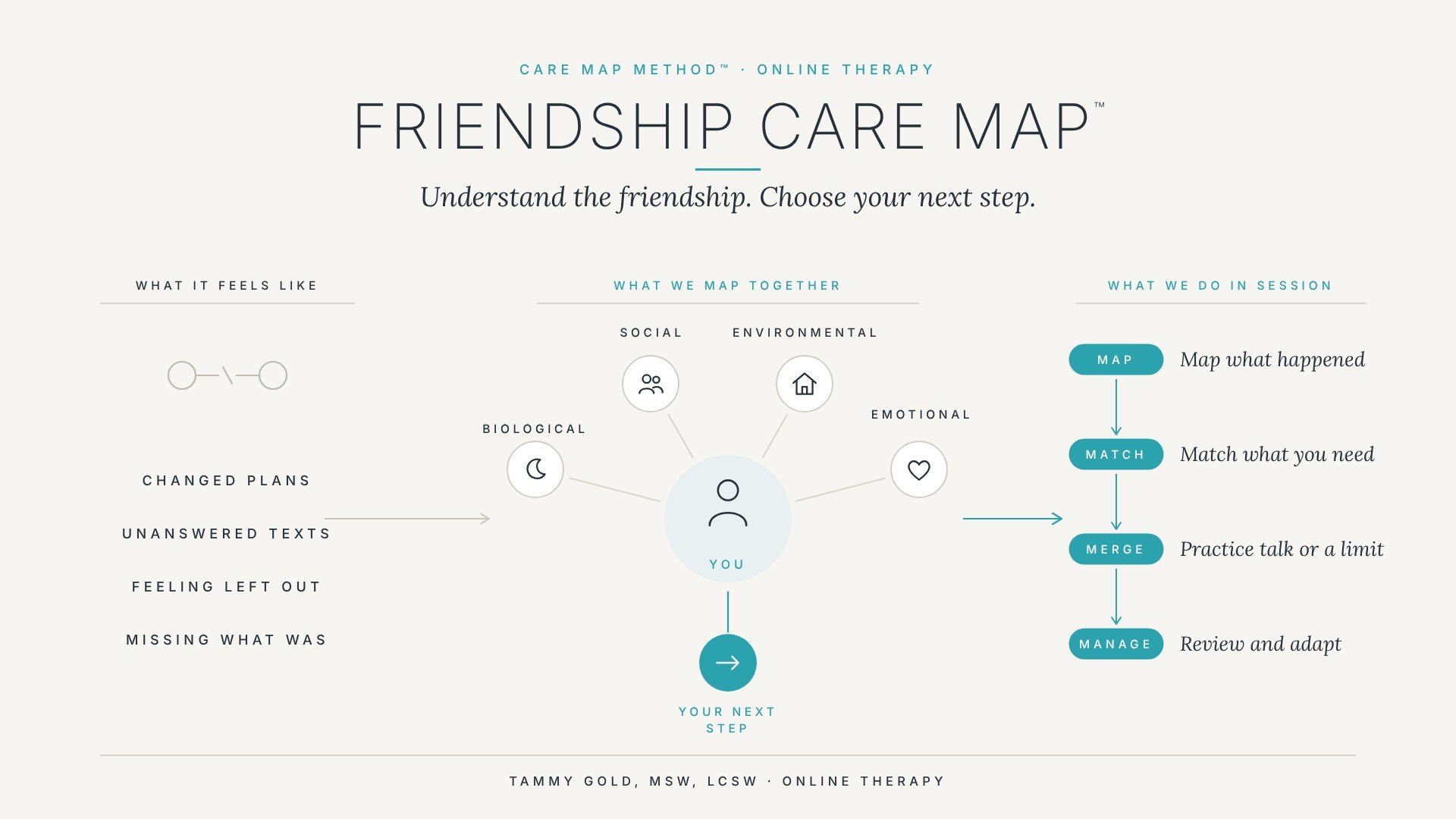
I use the Care Map Method™ to organize the emotional, social, environmental and biological factors involved. That can include your current support network, sleep, stress level and what else is changing in your life. We then develop an individualized treatment plan rather than applying a rule such as always repair the friendship or always walk away.
Working through an example
Imagine that a friend cancels twice and you see a photo of them with other people. You feel rejected and want to send a long message demanding an explanation. You might also be tempted to disappear without saying anything. Neither urge tells us the whole story, but both give us useful information about how hurt you feel.
In therapy we could identify the facts, the interpretation and what you want from the relationship. A next step might be a direct question, a clear statement of impact or a pause before responding. We would also consider whether this is an isolated event or part of a longstanding pattern.
Boundaries without a predetermined ending
A boundary can mean declining a request, changing how much time you spend together or naming a topic you are not willing to discuss. It does not have to mean cutting someone off. At the same time, some relationships may remain harmful or incompatible despite sincere attempts to communicate.
Therapy can help you consider safety, reciprocity, history and your own values. We can prepare for guilt or sadness even when a boundary is appropriate. The aim is not to eliminate every uncomfortable feeling before you act, but to help you respond with more clarity and less pressure to abandon your needs.
Grieving and rebuilding connection
When a friendship ends, you may lose routines, shared communities and a version of your future. It can take time to adjust. We can make room for grief without treating it as proof that you made the wrong decision. You may need different kinds of support from different people rather than a replacement best friend.
Rebuilding connection can begin with small, repeatable opportunities and a more realistic understanding of how adult friendships develop. We can also explore what you want to carry forward from the relationship and what you hope to do differently. You do not need the other person to attend for your own therapy to be useful.
About Tamara Gold
I am Tamara “Tammy” Gold, MSW, LCSW, CEC, a Columbia University-trained therapist, certified coach and author of Secrets of the Nanny Whisperer. My work with individuals and families informs a warm, collaborative approach that connects emotional understanding with practical next steps. Treatment is individualized to your needs; results and timelines vary.
Online appointments and insurance
Online appointments depend on your physical location at each session, clinical fit and current availability. Review my booking profiles to confirm whether I can serve you in your state. Selected insurance plans may be available through Headway or Alma. Coverage, medical-necessity requirements and your costs depend on your individual plan; a life problem alone does not establish insurance coverage.
Frequently asked questions
Can I go to therapy over a friendship breakup?
Yes. The loss of a friendship can affect mood, confidence, routines and other relationships. Therapy can help you process the experience and assess the support you need. Seeking care does not require minimizing or proving the importance of the friendship.
Does my friend need to attend?
No. This page describes individual therapy for your own concerns. Joint sessions would require a separate discussion about clinical appropriateness, consent, privacy and the service being provided.
Can you tell me whether my friend is toxic?
We can examine specific behaviors, their impact and the choices available to you. I cannot diagnose or reliably label someone I have not assessed. Focusing on patterns is generally more useful than assigning a sweeping label.
What if I keep feeling left out?
We can explore the actual social situations, your interpretations and any repeated patterns. That may include communication, belonging, social anxiety or relationships that are not meeting your needs.
Will therapy make me end the friendship?
There is no predetermined outcome. You may decide to communicate, adjust expectations, create distance or work toward repair. The goal is to support an informed choice that fits your values and circumstances.
Can insurance cover therapy for friendship stress?
Coverage depends on your plan and the clinical circumstances, including any applicable diagnosis and medical-necessity requirements. A friendship problem alone does not establish coverage. Verify eligibility and cost before scheduling.
Take the next step
If this sounds like the kind of support you need, review current appointment options and check insurance eligibility through my Headway or Alma profile. You can bring questions about fit, fees and the process before scheduling. You do not need a perfect explanation of the problem to begin.