

Horizon BCBS Therapy in New Jersey for Sibling Conflict and Family Caregiving
Online therapy in New Jersey for sibling conflict, caregiver burden, aging-parent decisions, boundaries, and family communication. Verify Horizon benefits.
Horizon BCBS therapy in New Jersey for sibling conflict, caregiver burden, aging-parent decisions, and family communication.
Horizon BCBS Therapy in New Jersey for Sibling Conflict and Family Caregiving
Family caregiving can create a painful imbalance. One sibling may handle appointments, calls, emergencies, and daily care while others participate less or criticize decisions from a distance. Old family roles quickly return, and conversations about the parent become arguments about fairness, loyalty, money, and who has always done more.
You do not have to carry this alone. My goal is to provide a warm, confidential, and nonjudgmental space where you can unpack what is happening without shame, blame, or pressure. Therapy can offer emotional support and practical direction at the same time.
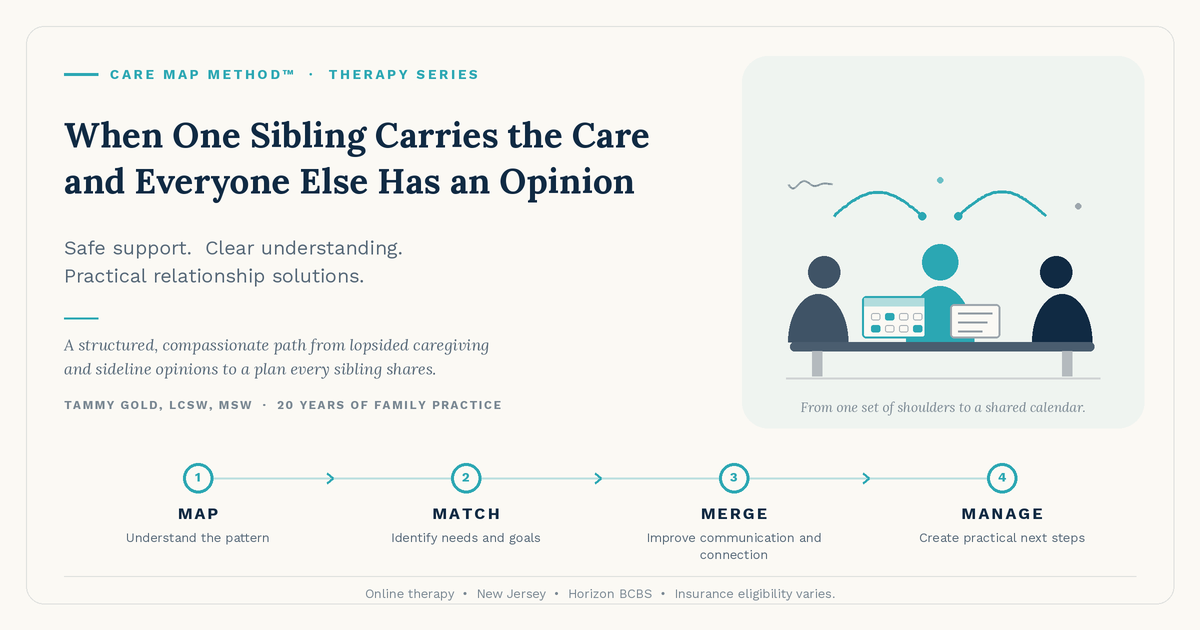
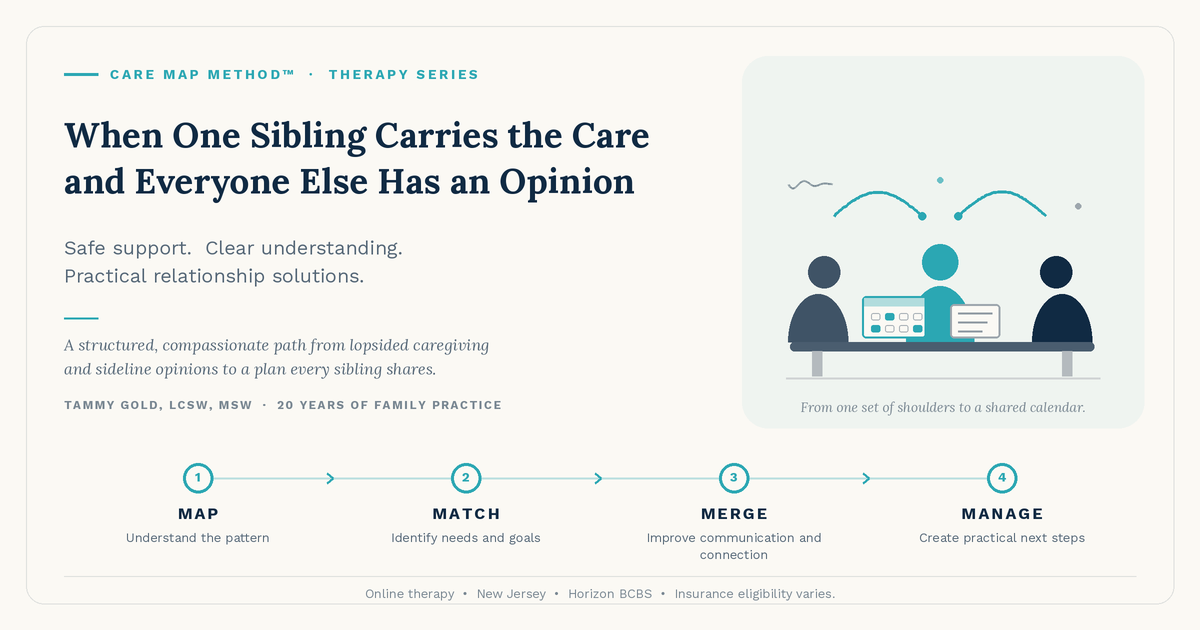
Therapy offers a neutral place to identify both the practical imbalance and the emotional history underneath it. We clarify what the parent needs, what each sibling can realistically contribute, and what boundaries are necessary. The work focuses on reducing blame and creating a plan that is more sustainable.
ONLINE THERAPY IN NEW JERSEY
Insurance may be available through Headway depending on your plan, eligibility, state, and session type. Verify benefits before booking.
How the Care Map Method™ helps
MAP
Document the care needs, current workload, family roles, emotional reactions, finances, distance, and available resources.
MATCH
Assign support based on capacity and skill, identify professional services, and clarify what cannot remain the responsibility of one person.
MERGE
Develop communication rules, shared documentation, respectful requests, and a process for making decisions.
MANAGE
Create a care calendar, role list, escalation plan, and regular review as the parent’s needs change.
What clients can work toward
· Make invisible caregiving work visible
· Reduce resentment and guilt
· Create clearer sibling responsibilities
· Protect the caregiver’s health and limits
Therapy is not only a place to talk about what went wrong. It is a place to feel heard, understand the pattern, practice healthier responses, and build a plan that can be used in daily life. Progress depends on the circumstances and cannot be guaranteed, but the work can become clearer, more intentional, and more supported.
Frequently asked questions
Can family therapy help when siblings live in different states?
Online sessions may allow family members to participate when legal, clinical, and licensing requirements are met. Individual therapy is also useful when joint work is not possible.
Does Horizon BCBS cover family caregiving therapy?
Coverage depends on the plan, clinical need, session type, and current network rules. Verify benefits before scheduling.
What if my siblings refuse to help?
Therapy can help you communicate clearly, stop overfunctioning, set limits, pursue outside resources, and decide what you can safely continue.
How do we include the aging parent in decisions?
The parent’s preferences and autonomy should be included whenever possible, while safety, capacity, medical advice, and legal considerations may affect the process.
Can therapy help with caregiver guilt?
Yes. Therapy can separate love from unlimited responsibility and help caregivers create boundaries that are compassionate and sustainable.
What practical tools might we use?
A family capacity assessment, care calendar, communication plan, provider question list, and written role agreement can make the situation more manageable
You deserve one place where you can be honest without worrying about judgment, shame, or blame. Together, we can understand what is happening, identify what needs to change, and create practical steps toward a healthier relationship and a more manageable life.
Caring for Children and Aging Parents at the Same Time
Adults caring for children and aging parents often face competing needs, financial pressure, guilt, and relationship strain. Learn how to create a more workable family care plan.
The sandwich generation describes adults who are supporting children while also helping aging parents or other older relatives. The term sounds simple, but the lived experience can involve dozens of competing responsibilities: school schedules, college planning, work deadlines, medical appointments, insurance questions, sibling disagreements, household needs, and unpredictable emergencies.
The central problem is often not a lack of love. It is that several people legitimately need you at the same time, while your own needs remain last on the list.
Why this stage is uniquely demanding
Middle adulthood was once imagined as a relatively stable period. In reality, it may involve parenting teenagers or young adults, caring for parents with increasing medical or cognitive needs, maintaining a career, managing a household, and navigating changes in marriage, health, and identity.
Each role has different emotional expectations. Children may need encouragement and independence. Aging parents may need protection while resisting loss of control. Employers may expect consistent performance regardless of what is happening at home. You may feel pulled in opposite directions all day.
The invisible mental load
The sandwich generation often carries a large amount of cognitive labor: remembering who needs what, anticipating problems, researching options, following up with professionals, and managing communication among family members.
This mental load can be exhausting even when the visible tasks seem manageable. You may sit at work while thinking about a parent's fall risk, then attend a child's event while worrying about an unanswered medical message. Your body is in one place while your mind is coordinating several systems.
Common emotional patterns
Several emotional experiences are especially common:
Guilt that someone is always receiving less attention than they need
Resentment followed by shame for feeling resentful
Anxiety about a parent’s safety or decline
Fear that caregiving will interfere with work or financial stability
Conflict with a spouse about time, money, privacy, or unequal labor
Anger toward siblings who appear less involved
Sadness about a child leaving home while a parent becomes more dependent
Loss of identity outside the roles of employee, parent, partner, and caregiver
How the pressure affects couples
Sandwich-generation stress can expose existing differences in how partners define responsibility. One partner may feel morally obligated to provide extensive hands-on care. The other may worry about finances, the children, or the impact on the household.
These disagreements are not always evidence that one partner is caring and the other is selfish. They may reflect different fears, family histories, and thresholds for risk. Productive conversations focus on specific capacities and consequences rather than accusations about character.
Mapping competing needs instead of reacting to emergencies
A useful first step is to stop treating every demand as equally urgent. The Care Map Method™ organizes needs across biological, emotional, social, and environmental domains and then separates immediate safety issues from important but nonurgent concerns.
For an aging parent, an immediate issue may be medication confusion or unsafe driving. For a teenager, it may be a mental health concern or school crisis. Other needs may be important but schedulable. A written map allows the family to see where professional support, shared responsibility, or a change in expectations is required.
A practical family capacity assessment
Ask these questions before agreeing to a new responsibility:
What exactly is being requested?
How often will it occur, and for how long?
What will I have to stop doing in order to take this on?
Could another person, service, or professional complete part of it?
Is this a true emergency, or has the family delayed planning until the issue feels urgent?
What boundary would make this responsibility manageable?
Reducing guilt through clearer roles
Guilt often grows in vague situations. When no one has defined who is responsible for what, the most responsive person may feel accountable for everything.
Clear roles do not eliminate sadness or difficult decisions, but they reduce confusion. A family care plan might specify who attends medical appointments, who manages finances, who handles weekly calls, and what will trigger a move to more professional support. Parenting responsibilities can be mapped in the same way so that one system does not silently consume all available energy.
Protecting your work and financial stability
Many adults underestimate the professional cost of ongoing caregiving. Missed work, reduced concentration, unplanned travel, and frequent interruptions can affect income and career progression.
Protecting your employment is not a sign that you care less. Your financial stability may be essential to your children, your future, and your ability to assist an aging parent. Therapy can help you make decisions that account for long-term consequences rather than responding solely to immediate guilt.
How therapy can help
Therapy can help sandwich-generation adults clarify priorities, communicate with spouses and siblings, set limits, process anticipatory grief, and recognize when they have moved from healthy responsibility into chronic overfunctioning.
It can also provide a consistent space in which you are not required to care for anyone else. That alone can be meaningful when nearly every relationship has become organized around another person's needs.
Creating a sustainable next step
You do not need to solve every future problem today. Begin by identifying the most unstable part of the system. It may be a parent's home safety, a sibling communication problem, a teenager's needs, or your own exhaustion.
Addressing one clearly defined pressure point is often more effective than attempting to become more efficient at carrying an impossible load.
Ready for support?
If you are caring for children and aging parents while trying to preserve your work, health, and relationships, therapy can help you clarify priorities and reduce the strain. Tammy Gold, MSW, LCSW, CEC, provides confidential virtual therapy for adults located in California, New Jersey, and Oregon.
Book through Psychology Today: https://www.psychologytoday.com/us/therapists/tamara-jill-gold-los-angeles-ca/17
Learn more: CareMapMethod.com
About Tammy Gold
Tammy Gold, MSW, LCSW, CEC, is the founder of Care Map Method™, a licensed clinical social worker in California, New Jersey, and Oregon, a certified coach, and the author of Secrets of the Nanny Whisperer. Her work centers on relationships, caregiving, burnout, parenting transitions, workplace stress, women’s midlife concerns, and practical support during major life changes.
Educational notice: This article is for general educational purposes and is not a substitute for individualized medical or mental health care. If you are experiencing an emergency or immediate safety concern, contact emergency services or an appropriate crisis resource in your area.
What are common signs of caregiver burnout?
Signs may include exhaustion, irritability, resentment, guilt, sleep problems, reduced concentration, withdrawal, health changes, hopelessness, and feeling unable to keep up with care demands.
How can therapy help caregiver burnout?
Therapy can help caregivers process emotions, identify unsustainable demands, set boundaries, communicate with family, ask for help, and develop a more realistic care plan.
Is it normal to feel resentful while caregiving?
Yes. Resentment can develop when responsibilities are excessive, support is limited, boundaries are unclear, or the caregiver’s own needs are repeatedly postponed. Feeling resentment does not mean you do not love the person.
What if my siblings will not help?
Therapy or coaching can help you clarify what you need, prepare a family conversation, define responsibilities, set limits, and decide what you can realistically continue providing.
How do I know when more professional care is needed?
Consider changes in safety, cognition, mobility, medication, nutrition, hygiene, isolation, wandering, falls, caregiver capacity, and whether current arrangements are sustainable.
Can I care for someone without losing myself?
That is a central goal. Sustainable caregiving requires support, boundaries, realistic expectations, shared responsibility where possible, and attention to the caregiver’s health and identity.
What Care Map worksheet pairs with caregiver burnout?
A Caregiver Burnout Snapshot, Family Capacity Assessment, Weekly Care Plan, Boundary Planner, or Biological-Emotional-Social-Environmental Care Map can help organize the situation.
When is caregiver burnout an emergency?
Seek urgent professional help when there is immediate danger, inability to provide safe care, abuse or neglect concerns, severe medical or psychiatric symptoms, or thoughts of harming yourself or someone else.