Aetna Therapy in New Jersey for Failure to Launch and Conflict With an Adult Child
Online therapy in New Jersey for failure to launch, adult-child conflict, boundaries, financial dependence, and family stress. Verify Aetna benefits through Headway.
Aetna therapy in New Jersey for failure to launch, adult-child conflict, boundaries, and building independence with the Care Map Method.
Aetna Therapy in New Jersey for Failure to Launch and Conflict With an Adult Child
Parents may feel frightened, guilty, angry, or exhausted when an adult child is not progressing toward work, education, financial responsibility, or independent living. The adult child may feel ashamed, criticized, anxious, misunderstood, or unsure where to begin. Repeated pressure and rescue can create a cycle in which everyone feels stuck.
You do not have to carry this alone. My goal is to provide a warm, confidential, and nonjudgmental space where you can unpack what is happening without shame, blame, or pressure. Therapy can offer emotional support and practical direction at the same time.
Therapy helps the family move beyond labels and examine the full picture. We distinguish skill gaps, emotional barriers, health concerns, family patterns, and environmental realities. Parents can learn to support growth without overfunctioning, while adult children can clarify goals, responsibilities, and achievable steps.
ONLINE THERAPY IN NEW JERSEY
Insurance may be available through Headway depending on your plan, eligibility, state, and session type. Verify benefits before booking.
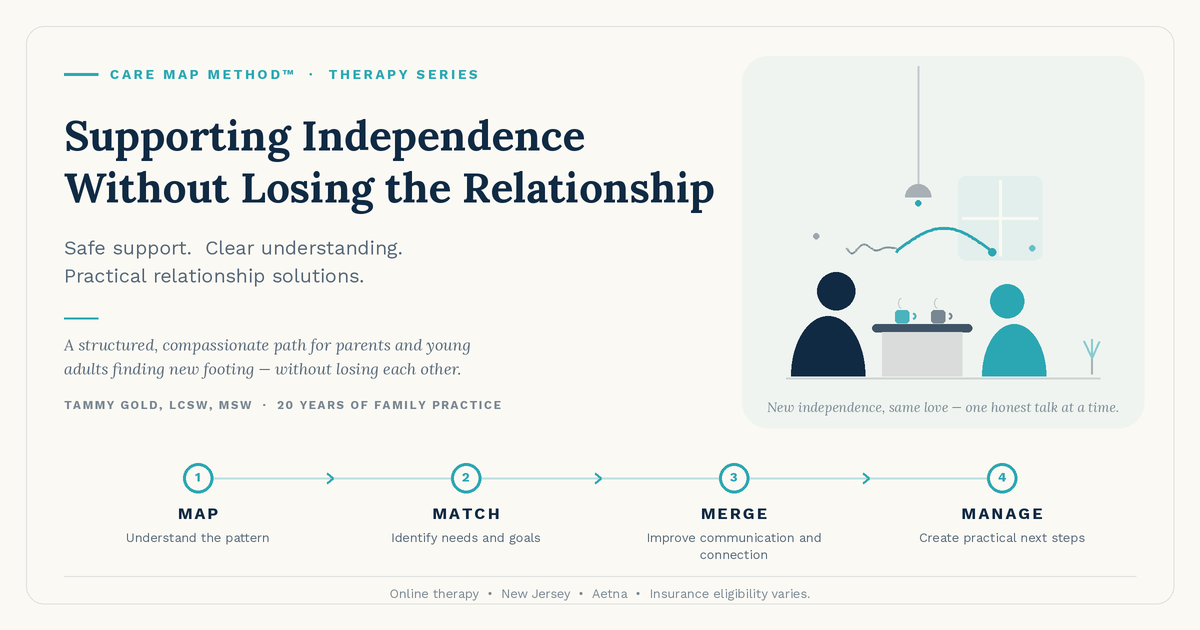
How the Care Map Method™ helps
MAP
Assess functioning, mental and physical health, daily routines, responsibilities, motivation, family dynamics, and environmental barriers.
MATCH
Identify appropriate expectations, supports, treatment referrals, skills, incentives, and consequences.
MERGE
Create respectful communication and align support with responsibility rather than rescue or repeated criticism.
MANAGE
Build written goals, timelines, household agreements, progress reviews, and a plan for adjusting support.
What clients can work toward
· Reduce recurring parent-adult child conflict
· Create clearer expectations and boundaries
· Support independence without abandonment
· Replace vague pressure with measurable next steps
Therapy is not only a place to talk about what went wrong. It is a place to feel heard, understand the pattern, practice healthier responses, and build a plan that can be used in daily life. Progress depends on the circumstances and cannot be guaranteed, but the work can become clearer, more intentional, and more supported.
Frequently asked questions
What does failure to launch mean?
It commonly describes difficulty progressing toward education, work, financial responsibility, household contribution, or independent living. It is a description, not a diagnosis.
Does Aetna cover online therapy in New Jersey?
Coverage varies by plan, eligibility, and network participation. Confirm benefits through Headway before booking.
Can parents attend without the adult child?
Yes. Parents can work on boundaries, communication, expectations, guilt, fear, and how they respond to dependence.
Should we stop financial support?
There is no universal answer. Support should be evaluated in relation to health, functioning, effort, family capacity, and whether it promotes growth or maintains dependence.
What if anxiety, depression, ADHD, or substance use is involved?
Those concerns may require specialized assessment or treatment. Therapy can help identify the need for additional providers and coordinate family expectations appropriately.
How do we set a deadline without destroying the relationship?
A deadline works best when it is realistic, specific, connected to clear steps, and communicated respectfully with predictable follow-through.