

Therapy for Sibling Conflict Over Aging Parents in Oregon
Carrying a parent's care while arguing with siblings can leave you angry, guilty and alone. Explore individual therapy in Oregon for the emotional strain, including how to clarify your needs and practice a specific request for support.
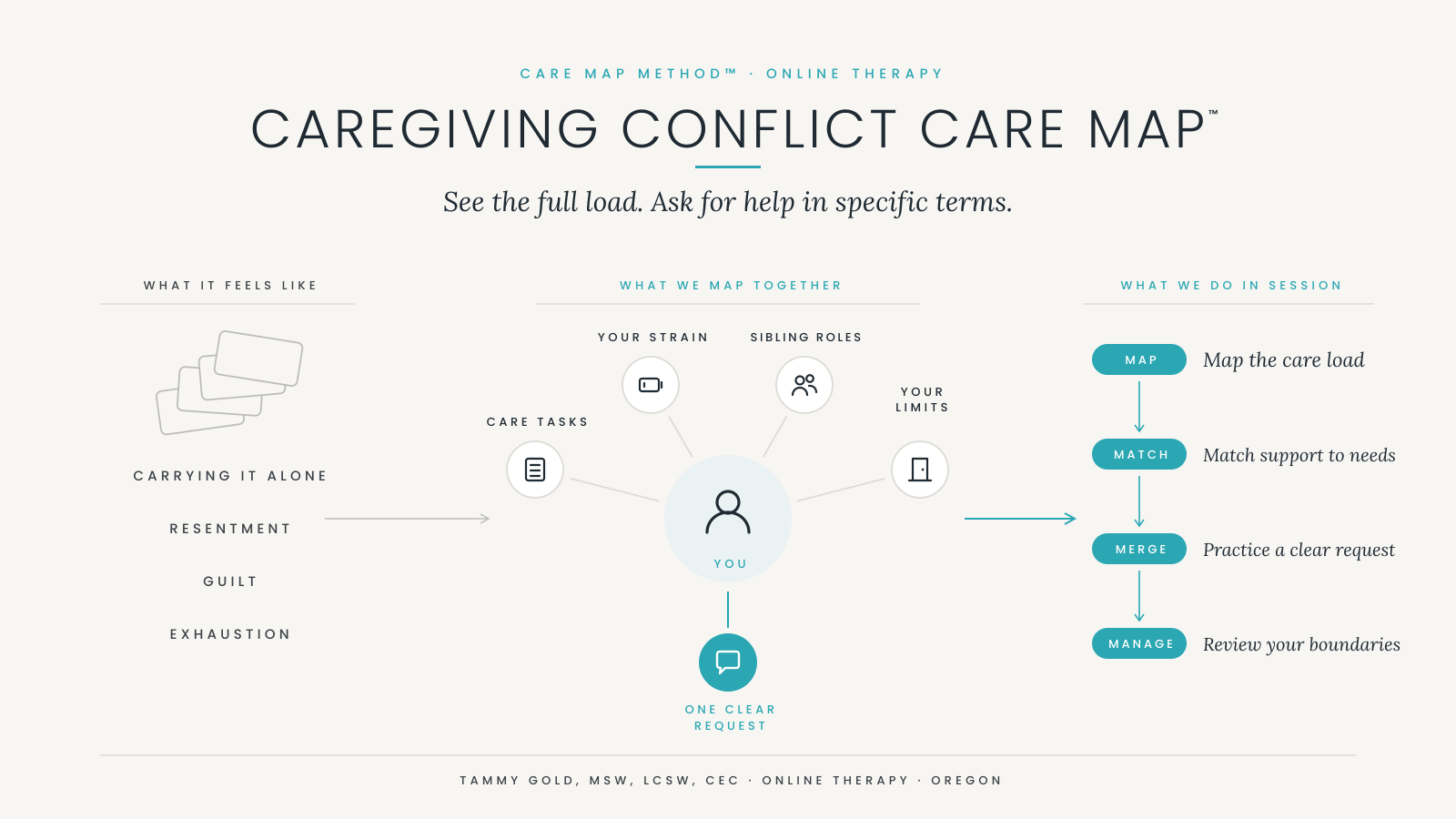
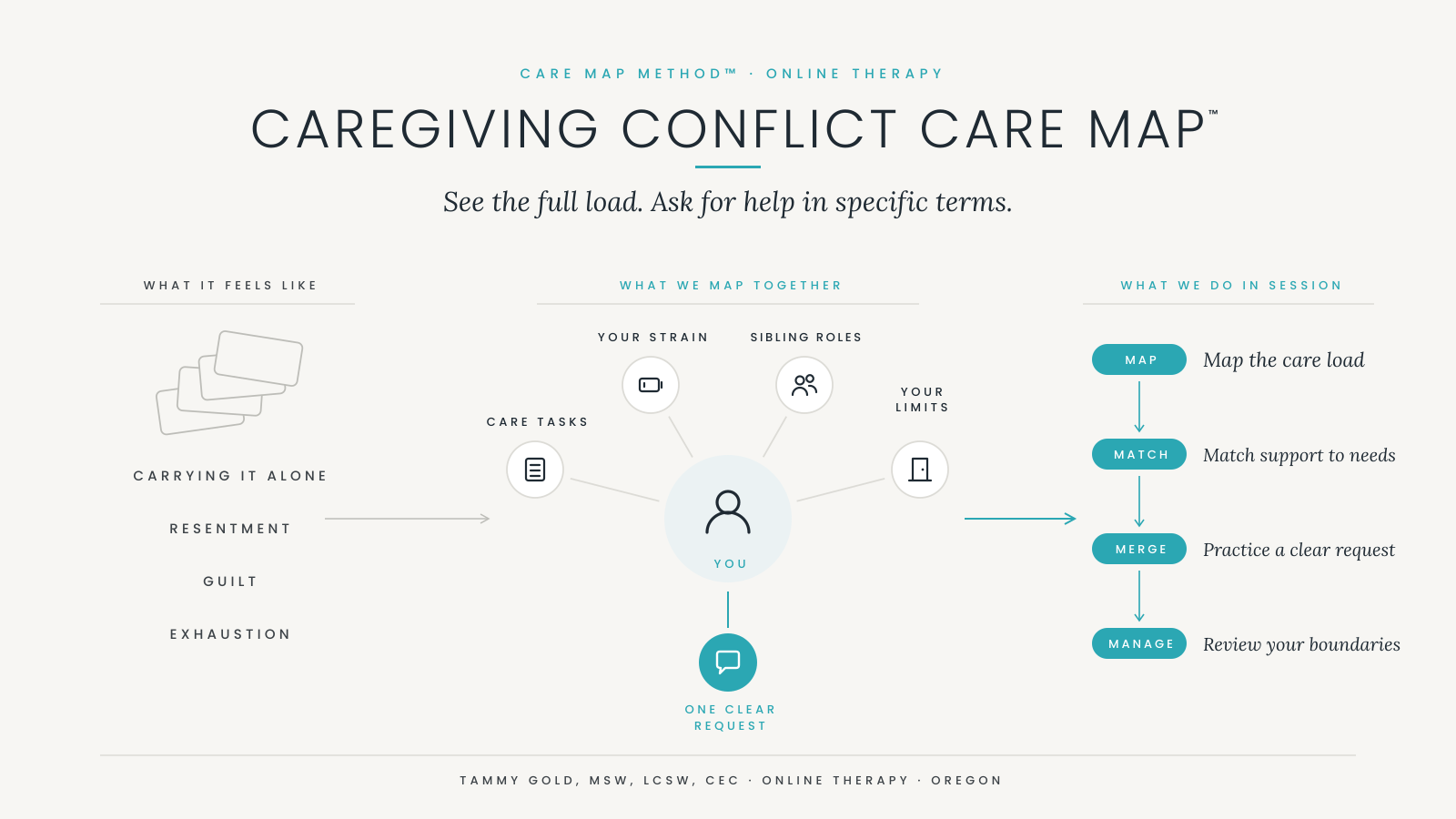
Four illustrated steps for exploring caregiving strain and practicing a specific request.
You schedule the appointments, follow up on the messages and notice when something changes with your parent. Then a sibling questions a decision from a distance. You may feel angry about carrying the responsibility and guilty for resenting people you love.
I’m Tammy Gold, LCSW. I offer individual online therapy for adults in Oregon dealing with caregiving strain, family conflict and emotional overwhelm. We can explore the effect this situation has on you, clarify what support you need and practice how you want to respond.
Check Oregon Insurance and Availability On Headway
The care load includes what other people do not see
An appointment may take an hour, but arranging it can involve several calls, transportation, reminders and time away from work. You may also be the person anticipating problems, tracking updates and trying to keep everyone calm. That invisible work can be difficult to explain until you are already exhausted.
We can make room for the emotional experience alongside the tasks. Perhaps you feel alone, watched or unable to step away. You may love being close to your parent and still need help. Those feelings can be discussed together without turning them into a judgment about whether you care enough.
Old family roles can enter a new care situation
You may have been the organizer long before your parent needed support. A sibling might expect you to know the answers, while you expect them to notice that you are struggling. The care discussion can quickly become a familiar argument about who contributes, who decides and who gets heard.
In individual therapy, we can explore the expectations you carry and how they affect your choices. We do not need to decide what an absent sibling secretly feels. We can consider what has actually happened, what you have asked for and which parts of the relationship remain uncertain.
What we might work on in a session
For example, we might discuss a day when you arranged a medical visit and received criticism afterward. We could look at the anger, worry or guilt the exchange brought up, and what you wanted your sibling to understand. We would also consider any real limits around time, distance or available resources.
From there, we might rehearse a request for one defined responsibility: making a particular call, arranging transportation or taking a scheduled update. We can explore how you want to respond if the person declines. Practicing the request supports your clarity; it cannot guarantee cooperation. A later conversation in therapy can help us review what the experience showed about your needs and options.
Using the four Care Map steps
The Care Map Method™ organizes Biological, Social, Environmental and Emotional factors. Your health and rest, family relationships, practical care setting and emotional history all help us understand the situation. Within therapy, the focus remains your mental health and functioning.
We MAP the responsibilities and their impact.
We MATCH support options to your needs and circumstances.
We MERGE a chosen approach into life through rehearsal, a boundary or a specific request.
We MANAGE the plan by reviewing what happened and adjusting what is feasible. It is a way to organize our work without expecting you to manage every person perfectly.
When saying what you need brings guilt
You may worry that asking for a break means your parent will go without care or that a sibling will think you are selfish. Sometimes a practical discussion cannot move forward until those fears have room in the conversation.
We can explore what being a responsible daughter, son or sibling means to you. We might distinguish what you choose to offer from what you feel unable to decline. The goal is to understand your values and capacity within real constraints, including situations where the available options are imperfect.
What individual therapy can and cannot take on
This page describes therapy for the adult seeking help. Your parent's medical assessment, treatment and legal decision-making remain with the appropriate professionals. Individual sessions are also different from family mediation or a consultation focused on selecting a care provider.
You can bring practical situations into therapy because they affect your well-being. We will clarify the purpose of our work and whether another type of support is needed. If family sessions are being considered, participation, fit and payment arrangements require a separate discussion.
About Tammy Gold and getting started
I’m Tamara “Tammy” Gold, MSW, LCSW, CEC, a licensed therapist, certified coach and author. I earned my MSW at Columbia University and my BA at the University of Pennsylvania. My work includes parenting, caregiving and difficult family relationships.
An initial appointment can begin with one recent exchange or the feeling you have been reluctant to say aloud. We will discuss symptoms, history, functioning and goals. Review my Headway or Alma profile for current Oregon appointments, exact-plan eligibility and estimated costs before scheduling.
Frequently asked questions
Can I attend if my siblings will not participate?
Yes. Individual therapy can focus on your own distress, needs and choices within the family situation. We can discuss relatives without requiring their attendance. A family treatment arrangement would involve separate assessment and agreement rather than being assumed from individual care.
Will you tell my siblings they need to help?
Individual therapy is centered on your care. We can work on how you understand the situation, express needs and respond to others. We cannot require relatives to cooperate or use your sessions to make decisions on their behalf.
Can we work on resentment and guilt together?
Yes. These feelings can occur alongside love, commitment and concern for your parent. We can explore what each feeling points to, how it affects you and what changes may fit your circumstances. You do not need to choose one acceptable emotion.
What if a sibling refuses the request we practice?
We can review the response, your feelings and the options available afterward. That may include revisiting a boundary, identifying another source of support or recognizing a limit. Rehearsing language does not promise that another person will agree.
Is this family mediation?
No. This page describes individual psychotherapy for your mental health concerns. Mediation aims to help people resolve a dispute through a different process. We can clarify the service you are looking for before beginning, including whether another professional would be appropriate.
Can you decide what medical care my parent needs?
Your parent's medical care belongs with their health professionals and authorized decision-makers. Therapy can explore how the situation affects you. Care-selection consulting is a separate service with different goals and arrangements; it should not be assumed to be covered psychotherapy.
Can I use Providence, Regence or Aetna in Oregon?
Review my Headway profile with your exact plan and Oregon location. Current participation and benefits determine available options; the company name alone is not enough. Coverage also depends on the assessed clinical service. Confirm estimated costs before scheduling.
How do I start an individual online session?
Check current Oregon availability through my provider profiles. Plan to attend from a private place while physically located in Oregon. You can begin with a recent family exchange, an ongoing worry or the feeling that you are carrying more than you can sustain.
Take the next step
You can review current Oregon appointment options and your exact insurance plan through my provider profile. Confirm estimated costs before scheduling. We can begin with the situation you want help understanding.

Sandwich Generation Stress Therapy
Support for adults simultaneously managing children, aging parents, work, relationships and the invisible emotional load of family caregiving.
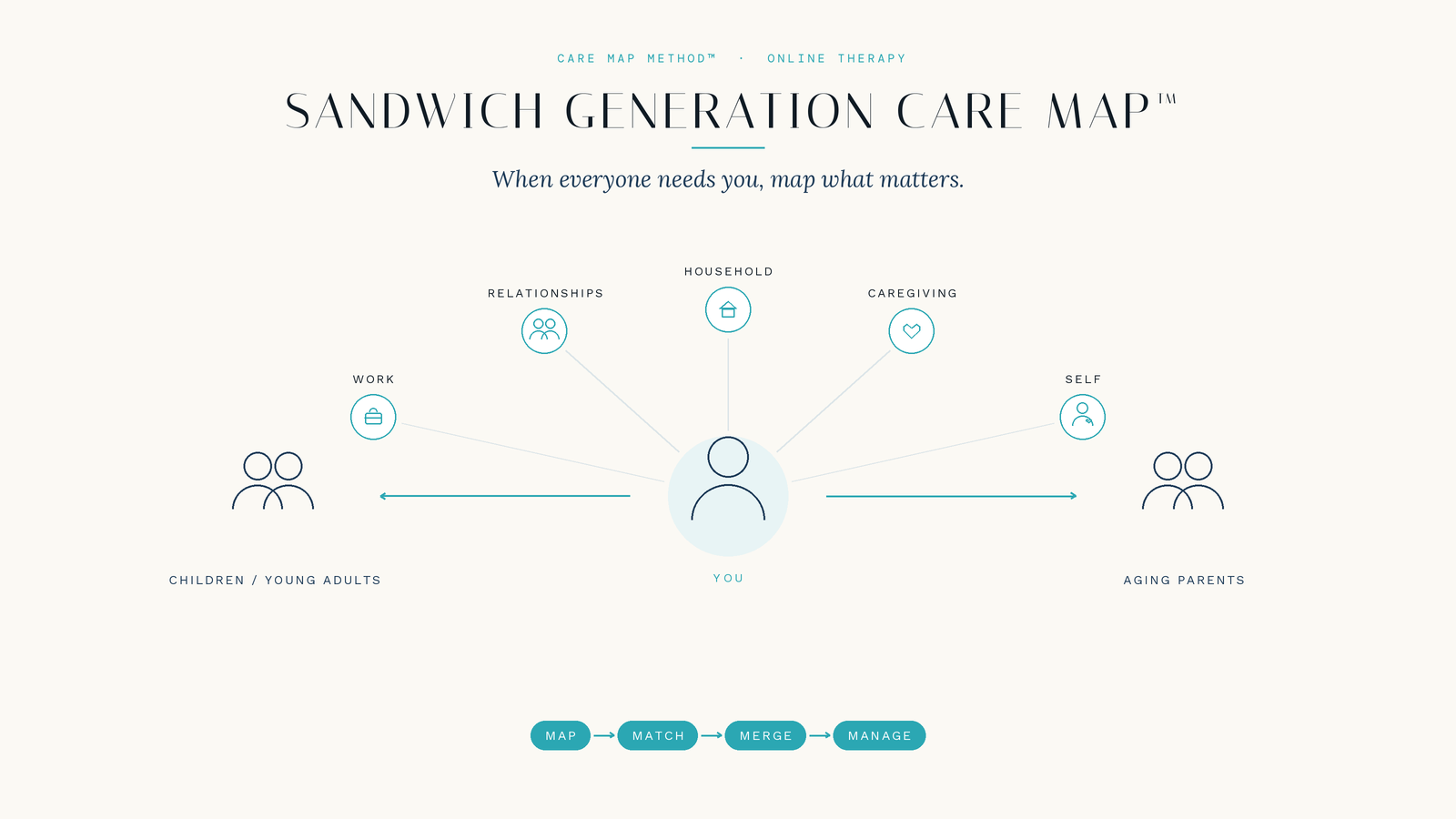
Sandwich Generation Care Map showing competing responsibilities
Therapy for the Sandwich Generation
You may be helping a child with one crisis while answering a call about an aging parent and trying to keep up with work, a relationship and your own responsibilities. The sandwich generation often functions as the family’s coordination center, carrying logistical tasks and emotional worry that other people may not fully see. Therapy can help you find a more sustainable way to live inside competing demands.
Check Insurance Eligibility & Book Online Therapy → ON HEADWAY
What You May Be Dealing With
You are caring for children and aging parents at the same time.
Everyone seems to need you, and there is no time when you are truly off duty.
You feel guilty when you prioritize yourself.
Work is being affected by family responsibilities.
You are irritable, exhausted or emotionally numb.
Your partner or siblings do not seem to understand the amount you are carrying.
You are making decisions for multiple generations at once.
You worry that if you stop managing everything, the system will fall apart.
How Therapy Can Help
Therapy can help you examine over-responsibility, guilt, boundaries, resentment, anxiety and the family roles that keep you in constant management mode. Together, we can look at what is truly yours to carry, what can be delegated, where expectations need to change and how to protect your emotional capacity while remaining connected to the people you care about.
The Care Map Method™ in Therapy
Care Map Method™ is a structured way to organize the people, needs, stressors and choices involved in a complex real-life situation. In psychotherapy, it is used only as an organizing framework within individualized clinical care—not as a substitute for assessment, diagnosis or treatment planning.
MAP — See the full system: children, parents, work, partner, logistics, emotional load and your own needs.
MATCH — Identify boundaries, coping tools, communication strategies and supports for the highest-pressure areas.
MERGE — Put changes into schedules, conversations, caregiving roles and family expectations.
MANAGE — Revisit the plan as children and parents move into new stages.
Why Work With Tammy Gold
Tammy Gold’s work spans parenting, childcare, caregiving and eldercare, giving her a broad family-systems perspective on the pressures unique to the sandwich generation. In therapy, the Care Map Method™ can help clients see competing roles more clearly and reduce the sense that every problem must be solved simultaneously.
Insurance & Online Therapy
Online therapy is available for clients located in states where Tammy is licensed and accepting clients. Selected insurance plans are accepted through Headway. Coverage, copays, deductibles, coinsurance and eligibility vary by plan and member.
Use the Headway booking link to check current insurance eligibility and available appointment times. Do not publish contracted reimbursement amounts on the website.
STATES
Oregon: Providence Health Plan • Aetna • Regence BlueCross BlueShield of Oregon • Carelon Behavioral Health • Providence Medicare Advantage.
California: Providence Health Plan • Aetna • Carelon Behavioral Health • Anthem Blue Cross California.
New Jersey: Providence Health Plan • Aetna • Carelon Behavioral Health.
Always verify current participation before publishing.
Frequently Asked Questions
What is sandwich-generation stress?
It refers to the strain that can occur when an adult is simultaneously supporting children and aging parents while also managing work, relationships and personal responsibilities.
Can therapy help when I am responsible for both children and parents?
Yes. Therapy can address stress, anxiety, guilt, resentment, boundaries and the emotional effects of carrying multiple caregiving roles.
How can I reduce caregiver resentment and guilt?
Therapy can help you examine unrealistic expectations, clarify responsibility, make room for difficult emotions and develop more sustainable boundaries.
Can therapy help with sibling or family conflict?
Individual therapy can help you understand your role in conflict and prepare for clearer communication, even when other family members are not participating.
How do I book through insurance?
Use the Headway link to verify current eligibility, expected costs and available appointments.
Reach Out Today info@CareMapMethod 818.308.1358
Being needed by two generations does not mean you have to disappear in the middle. Check insurance eligibility and book online therapy through Headway.