
Boundary Setting & Difficult Relationships Therapy
Stop repeating the same exhausting relationship patterns. Build clearer boundaries, stronger communication and a plan for difficult interactions.
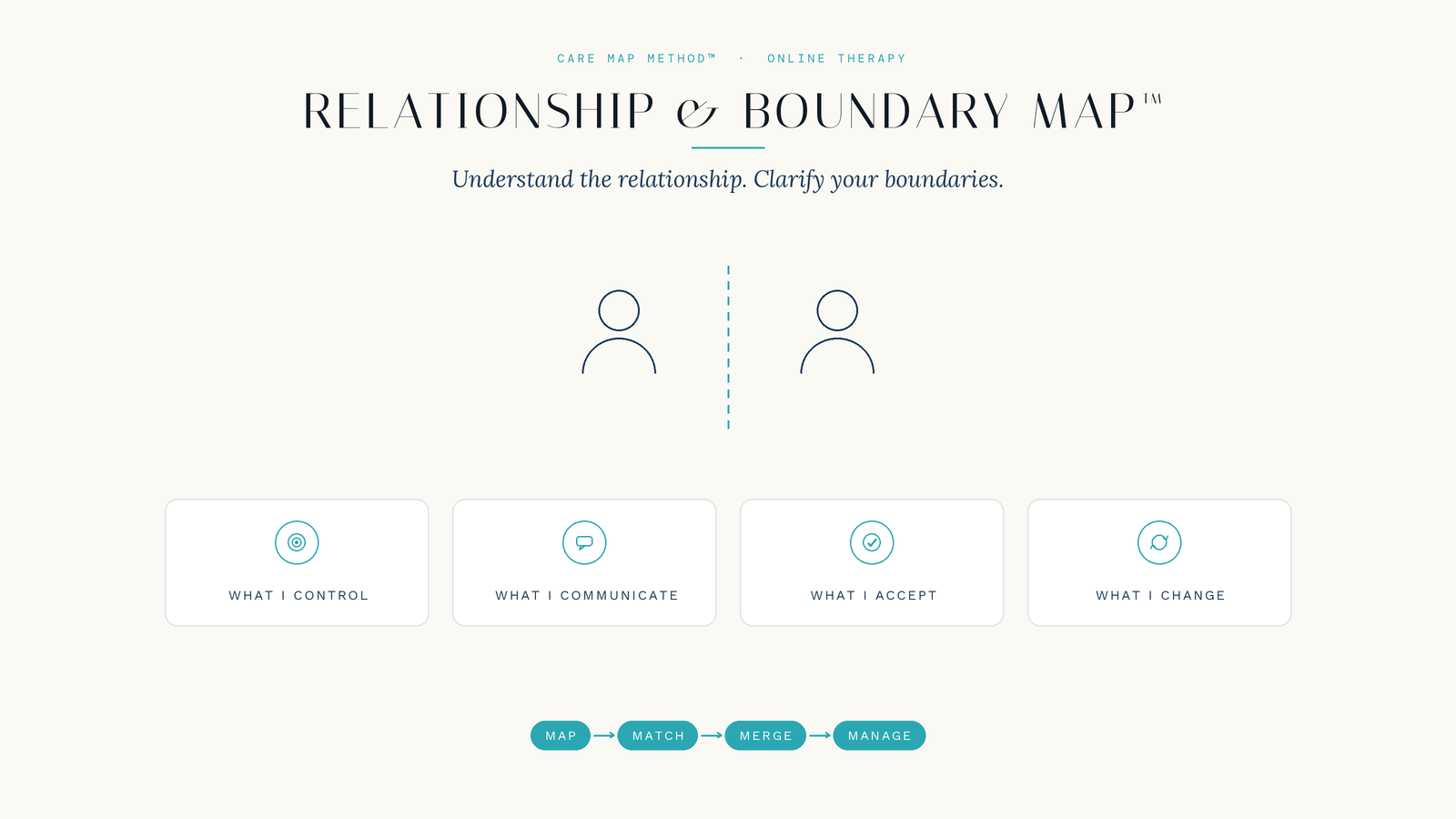
Two adults having a calm but serious conversation with appropriate physical space
Therapy for Boundaries & Difficult Relationships
Knowing that you “need a boundary” is very different from being able to set one with someone you love, work with, depend on or fear disappointing. Difficult relationships often involve history, guilt, loyalty, anxiety and patterns that do not change just because you found the right sentence online. Therapy can help you understand why the pattern continues and what a healthier role could look like.
Check Insurance Eligibility & Book Online Therapy → HEADWAY LINK
What You May Be Dealing With
You say yes when you want to say no.
You feel responsible for other people’s reactions or emotions.
You avoid conflict until resentment builds.
A family member, partner, friend or colleague repeatedly crosses limits.
You over-explain, apologize or second-guess yourself after setting boundaries.
You fear that being direct will damage the relationship.
You are exhausted by people pleasing or emotional caretaking.
The same conflict keeps repeating even after many conversations.
How Therapy Can Help
Boundary work in therapy is not simply learning to be more assertive. It can involve exploring attachment, fear of rejection, family expectations, guilt, trauma history, role patterns and the beliefs that make limits feel dangerous or selfish. Therapy can help you identify what a boundary is actually protecting, communicate more clearly, tolerate discomfort and make decisions about relationships that do not respond to reasonable limits.
The Care Map Method™ in Therapy
Care Map Method™ is a structured way to organize the people, needs, stressors and choices involved in a complex real-life situation. In psychotherapy, it is used only as an organizing framework within individualized clinical care—not as a substitute for assessment, diagnosis or treatment planning.
MAP — Identify the relationship pattern, triggers, expectations and emotional costs.
MATCH — Choose communication, coping and boundary strategies appropriate to the relationship and level of risk.
MERGE — Practice applying those limits in real situations while managing guilt, anxiety or pushback.
MANAGE — Observe what happens over time and adjust your role based on the other person’s behavior and your own well-being.
Why Work With Tammy Gold
Tammy Gold’s clinical work centers on relationships, family systems, caregiving and the emotional complexity of real-life roles. The Care Map Method™ helps organize what is happening in a relationship so therapy can move beyond generic advice toward a clearer understanding of patterns and choices.
Insurance & Online Therapy
Online therapy is available for clients located in states where Tammy is licensed and accepting clients. Selected insurance plans are accepted through Headway. Coverage, copays, deductibles, coinsurance and eligibility vary by plan and member.
Use the Headway booking link to check current insurance eligibility and available appointment times. Do not publish contracted reimbursement amounts on the website.
STATES
Oregon: Providence Health Plan • Aetna • Regence BlueCross BlueShield of Oregon • Carelon Behavioral Health • Providence Medicare Advantage.
California: Providence Health Plan • Aetna • Carelon Behavioral Health • Anthem Blue Cross California.
New Jersey: Providence Health Plan • Aetna • Carelon Behavioral Health.
Always verify current participation before publishing.
Frequently Asked Questions
Why is setting boundaries so difficult?
Boundaries can activate fears of rejection, guilt, conflict or loss, especially when family or relationship patterns have rewarded over-functioning or people pleasing. Therapy can help explore those patterns.
Can therapy help with people pleasing?
Yes. Therapy can address the beliefs, anxiety and relationship patterns that make it hard to tolerate other people’s disappointment.
How do I set a boundary without ending the relationship?
A boundary does not automatically end a relationship. Therapy can help you clarify what you need, communicate it more directly and observe whether the relationship can adapt.
Can we work on scripts for difficult conversations?
Therapy can include practicing language and communication approaches as part of broader work on emotions, patterns and boundaries.
Is online therapy covered by insurance?
Coverage depends on your plan and eligibility. Use Headway to verify current benefits and expected out-of-pocket costs.
If a relationship repeatedly leaves you anxious, resentful or depleted, therapy can help you understand your part in the pattern and build clearer limits. Check insurance eligibility and book through Headway.

Aetna Therapy in New Jersey for Adult Sibling Conflict, Resentment & Family Stress
Online therapy in New Jersey for adult sibling conflict, resentment, family roles and boundaries. Aetna eligibility may be available through Headway.
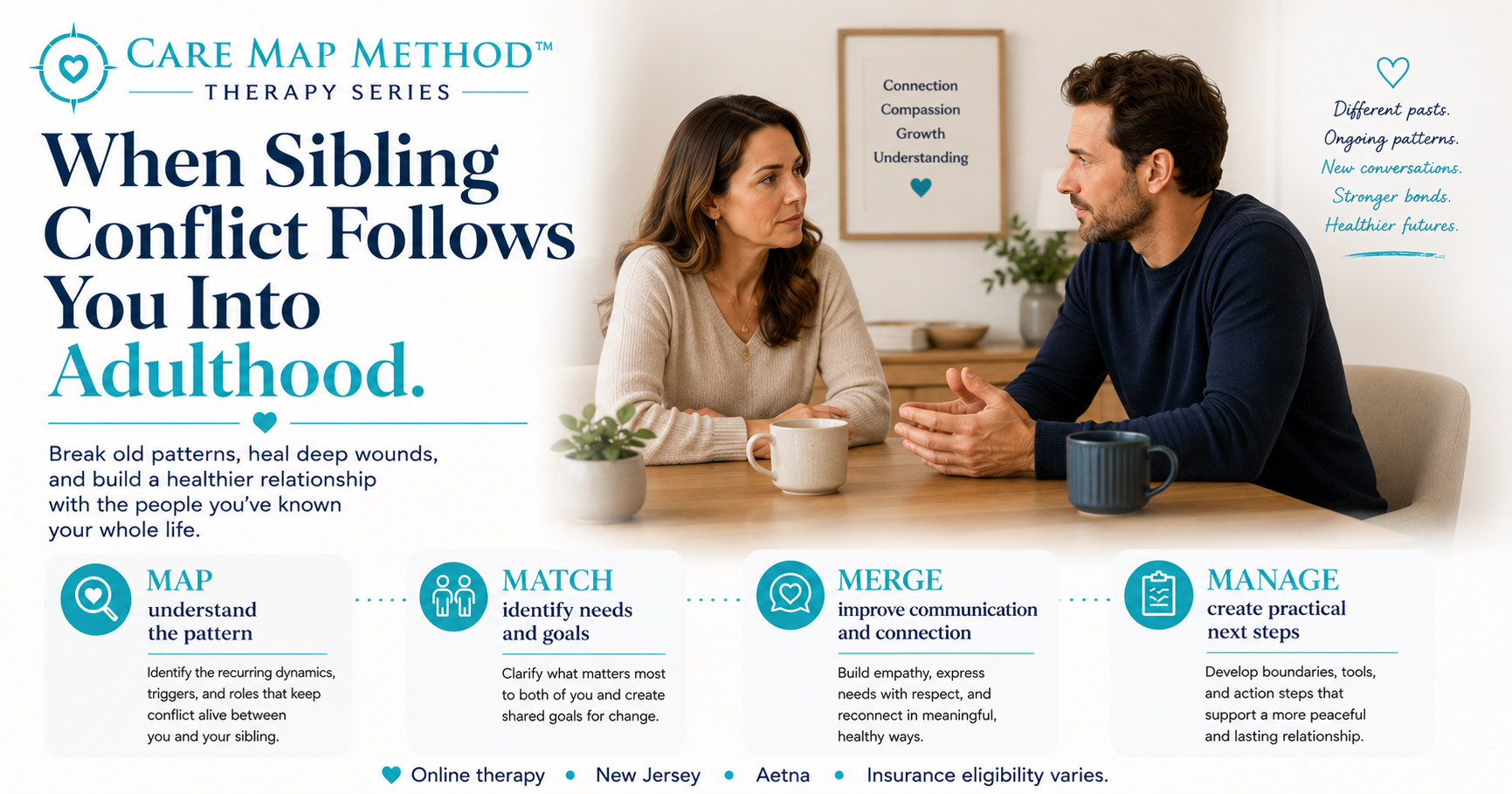
Aetna therapy in New Jersey for adult sibling conflict, resentment, family roles and healthier boundaries with the Care Map Method.
When Sibling Conflict Follows You Into Adulthood
Adult sibling conflict can instantly reopen old roles. Therapy can help you understand the history without staying trapped in it.
I provide online therapy to clients in New Jersey and participate with select insurance plans through Headway. Aetna eligibility and benefits vary by individual plan and should be verified before scheduling.
Care Map Method™: MAP → MATCH → MERGE → MANAGE
MAP — identify old family roles, current triggers and unresolved hurt.
MATCH — clarify needs, expectations and appropriate boundaries.
MERGE — improve direct communication and reduce triangulation.
MANAGE — decide what a healthier relationship looks like now.
Sibling conflict is rarely only about the current issue
Arguments about parents, holidays, money, caregiving, inheritance or grandchildren can carry decades of comparison, favoritism and old roles underneath them.
You are allowed to want both peace and connection
Therapy can help you stop getting pulled into the same role you had at age twelve. We identify what belongs to the present and what belongs to the family history.
Build communication that is direct and realistic
We can work on boundary language, difficult conversations, expectations and ways to avoid involving other relatives in the conflict.
A healthier relationship may look different
The goal is not always closeness. Sometimes success means respectful contact, clearer limits, less guilt and more emotional freedom.
Ready for support and a practical plan? If you are located in New Jersey, you can view current availability and verify insurance eligibility through my Headway booking link. I provide a warm, nonjudgmental space focused on understanding the problem and creating real next steps.
Can therapy help adult siblings who are not both attending?
Yes. Individual therapy can help you understand the pattern and change your own responses and boundaries.
Why do sibling fights feel so intense?
They often activate childhood roles, comparison, loyalty and long-standing unmet needs.
Can you help with siblings fighting over aging parents?
Yes. Caregiving roles, responsibility and decision-making are common sources of adult sibling conflict.
Does Aetna cover therapy in New Jersey?
Coverage depends on your plan and eligibility. Verify through Headway.
What if I do not want a close relationship with my sibling?
Therapy can help you define a level of contact and boundaries that protect your wellbeing.