
Empty Nest & Midlife Family Transitions
When active parenting changes, questions about identity, relationships and what comes next can become unexpectedly intense. Therapy can help you navigate the transition.
Adult alone in calm home environment contemplating next stage; hopeful rather than lonely
Therapy for Empty Nest & Midlife Family Transitions
When children become independent, the change can bring pride and grief at the same time. Daily responsibilities shift, relationships change, and questions that were easy to postpone during active parenting may become harder to ignore. Therapy can help you understand the emotional impact of the empty nest and decide what you want this stage of life to become.
Check Insurance Eligibility & Book Online Therapy → CLICK ON HEADWAY
What You May Be Dealing With
You feel unexpectedly sad, anxious or unneeded.
Your relationship with a partner feels different without children at home.
You are unsure how often to contact or advise adult children.
You are struggling with identity after years of intensive parenting.
Career or retirement questions are becoming more urgent.
Aging parents are simultaneously requiring more of you.
You are comparing your life to what you thought midlife would look like.
You want to build a meaningful next chapter but feel stuck.
How Therapy Can Help
Therapy can create space for grief without treating the transition as a failure. We can explore identity, relationship changes, purpose, boundaries with adult children and the practical decisions that often converge in midlife. For some people, the empty nest is less about losing a role and more about learning how to hold that role differently.
The Care Map Method™ in Therapy
Care Map Method™ is a structured way to organize the people, needs, stressors and choices involved in a complex real-life situation. In psychotherapy, it is used only as an organizing framework within individualized clinical care—not as a substitute for assessment, diagnosis or treatment planning.
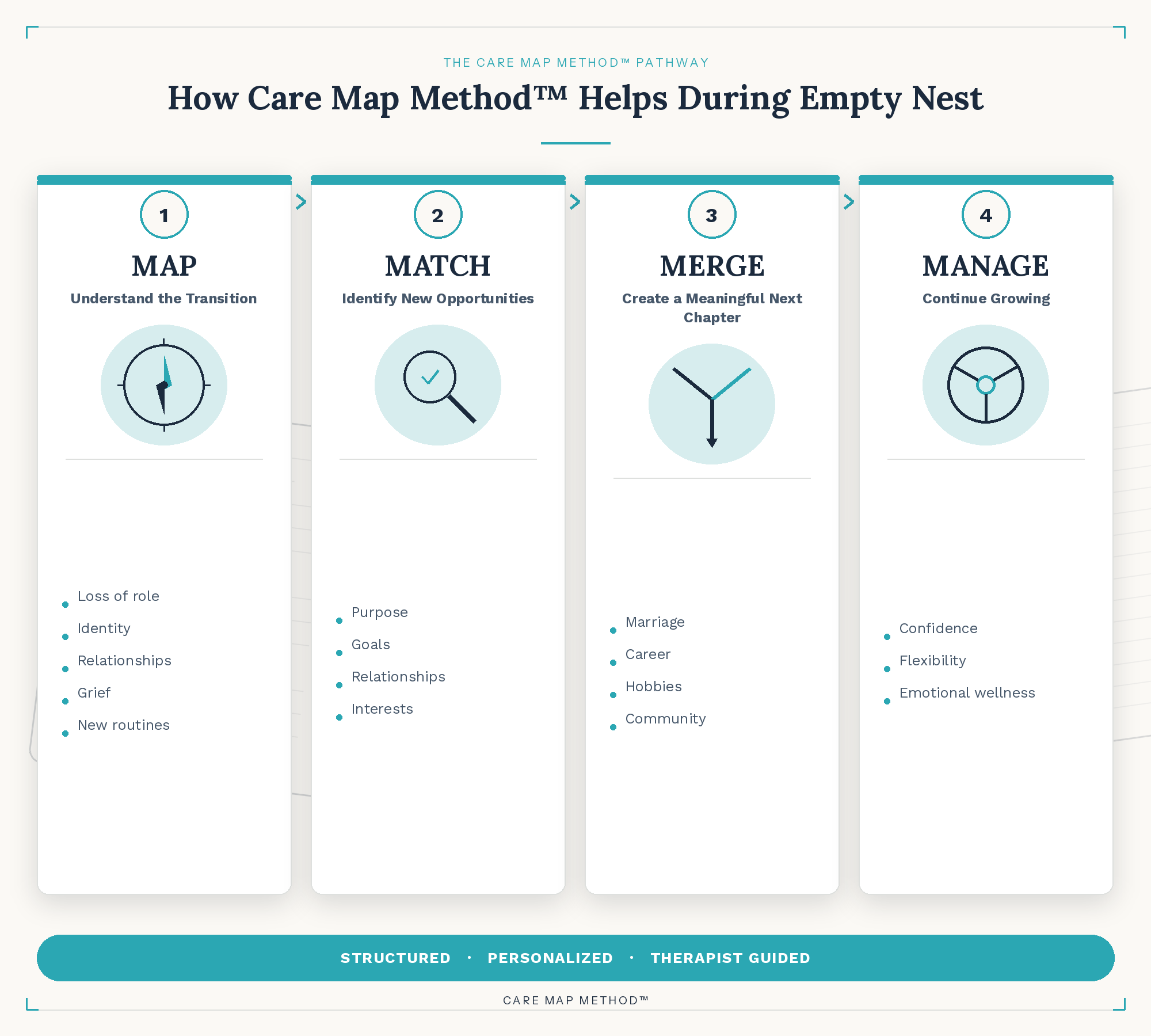
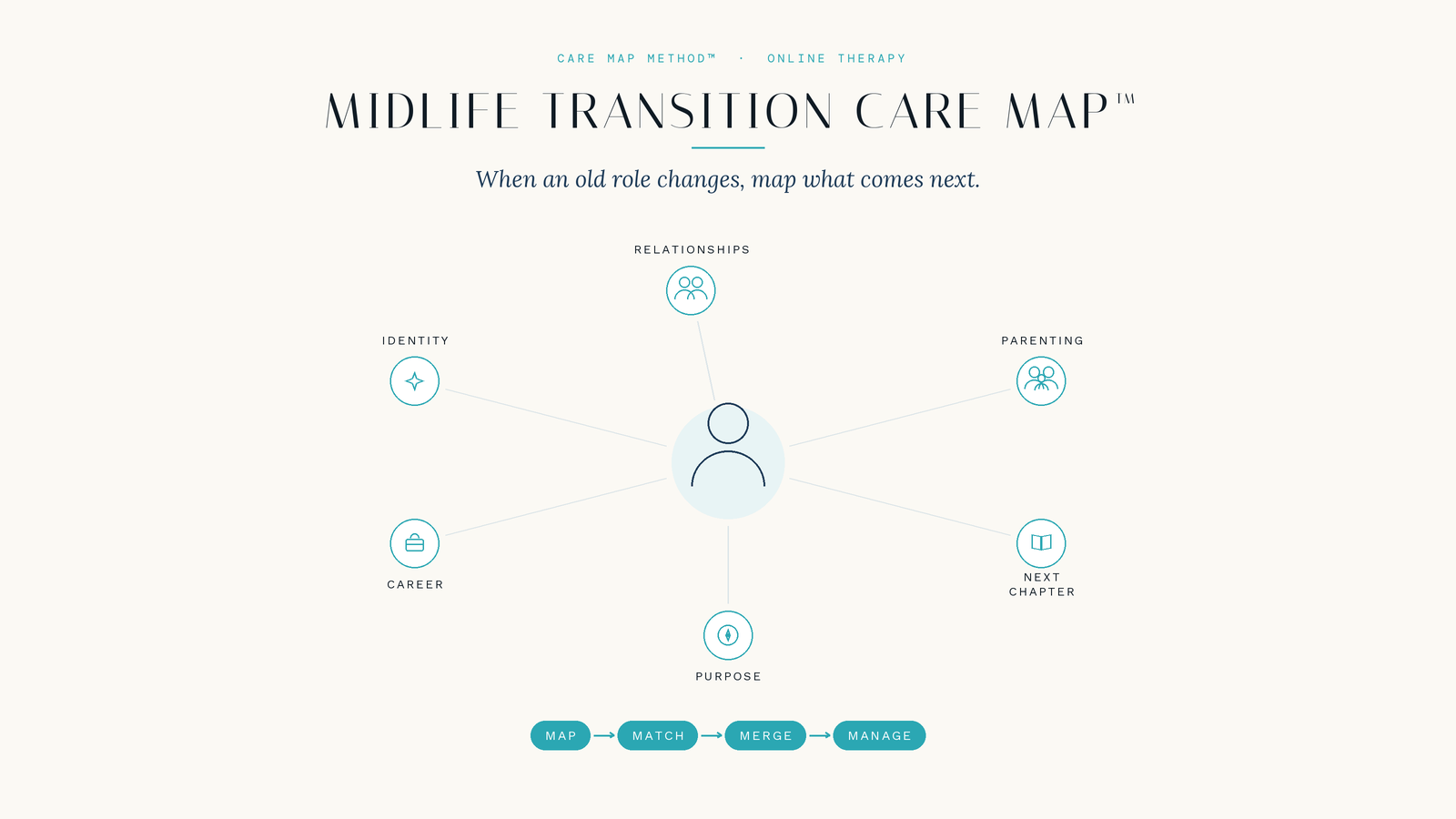
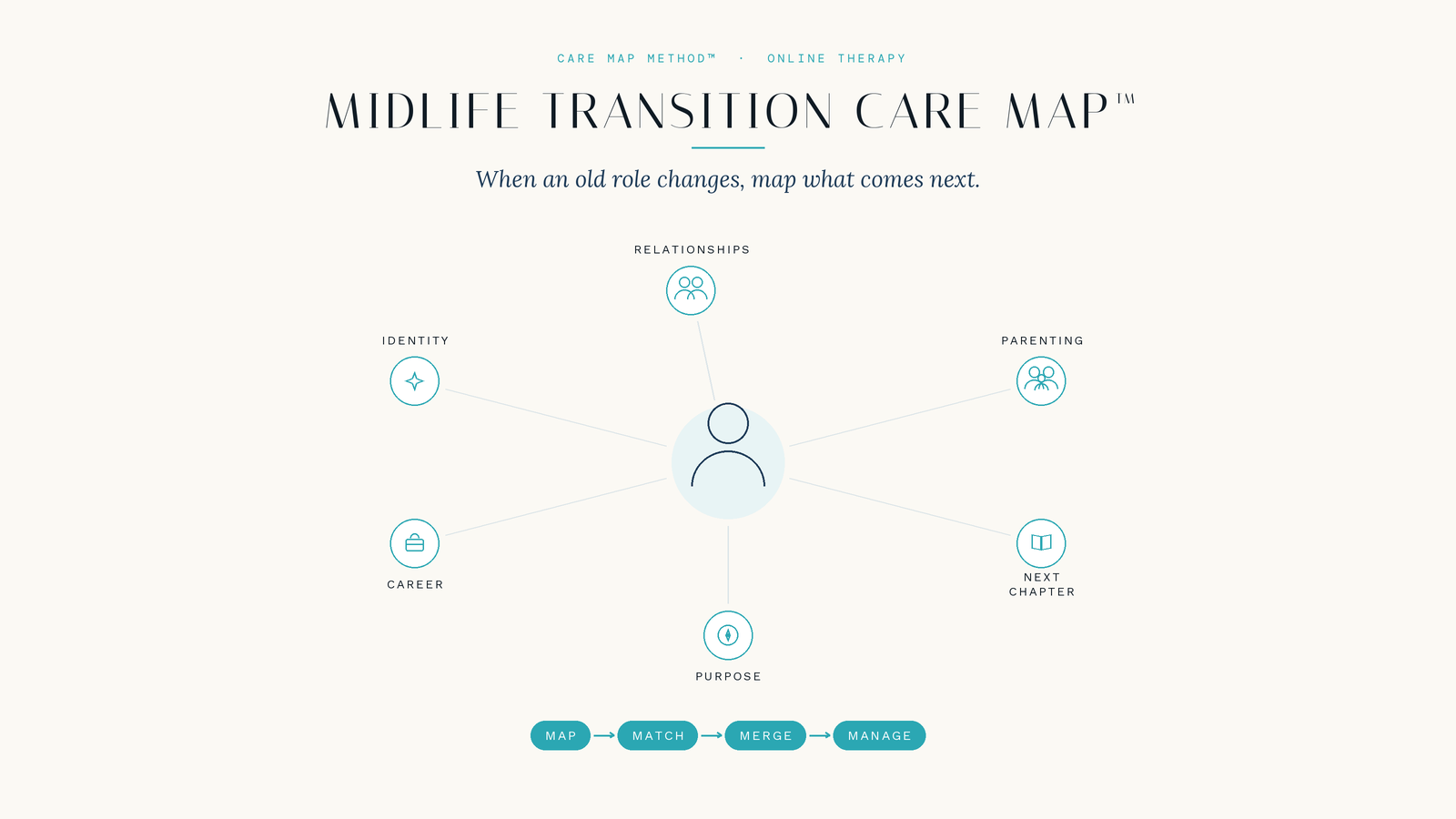
MAP — Identify what has changed across identity, relationships, daily structure and family roles.
MATCH — Identify supports, routines, boundaries and goals suited to this new stage.
MERGE — Build meaningful changes into daily life while redefining relationships with adult children.
MANAGE — Reassess as family, career, partnership and caregiving roles continue to evolve.
Why Work With Tammy Gold
Tammy Gold works across the family lifecycle, including parenting, launch, caregiving and eldercare. This perspective allows therapy to place empty-nest stress within the larger developmental changes occurring across the entire family system.
Insurance & Online Therapy
Online therapy is available for clients located in states where Tammy is licensed and accepting clients. Selected insurance plans are accepted through Headway. Coverage, copays, deductibles, coinsurance and eligibility vary by plan and member.
Use the Headway booking link to check current insurance eligibility and available appointment times. Do not publish contracted reimbursement amounts on the website.
STATE-SPECIFICS
Oregon: Providence Health Plan • Aetna • Regence BlueCross BlueShield of Oregon • Carelon Behavioral Health • Providence Medicare Advantage.
California: Providence Health Plan • Aetna • Carelon Behavioral Health • Anthem Blue Cross California.
New Jersey: Providence Health Plan • Aetna • Carelon Behavioral Health.
Always verify current participation before publishing.
Frequently Asked Questions
Is empty nest sadness normal?
Many parents experience grief, loneliness, anxiety or identity changes when children leave home. Therapy can help when those emotions are difficult to navigate or begin affecting functioning.
Can therapy help me change my relationship with my adult child?
Yes. Therapy can focus on boundaries, communication, expectations and adjusting from a more managerial parenting role toward an adult-to-adult relationship.
What if my marriage feels different now?
Midlife transitions can expose relationship issues that were easier to ignore when parenting demands were high. Individual therapy can help you understand your own needs and patterns.
Can therapy help with midlife career decisions too?
Yes, when career questions are part of the broader emotional transition and identity work.
Is insurance available?
Selected plans are accepted through Headway. Verify current eligibility and cost through the booking link.
FINAL CTA
The end of one family stage can be the beginning of a more deliberate next one. Check insurance eligibility and book online therapy through Headway.
Email Info@CareMapMethod.com TextL 818.308.1358
Empty Nest Syndrome: Finding Purpose During Life’s Next Chapter
When children leave home, parents may experience grief, identity changes, relationship strain, and uncertainty about what comes next. Therapy can help make this transition meaningful.
When a child leaves for college, moves out, marries, or becomes more independent, parents often feel proud and relieved. They may also feel grief, loneliness, anxiety, or a surprising loss of direction.
These reactions can coexist. Loving your child's independence does not prevent you from missing the daily relationship, familiar routines, and identity that active parenting provided.
Why the empty nest can feel like a real loss
Parenting structures time, attention, relationships, and the physical home for many years. School calendars, meals, activities, transportation, and emotional support create a daily rhythm. When that rhythm changes, the absence can be felt in ordinary moments: a quiet kitchen, an unused bedroom, or a weekend with no one to drive anywhere.
The loss is not only of proximity. It may include the loss of a role in which you felt needed and competent. Even when the transition is developmentally healthy, it can require genuine grieving.
Common empty-nest experiences
Parents may notice:
Sadness or tearfulness that seems disproportionate to the event
Anxiety about the child’s safety, choices, or adjustment
Compulsive checking, texting, or monitoring
Difficulty sleeping or concentrating
A sense that the home or marriage feels unfamiliar
Uncertainty about personal goals or identity
Resentment when the adult child appears distant
Conflict with a partner who is adjusting differently
Relief followed by guilt for feeling relieved
When partners experience the transition differently
One partner may feel devastated while the other feels energized by new freedom. One may want frequent contact with the child; the other may emphasize independence. These differences can create conflict if each person interprets the other's response as uncaring or excessive.
Couples may also discover that years of child-centered routines allowed them to avoid unresolved issues. The quieter home can expose emotional distance, unequal labor, or uncertainty about what they enjoy together. This does not necessarily mean the relationship is failing. It means the couple may need to build a new version of the relationship rather than waiting for the old one to return.
Letting the parent-child relationship evolve
Adult children still need connection, but the form of support changes. The parent's task gradually shifts from direct management to availability, consultation, and respect for autonomy.
This transition can be difficult when worry is high. Frequent advice or checking may feel like love to the parent but like mistrust to the adult child. Therapy can help parents tolerate uncertainty while maintaining a warm, appropriate connection.
The empty nest and women’s identity
Women are often encouraged to invest deeply in caregiving and then expected to transition smoothly when daily caregiving decreases. The resulting identity questions can be significant: Who am I when I am not organizing everyone else's life? What do I want beyond being needed?
These questions are not selfish. They are part of constructing a fuller identity that can include parenting without being limited to it.
When aging parents enter the picture
For many adults, the empty nest is not an uncomplicated release from caregiving. As children become independent, aging parents may begin to need more support.
This can create a rapid shift from one caregiving system to another, leaving little time to recover or consider personal goals. It is important to avoid automatically filling every newly available hour with eldercare. A sustainable plan should account for the adult child's independence, the older parent's needs, and the midlife adult's own health and future.
Rebuilding purpose without forcing a reinvention
You do not need to identify a dramatic new purpose immediately. Purpose can be rebuilt gradually through relationships, work, creativity, learning, service, health, travel, or simple routines that belong to you.
Start by noticing what was postponed during intensive parenting. Some interests will still matter; others will not. The goal is not to recreate your pre-parenting self but to discover what fits now.
A practical transition map
Consider mapping four areas:
Biological: sleep, health, movement, and energy during the transition
Emotional: grief, relief, anxiety, pride, regret, and changing identity
Social: friendships, partnership, community, and the evolving relationship with the adult child
Environmental: changes to the home, schedule, finances, work, and caregiving responsibilities
How therapy can help
Therapy can provide support when the transition brings persistent sadness, anxiety, relationship conflict, or a sense of emptiness. It can help parents process grief, adjust communication with adult children, strengthen a partnership, and clarify what they want from the next stage of life.
The work is not about erasing attachment. It is about allowing the relationship with your child to mature while expanding your own life.
The next chapter can hold more than one truth
You can miss the version of family life that has ended and still welcome what comes next. You can be proud of your child and feel lonely. You can appreciate new freedom and feel uncertain about how to use it.
A healthy transition does not require choosing one emotion. It requires making room for the full experience while gradually building a life that remains connected, purposeful, and your own.
Ready for support?
If the empty-nest transition has brought grief, anxiety, relationship strain, or uncertainty about your identity, therapy can help you move into the next chapter with greater clarity. Tammy Gold, MSW, LCSW, CEC, provides confidential virtual therapy for adults located in California, New Jersey, and Oregon.
Book through Psychology Today: https://www.psychologytoday.com/us/therapists/tamara-jill-gold-los-angeles-ca/1713403
Learn more: CareMapMethod.com
About Tammy Gold
Tammy Gold, MSW, LCSW, CEC, is the founder of Care Map Method™, a licensed clinical social worker in California, New Jersey, and Oregon, a certified coach, and the author of Secrets of the Nanny Whisperer. Her work centers on relationships, caregiving, burnout, parenting transitions, workplace stress, women’s midlife concerns, and practical support during major life changes.
Educational notice: This article is for general educational purposes and is not a substitute for individualized medical or mental health care. If you are experiencing an emergency or immediate safety concern, contact emergency services or an appropriate crisis resource in your area.