

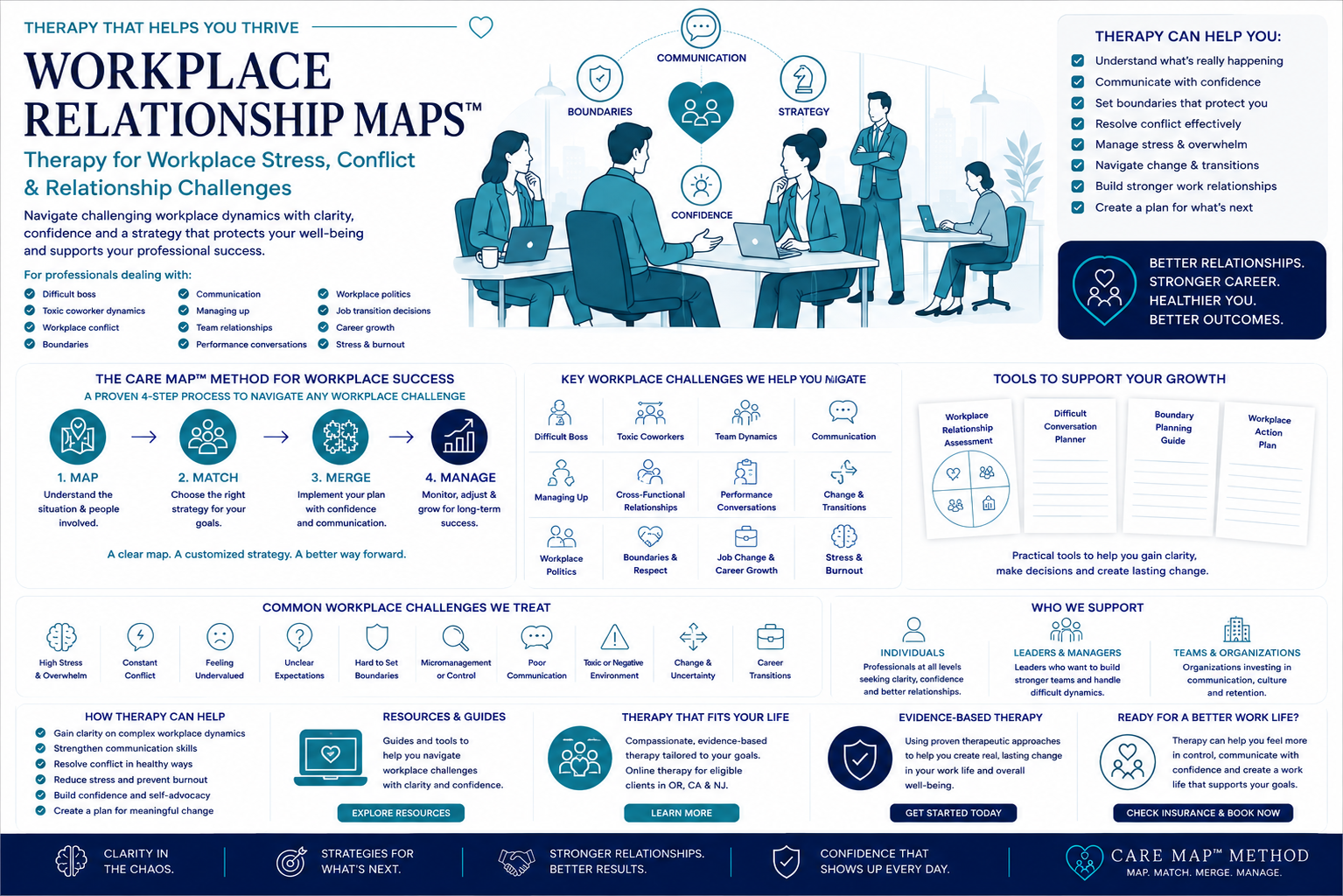
Online Therapy for Workplace Stress, Difficult Bosses & Conflict
Work stress can follow you home. Get personalized therapy for difficult bosses, coworker conflict, boundaries, burnout and career stress.
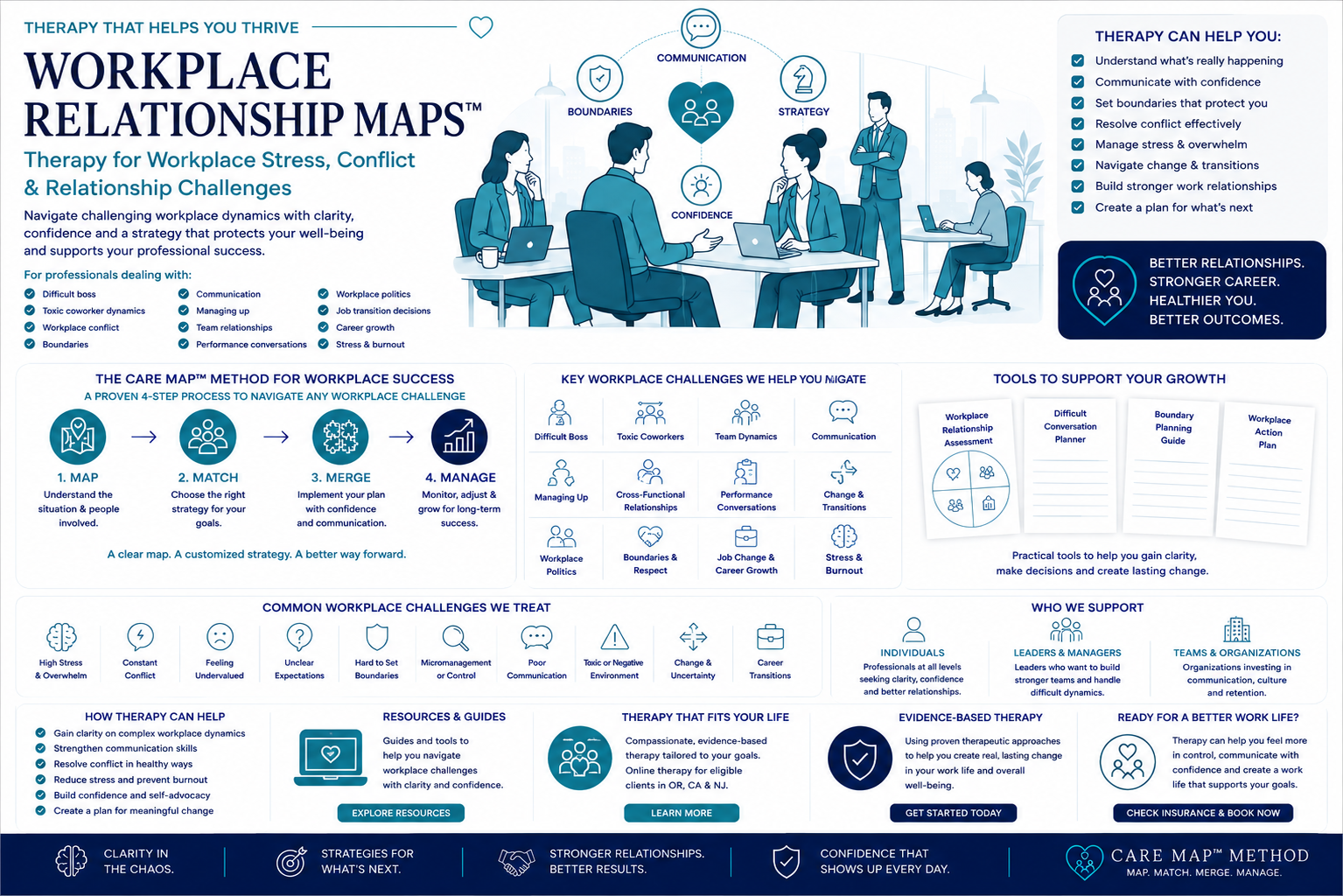
Online therapy for workplace stress, difficult bosses, coworker conflict, boundaries and burnout in CA, NJ and Oregon Check insurance eligibility and book online.
Online Therapy for Workplace Stress, Difficult Bosses & Conflict
A difficult boss, a tense coworker relationship, or a politically complicated workplace can take up far more mental space than the hours you spend at work. You may replay conversations, second-guess what you said, worry about your reputation, or feel stuck between speaking up and staying quiet. Therapy can give you a structured place to understand what is happening, how it is affecting you, and what choices are realistically available.
Check Insurance Eligibility & Book Online Therapy → Via HEADWAY
What You May Be Dealing With
You dread meetings, emails or interactions with a particular person.
You replay workplace conversations long after the workday ends.
You feel micromanaged, criticized, excluded or undervalued.
You are unsure how to set a boundary without making the situation worse.
Coworker conflict is affecting your confidence, sleep, mood or concentration.
You are trying to decide whether to address the situation, escalate it, change roles or leave.
You are burned out from carrying too much responsibility or emotional labor.
You want to communicate more clearly without becoming reactive or shutting down.
How Therapy Can Help
Therapy is not about giving you a one-size-fits-all script for dealing with a difficult person. The work starts by understanding the specific relationship, the power dynamics, your emotional reactions, your goals and the risks involved. Together, we can identify patterns, strengthen boundaries, prepare for difficult conversations, work on emotional regulation, and clarify what is within your control. If a job decision is part of the problem, therapy can also help you separate fear, exhaustion and frustration from the practical factors that matter to your next step.
The Care Map Method™ in Therapy
Care Map Method™ is a structured way to organize the people, needs, stressors and choices involved in a complex real-life situation. In psychotherapy, it is used only as an organizing framework within individualized clinical care—not as a substitute for assessment, diagnosis or treatment planning.
MAP — Identify the people, pressures, triggers, history and emotional impact of the workplace situation.
MATCH — Identify coping strategies, communication approaches, boundaries and decision-making tools that fit the situation.
MERGE — Practice how to apply those strategies in real conversations, meetings, routines and workdays.
MANAGE — Review what changes, what does not, and how you want to respond as the situation evolves.
Why Work With Tammy Gold
Tammy Gold is a licensed therapist, author and nationally recognized parenting, relationship and caregiving expert with more than 20 years of experience helping people navigate complex interpersonal situations. Her Care Map Method™ provides a structured way to organize the people, needs, stressors and choices involved in a real-life problem while keeping psychotherapy individualized to the client.
Insurance & Online Therapy
Online therapy is available for clients located in states where Tammy is licensed and accepting clients. Selected insurance plans are accepted through Headway. Coverage, copays, deductibles, coinsurance and eligibility vary by plan and member.
Use the Headway booking link to check current insurance eligibility and available appointment times. Do not publish contracted reimbursement amounts on the website.
Oregon: Providence Health Plan • Aetna • Regence BlueCross BlueShield of Oregon • Carelon Behavioral Health • Providence Medicare Advantage.
California: Providence Health Plan • Aetna • Carelon Behavioral Health • Anthem Blue Cross California.
New Jersey: Providence Health Plan • Aetna • Carelon Behavioral Health.
Always verify current participation before publishing.
Frequently Asked Questions
Do you offer therapy for problems with a boss or coworker?
Yes. Individual therapy can focus on the emotional and relational impact of a difficult workplace situation, including communication, boundaries, anxiety, burnout, confidence and decision-making.
Can therapy help me decide whether to stay in or leave a job?
Therapy can help you clarify what is driving the decision, identify your priorities, examine recurring patterns and think through the emotional consequences of different options. The decision remains yours.
How can therapy help with workplace boundaries?
Therapy can help you identify where boundaries are unclear, understand why asserting them feels difficult, and develop more sustainable ways to communicate limits while managing the emotions that come with doing so.
Can I use insurance for online therapy?
Selected insurance plans are accepted through Headway. Eligibility and out-of-pocket costs depend on your individual plan. Use the booking link to verify current benefits.
Do you provide online therapy throughout New Jersey, California, or Oregon?
Telehealth sessions are available to appropriate clients located in states where Tammy is licensed and currently accepting clients. Availability can be confirmed through the booking process.
Work problems do not have to occupy every part of your life. If you want a structured place to understand the relationship, reduce the emotional spillover and decide what comes next, check your insurance eligibility and book an online therapy session through Headway.
Workplace Burnout or Just Too Much? How to Know When It Is Time for Therapy
Workplace burnout can affect sleep, health, confidence, and relationships. Learn how it differs from ordinary stress and when therapy may help.
A demanding job can produce temporary periods of stress. Burnout is different. It develops when high demands, low control, inadequate recovery, conflict, or misalignment continue long enough that your emotional and physical resources begin to erode.
You may still be performing well. In fact, many people seek therapy only after months of compensating through longer hours, perfectionism, and constant availability. Outward competence can hide significant internal depletion.
Burnout versus ordinary work stress
Ordinary stress usually has a clear endpoint. A project ends, a deadline passes, or a busy season settles down. Burnout is more persistent and often includes emotional exhaustion, cynicism or detachment, and a reduced sense of effectiveness.
You may notice that weekends no longer restore you, small requests feel intolerable, or achievements produce little satisfaction. The issue is not simply that work is difficult. It is that the current relationship between you and the work has become unsustainable.
Signs that work stress is affecting your health
Common signs include:
Difficulty falling asleep because your mind continues rehearsing work problems
Waking with dread or physical tension
Headaches, gastrointestinal symptoms, muscle pain, or persistent fatigue
Increased reliance on alcohol, food, screens, or other numbing behaviors
Trouble concentrating or making decisions
Feeling emotionally flat with family and friends
Frequent irritability or conflict at home
Checking messages compulsively or feeling unable to disconnect
Believing that one mistake could expose you as inadequate
The relationship side of workplace burnout
Burnout is not only about workload. It can be driven by relationships: an unpredictable manager, unclear expectations, a hostile coworker, chronic lack of recognition, pressure to absorb other people's responsibilities, or a culture in which boundaries are punished.
People who are highly attuned to others may spend enormous energy managing a boss's mood, preventing conflict, or compensating for a disorganized team. This emotional labor is real work, even when it is not listed in the job description.
Perfectionism and overfunctioning
Perfectionism can initially look like a professional advantage. You anticipate problems, produce careful work, and become the person others rely on. Over time, however, the standard may become impossible to maintain.
Overfunctioning occurs when you repeatedly do more than your role requires because you fear what will happen if you stop. The workplace then adapts around your extra labor. Therapy can help you distinguish professional responsibility from anxiety-driven overresponsibility.
When the problem follows you home
Workplace burnout often enters personal relationships. You may be physically present but mentally preoccupied, too depleted for intimacy, or impatient with ordinary family needs. A partner may experience your withdrawal as disinterest, while you feel that there is simply nothing left to give.
This is an important signal. A job does not have to be objectively terrible to be incompatible with your current health, family responsibilities, or values.
A practical workplace stress map
Before making a major decision, map the problem specifically:
Demands: What tasks, hours, or expectations are creating the greatest strain?
Control: Which parts of the role can you influence, and which are fixed?
Relationships: Which interactions consistently increase stress?
Recovery: Do you have genuine periods when you are not working or anticipating work?
Values: Is the job asking you to act in ways that conflict with your priorities?
Consequences: What is the current arrangement costing your health and relationships?
Boundaries that are more useful than “work-life balance”
The phrase work-life balance can feel unrealistic when work demands fluctuate. More useful boundaries are concrete and observable.
Examples include setting a time after which nonurgent messages wait until morning, requesting written priorities when assignments conflict, limiting how often you rescue a colleague, or protecting one recurring block of personal time. A boundary is not merely what you ask another person to do. It is the action you will take to protect a limit.
Should you leave the job?
Therapy should not automatically persuade you to stay or leave. It can help you evaluate the situation with greater clarity.
Some workplace problems improve through communication, role clarification, leave, a schedule change, or stronger boundaries. Others reflect a culture or leadership structure that is unlikely to change. The task is to assess whether the environment can become workable and what risks accompany each option.
How therapy can help
Therapy for workplace burnout can address stress regulation, conflict patterns, perfectionism, imposter feelings, decision-making, and the effect of work on relationships.
It can also help you prepare for difficult conversations, understand why certain authority dynamics feel especially activating, and build a transition plan if leaving becomes the healthiest choice. The aim is not to help you tolerate unlimited stress. It is to help you respond strategically rather than from panic or depletion.
You do not have to wait for collapse
Many professionals assume they should seek help only when they can no longer function. Earlier support is often more effective. If work is consistently affecting sleep, health, confidence, or relationships, that is enough reason to take the problem seriously.
Burnout is not proof that you are incapable. It may be evidence that your current workload, workplace relationships, or coping structure needs to change.
Ready for support?
If workplace stress is affecting your sleep, health, confidence, or relationships, therapy can help you assess the situation, set clearer boundaries, and make informed decisions. Tammy Gold, MSW, LCSW, CEC, provides confidential virtual therapy for adults located in California, New Jersey, and Oregon.
Book through Psychology Today: https://www.psychologytoday.com/us/therapists/tamara-jill-gold-los-angeles-ca/1713403
Learn more: CareMapMethod.com
About Tammy Gold
Tammy Gold, MSW, LCSW, CEC, is the founder of Care Map Method™, a licensed clinical social worker in California, New Jersey, and Oregon, a certified coach, and the author of Secrets of the Nanny Whisperer. Her work centers on relationships, caregiving, burnout, parenting transitions, workplace stress, women’s midlife concerns, and practical support during major life changes.
Educational notice: This article is for general educational purposes and is not a substitute for individualized medical or mental health care. If you are experiencing an emergency or immediate safety concern, contact emergency services or an appropriate crisis resource in your area.