

When your job occupies more than your working hours
Dreading Monday, replaying feedback or checking messages after hours? Therapy can help you understand work anxiety and develop a response that fits your job and circumstances.
You may notice anxiety before you even open your laptop. A meeting invitation can make your stomach tighten. A brief message from your manager can become something you analyze all day. By Sunday afternoon, you may already be preparing emotionally for Monday, even when nothing specific has happened.
Therapy for work anxiety can help you understand what your mind is anticipating and how the worry is affecting your life. The concern may involve workload, performance fears, conflict, uncertainty or an environment that really is difficult. We can take those possibilities seriously without assuming either that your job is fine or that quitting is the only answer.
Distinguishing the job problem from the anxiety pattern
A new role, unclear expectations or inconsistent feedback can leave almost anyone unsettled. Anxiety can also make neutral situations feel threatening. You may interpret a correction as evidence that you are failing, compare yourself constantly with coworkers or put off a task because you feel you must do it perfectly.
We can examine what happened, what you inferred and what information is still missing. That does not mean explaining away poor treatment. It means making room for both the external conditions and your internal response. The more clearly we understand the problem, the more specific our next steps can be.
What we can work on in sessions
Our work might include preparing for a feedback conversation, responding to a mistake without spiraling, setting realistic availability or recognizing the point at which planning turns into repeated worry. We may explore how earlier experiences with criticism influence what happens with a supervisor now. We can also look at whether sleep, health, financial insecurity or responsibilities outside work are narrowing your capacity.
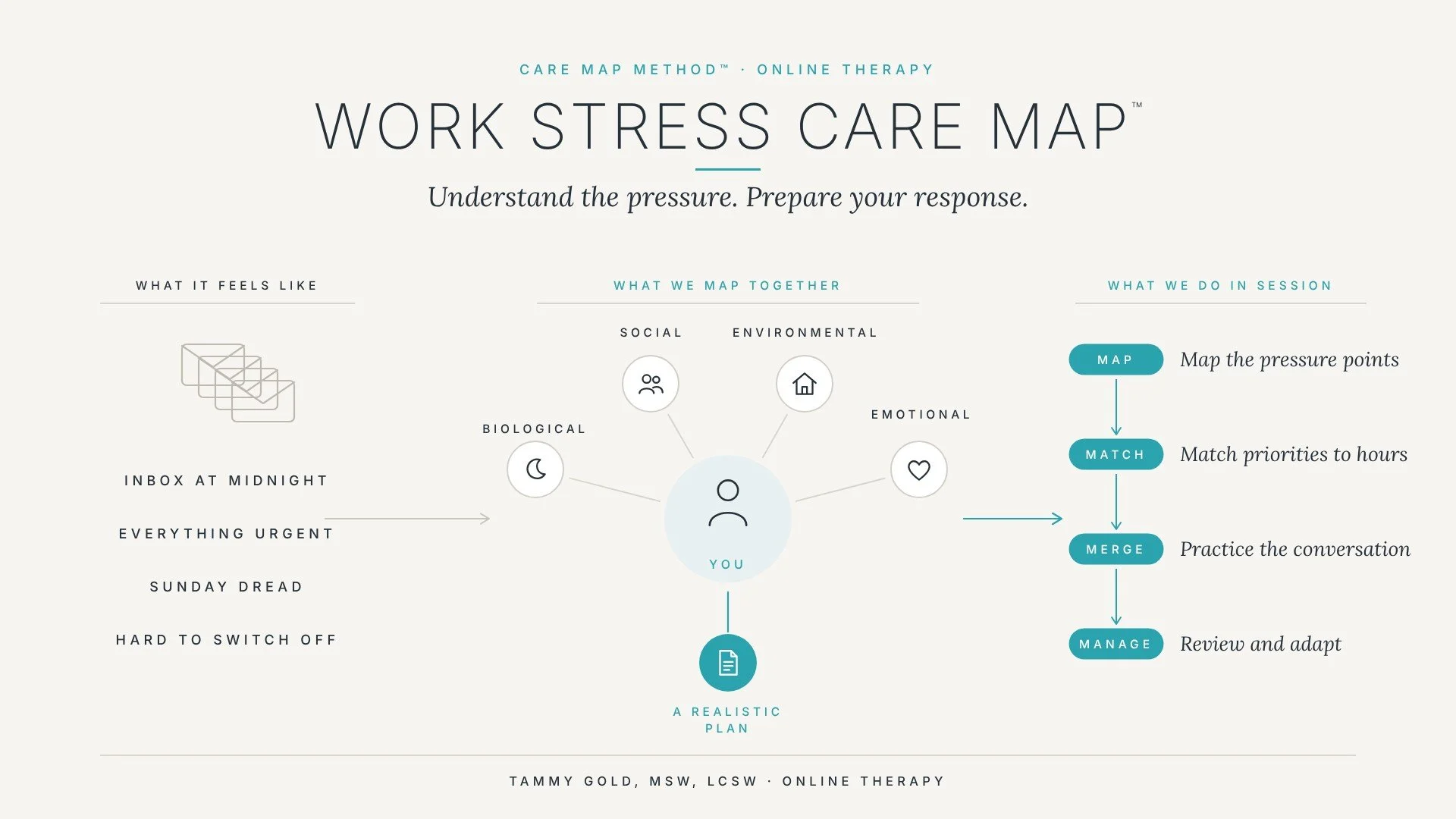
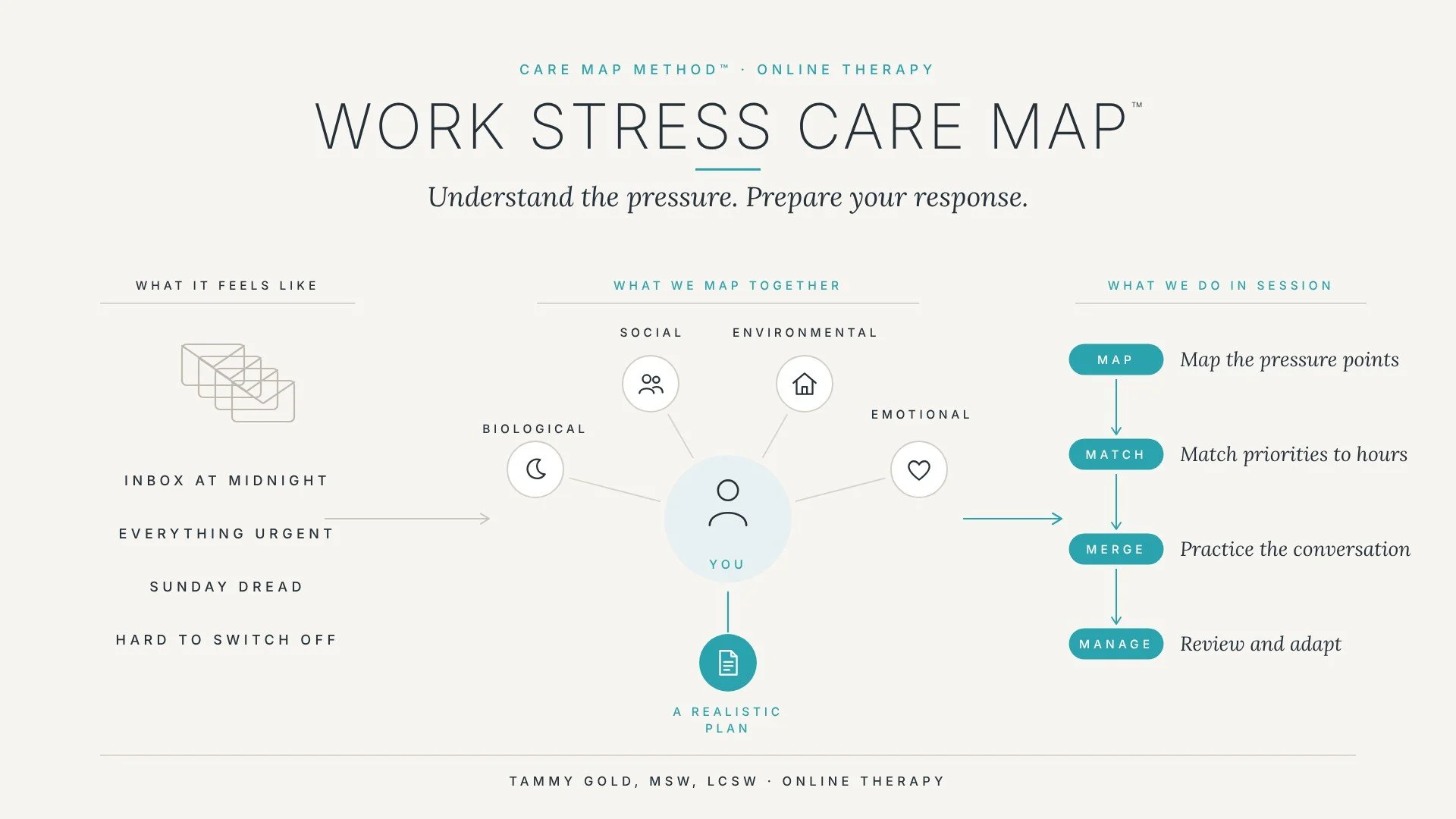
Using the Care Map Method™, we can
MAP the work situation,
MATCH strategies to the source of distress,
MERGE changes into actual workdays and
MANAGE the results over time.
This framework organizes individualized clinical care; it does not replace assessment or make it your responsibility to fix an unhealthy workplace.
A practical example involving feedback
Suppose your manager says a project needs revisions. Before you have read the details, you are convinced you will lose your job. You spend the evening rereading the message, delay starting the changes and arrive the next morning exhausted. The anxiety has become an additional problem alongside the work itself.
In therapy we might separate the actual request from the feared outcome, notice what your body does when you feel criticized and identify the information you need. A useful step might be asking which two revisions matter most. We would also address the emotional meaning of making a mistake, rather than relying only on productivity advice.
Creating boundaries that account for your role
Advice to stop checking messages is not useful if your job includes genuine on-call duties. Advice to confront your boss may not fit your position or financial security. We can consider the responsibilities you actually have, what flexibility exists and what changes are safest and most realistic for you.
A boundary may begin with clarifying expected response times, creating an end-of-day task note or agreeing on priorities when work exceeds capacity. It can also involve deciding what you will do when a request falls outside that agreement. We can practice language and follow-through while recognizing that you cannot control another person's response.
Making thoughtful decisions about staying or leaving
Sometimes therapy helps a person feel more comfortable in a job. Sometimes it helps them recognize that the role no longer fits. We can examine your values, symptoms, resources and options without forcing an immediate decision. If you need recruiting, vocational testing or legal guidance, those services require the appropriate professional.
The purpose of therapy is to address the emotional and behavioral effects of work stress and support clearer choices. We can review whether your anxiety is easing, whether you are recovering outside work and whether the changes you try are helping. Your goals can evolve as you learn more about the situation.
About Tamara Gold
I am Tamara “Tammy” Gold, MSW, LCSW, CEC, a Columbia University-trained therapist, certified coach and author of Secrets of the Nanny Whisperer. My work with individuals and families informs a warm, collaborative approach that connects emotional understanding with practical next steps. Treatment is individualized to your needs; results and timelines vary.
Online appointments and insurance
Online appointments depend on your physical location at each session, clinical fit and current availability. Review my booking profiles to confirm whether I can serve you in your state. Selected insurance plans may be available through Headway or Alma. Coverage, medical-necessity requirements and your costs depend on your individual plan; a life problem alone does not establish insurance coverage.
Frequently asked questions
Can therapy help with Sunday scaries?
Yes, we can explore the specific worries that build before the workweek and how they affect your behavior, sleep and relationships. The plan depends on whether the main issue is workload, conflict, uncertainty, anxiety or a combination of factors.
What if my workplace really is unhealthy?
Therapy can help you assess the impact, consider your options and protect your wellbeing. It does not require you to view unreasonable conditions as acceptable. Legal or employment-rights questions should be addressed with an appropriately qualified professional.
Can we work on fear of making mistakes?
Yes. We can examine the beliefs and experiences behind that fear, how you respond when something goes wrong and what helps you repair a mistake without prolonged self-criticism or avoidance.
Will you help me decide whether to quit?
We can explore the emotional and practical factors involved, including your financial situation and available alternatives. The decision remains yours. Therapy is not job placement or a guarantee of a particular employment outcome.
Is work anxiety always an anxiety disorder?
No. Distress at work can reflect many circumstances. Assessment considers the pattern, duration, severity and effect on functioning before determining whether a clinical diagnosis is appropriate.
Can I schedule around my workday?
Current appointment options are available through my booking profiles. Availability changes. Check the time zone displayed and confirm your physical location before a virtual session.
Take the next step
If this sounds like the kind of support you need, review current appointment options and check insurance eligibility through my Headway or Alma profile. You can bring questions about fit, fees and the process before scheduling. You do not need a perfect explanation of the problem to begin.

Caregiver Burnout: When Caring for Everyone Else Is Costing You Your Health
Caregiver burnout can affect your health, relationships, concentration, and ability to provide care. Learn the warning signs and how therapy can help you create a more sustainable plan.
Caregiving often begins with love, urgency, or a sense of responsibility. You may start by attending one medical appointment, arranging groceries, or checking in more often. Over time, the role can quietly expand until you are coordinating medications, managing family conflict, handling emergencies, and trying to keep your own household and work life functioning at the same time.
Many caregivers do not recognize burnout until they are already depleted. They may tell themselves that their loved one has it worse, that no one else can help, or that resting would be selfish. Yet caregiving is not sustainable when the caregiver's physical health, emotional stability, and relationships are deteriorating.
What caregiver burnout actually looks like
Caregiver burnout is more than feeling tired after a difficult week. It is a state of ongoing physical, emotional, and mental depletion related to prolonged caregiving demands and insufficient recovery, support, or control.
Burnout may develop gradually. Because the caregiver keeps adapting to each new demand, the level of strain can begin to feel normal. The most important question is not whether you are managing to complete the tasks. It is whether the current arrangement is costing you more than you can continue to give.
Common warning signs
You may be approaching or experiencing caregiver burnout when several of the following patterns persist:
Constant fatigue that does not improve with one good night of sleep
Irritability, resentment, anger, or emotional numbness
Difficulty concentrating, making decisions, or completing ordinary tasks
Withdrawing from friends, activities, or relationships
Feeling trapped, guilty, or convinced that no one else can do the job correctly
Changes in appetite, sleep, headaches, muscle tension, or other stress-related symptoms
Frequent conflict with siblings, a spouse, paid caregivers, or the person receiving care
Losing patience and then feeling ashamed about it
Neglecting your own medical appointments, finances, work, or household needs
Why responsible caregivers are especially vulnerable
The people most likely to become overextended are often the most conscientious. They notice what needs to be done, anticipate problems, and step in before others ask. Those strengths are valuable, but without limits they can produce a role in which one person becomes the default manager of everyone else's needs.
Family systems can reinforce this pattern. One sibling may live farther away. Another may minimize the parent's decline. A spouse may assume you have the situation handled. The aging parent may resist outside help. You can end up carrying both the practical labor and the emotional burden of convincing everyone that change is necessary.
How burnout affects relationships
Caregiving stress rarely stays confined to the caregiving relationship. It can enter a marriage through arguments about time, money, privacy, and competing responsibilities. It can affect parenting when patience is low. It can create resentment between siblings when contributions feel unequal.
Burnout can also distort your relationship with the person receiving care. Love may still be present, but it becomes mixed with frustration, grief, obligation, and anticipatory loss. Therapy can provide a place to speak honestly about those mixed feelings without being judged.
A Care Map Method™ perspective
The Care Map Method™ begins by mapping the whole situation rather than reacting to the loudest immediate problem. For caregivers, that means assessing not only the loved one's needs but also the caregiver's capacity.
A useful map includes four areas: biological needs such as sleep, health, medication, and physical stamina; emotional needs such as grief, fear, anger, and guilt; social needs such as family cooperation, friendship, and respite; and environmental needs such as the home, transportation, safety, finances, and access to professional care.
When one area is ignored, the entire care plan becomes less stable. A plan that keeps an older adult safe but causes the primary caregiver to become ill is not a successful long-term plan.
Practical steps that reduce strain
Burnout rarely resolves through positive thinking alone. It usually requires changing the structure around the caregiver.
Write down every recurring caregiving task, including invisible tasks such as reminders, research, and emotional reassurance.
Separate tasks that only you can do from tasks another relative, professional, or service could handle.
Create one shared place for schedules, medical information, contacts, and updates.
Set a specific boundary rather than making a vague request. For example: “I can attend one appointment each week, but I cannot remain the only transportation plan.”
Schedule recovery time before you feel you have earned it. Recovery is part of maintaining the care system.
Ask the medical team, social worker, agency, or community program what respite and caregiver resources are available.
How therapy can help
Therapy for caregiver burnout is not simply a place to vent. It can help you examine the beliefs and relationship patterns that keep you overfunctioning, practice clearer boundaries, manage guilt, communicate with family members, and make decisions under stress.
It can also help you process grief. Caregivers often grieve many losses before a death: a parent's independence, a spouse's personality, the future they expected, or the relationship they once had. Naming those losses can reduce the pressure to pretend that everything is fine.
The goal is not to make you care less. It is to help you care in a way that is emotionally and practically sustainable.
When it is time to seek support
Consider reaching out when stress is persistent, your health or relationships are being affected, you feel unable to set limits, or you are making major care decisions while emotionally depleted. You do not have to wait until you are in crisis to deserve support.
A healthier care plan includes the caregiver. Your needs are not separate from the system; they are one of the conditions that determine whether the system can continue.
Ready for support?
If caregiving has left you depleted, resentful, anxious, or unsure how to set limits, therapy can help you build a more sustainable plan. Tammy Gold, MSW, LCSW, CEC, provides confidential virtual therapy for adults located in California, New Jersey, and Oregon.
Book through Psychology Today: https://www.psychologytoday.com/us/therapists/tamara-jill-gold-los-angeles-ca/1713403
Learn more: CareMapMethod.com
About Tammy Gold
Tammy Gold, MSW, LCSW, CEC, is the founder of Care Map Method™, a licensed clinical social worker in California, New Jersey, and Oregon, a certified coach, and the author of Secrets of the Nanny Whisperer. Her work centers on relationships, caregiving, burnout, parenting transitions, workplace stress, women’s midlife concerns, and practical support during major life changes.
Educational notice: This article is for general educational purposes and is not a substitute for individualized medical or mental health care. If you are experiencing an emergency or immediate safety concern, contact emergency services or an appropriate crisis resource in your area.
What are common signs of caregiver burnout?
Signs may include exhaustion, irritability, resentment, guilt, sleep problems, reduced concentration, withdrawal, health changes, hopelessness, and feeling unable to keep up with care demands.
How can therapy help caregiver burnout?
Therapy can help caregivers process emotions, identify unsustainable demands, set boundaries, communicate with family, ask for help, and develop a more realistic care plan.
Is it normal to feel resentful while caregiving?
Yes. Resentment can develop when responsibilities are excessive, support is limited, boundaries are unclear, or the caregiver’s own needs are repeatedly postponed. Feeling resentment does not mean you do not love the person.
What if my siblings will not help?
Therapy or coaching can help you clarify what you need, prepare a family conversation, define responsibilities, set limits, and decide what you can realistically continue providing.
How do I know when more professional care is needed?
Consider changes in safety, cognition, mobility, medication, nutrition, hygiene, isolation, wandering, falls, caregiver capacity, and whether current arrangements are sustainable.
Can I care for someone without losing myself?
That is a central goal. Sustainable caregiving requires support, boundaries, realistic expectations, shared responsibility where possible, and attention to the caregiver’s health and identity.
What Care Map worksheet pairs with caregiver burnout?
A Caregiver Burnout Snapshot, Family Capacity Assessment, Weekly Care Plan, Boundary Planner, or Biological-Emotional-Social-Environmental Care Map can help organize the situation.
When is caregiver burnout an emergency?
Seek urgent professional help when there is immediate danger, inability to provide safe care, abuse or neglect concerns, severe medical or psychiatric symptoms, or thoughts of harming yourself or someone else.