

When your job occupies more than your working hours
Dreading Monday, replaying feedback or checking messages after hours? Therapy can help you understand work anxiety and develop a response that fits your job and circumstances.
You may notice anxiety before you even open your laptop. A meeting invitation can make your stomach tighten. A brief message from your manager can become something you analyze all day. By Sunday afternoon, you may already be preparing emotionally for Monday, even when nothing specific has happened.
Therapy for work anxiety can help you understand what your mind is anticipating and how the worry is affecting your life. The concern may involve workload, performance fears, conflict, uncertainty or an environment that really is difficult. We can take those possibilities seriously without assuming either that your job is fine or that quitting is the only answer.
Distinguishing the job problem from the anxiety pattern
A new role, unclear expectations or inconsistent feedback can leave almost anyone unsettled. Anxiety can also make neutral situations feel threatening. You may interpret a correction as evidence that you are failing, compare yourself constantly with coworkers or put off a task because you feel you must do it perfectly.
We can examine what happened, what you inferred and what information is still missing. That does not mean explaining away poor treatment. It means making room for both the external conditions and your internal response. The more clearly we understand the problem, the more specific our next steps can be.
What we can work on in sessions
Our work might include preparing for a feedback conversation, responding to a mistake without spiraling, setting realistic availability or recognizing the point at which planning turns into repeated worry. We may explore how earlier experiences with criticism influence what happens with a supervisor now. We can also look at whether sleep, health, financial insecurity or responsibilities outside work are narrowing your capacity.
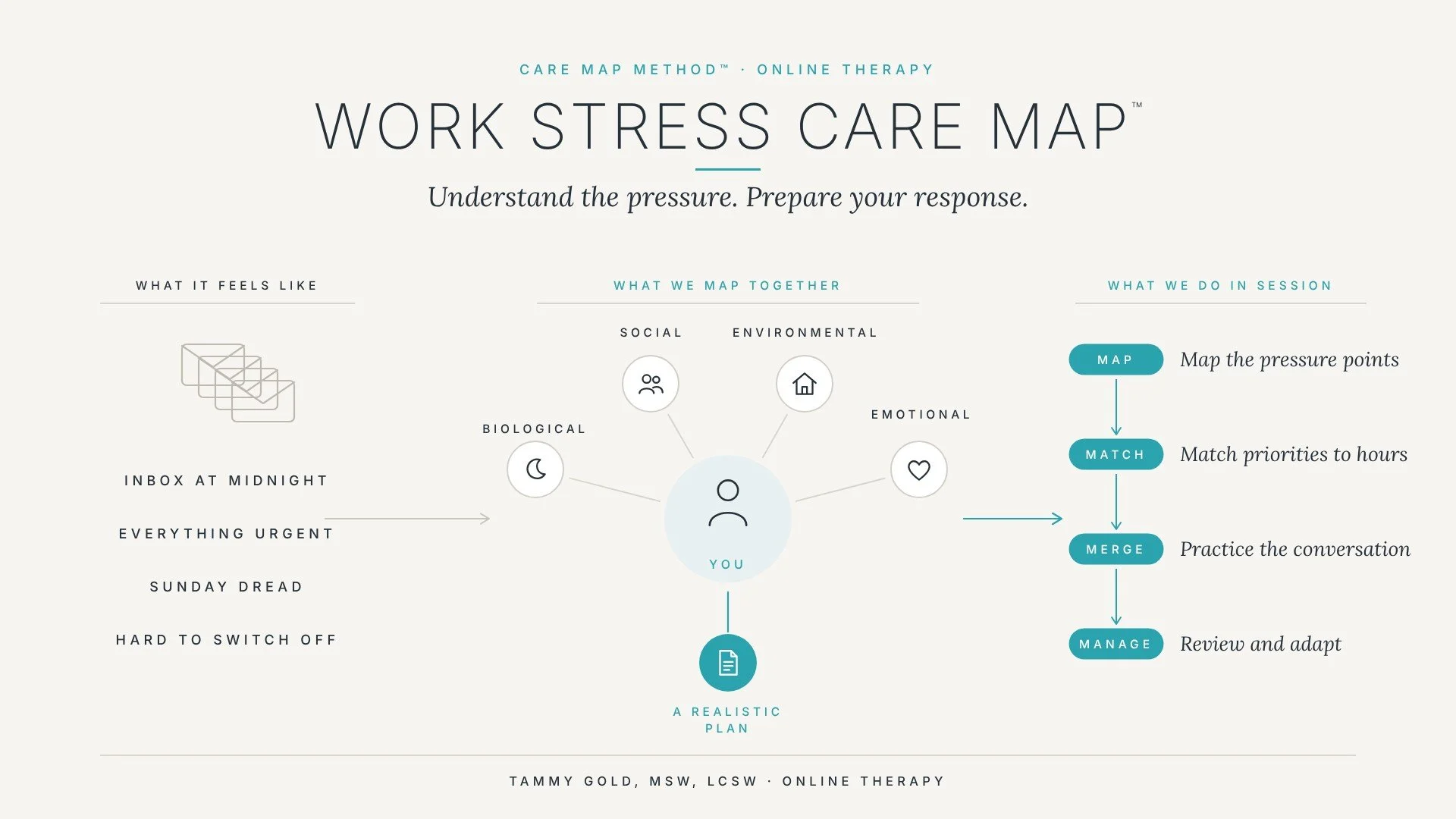
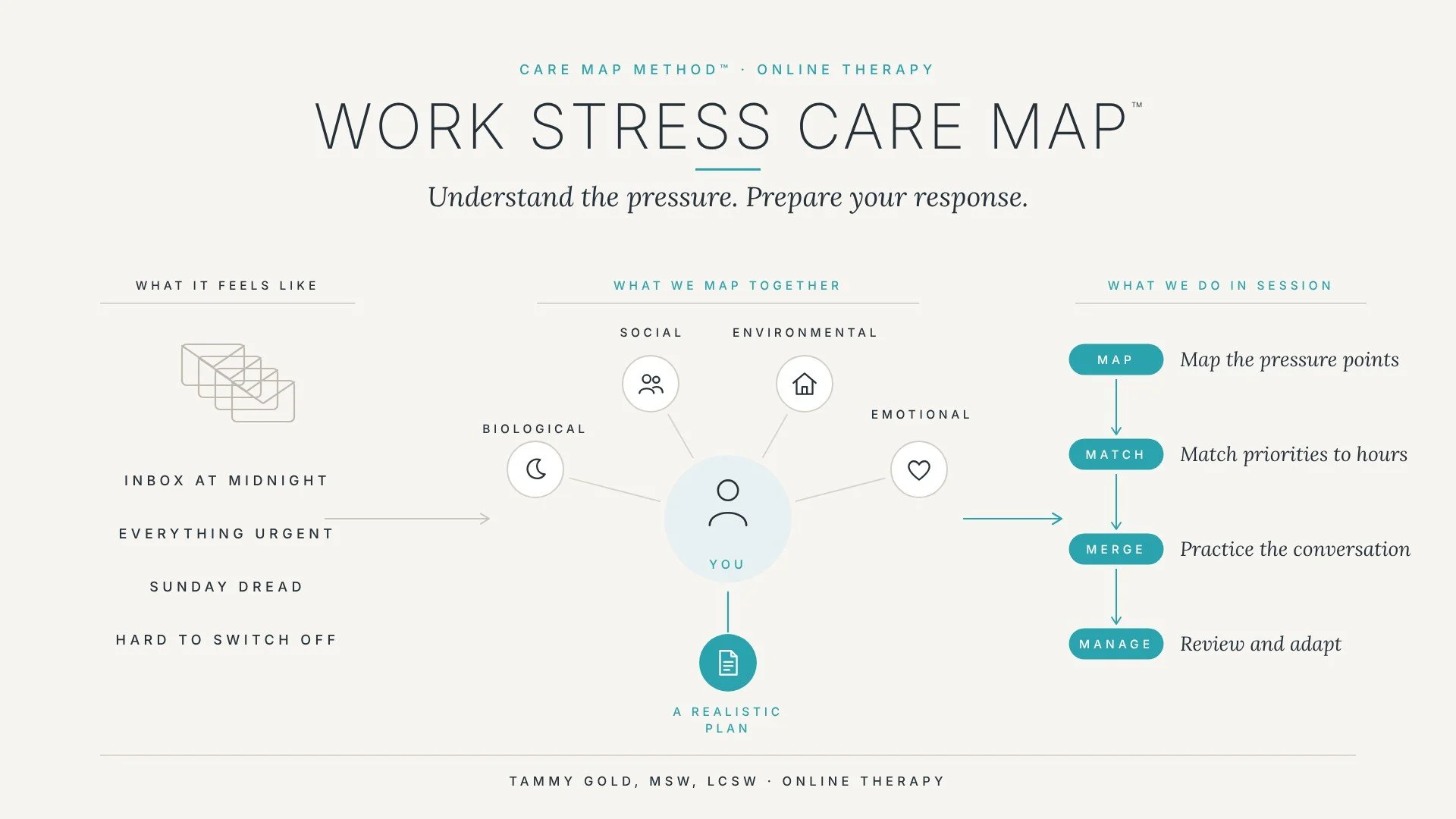
Using the Care Map Method™, we can
MAP the work situation,
MATCH strategies to the source of distress,
MERGE changes into actual workdays and
MANAGE the results over time.
This framework organizes individualized clinical care; it does not replace assessment or make it your responsibility to fix an unhealthy workplace.
A practical example involving feedback
Suppose your manager says a project needs revisions. Before you have read the details, you are convinced you will lose your job. You spend the evening rereading the message, delay starting the changes and arrive the next morning exhausted. The anxiety has become an additional problem alongside the work itself.
In therapy we might separate the actual request from the feared outcome, notice what your body does when you feel criticized and identify the information you need. A useful step might be asking which two revisions matter most. We would also address the emotional meaning of making a mistake, rather than relying only on productivity advice.
Creating boundaries that account for your role
Advice to stop checking messages is not useful if your job includes genuine on-call duties. Advice to confront your boss may not fit your position or financial security. We can consider the responsibilities you actually have, what flexibility exists and what changes are safest and most realistic for you.
A boundary may begin with clarifying expected response times, creating an end-of-day task note or agreeing on priorities when work exceeds capacity. It can also involve deciding what you will do when a request falls outside that agreement. We can practice language and follow-through while recognizing that you cannot control another person's response.
Making thoughtful decisions about staying or leaving
Sometimes therapy helps a person feel more comfortable in a job. Sometimes it helps them recognize that the role no longer fits. We can examine your values, symptoms, resources and options without forcing an immediate decision. If you need recruiting, vocational testing or legal guidance, those services require the appropriate professional.
The purpose of therapy is to address the emotional and behavioral effects of work stress and support clearer choices. We can review whether your anxiety is easing, whether you are recovering outside work and whether the changes you try are helping. Your goals can evolve as you learn more about the situation.
About Tamara Gold
I am Tamara “Tammy” Gold, MSW, LCSW, CEC, a Columbia University-trained therapist, certified coach and author of Secrets of the Nanny Whisperer. My work with individuals and families informs a warm, collaborative approach that connects emotional understanding with practical next steps. Treatment is individualized to your needs; results and timelines vary.
Online appointments and insurance
Online appointments depend on your physical location at each session, clinical fit and current availability. Review my booking profiles to confirm whether I can serve you in your state. Selected insurance plans may be available through Headway or Alma. Coverage, medical-necessity requirements and your costs depend on your individual plan; a life problem alone does not establish insurance coverage.
Frequently asked questions
Can therapy help with Sunday scaries?
Yes, we can explore the specific worries that build before the workweek and how they affect your behavior, sleep and relationships. The plan depends on whether the main issue is workload, conflict, uncertainty, anxiety or a combination of factors.
What if my workplace really is unhealthy?
Therapy can help you assess the impact, consider your options and protect your wellbeing. It does not require you to view unreasonable conditions as acceptable. Legal or employment-rights questions should be addressed with an appropriately qualified professional.
Can we work on fear of making mistakes?
Yes. We can examine the beliefs and experiences behind that fear, how you respond when something goes wrong and what helps you repair a mistake without prolonged self-criticism or avoidance.
Will you help me decide whether to quit?
We can explore the emotional and practical factors involved, including your financial situation and available alternatives. The decision remains yours. Therapy is not job placement or a guarantee of a particular employment outcome.
Is work anxiety always an anxiety disorder?
No. Distress at work can reflect many circumstances. Assessment considers the pattern, duration, severity and effect on functioning before determining whether a clinical diagnosis is appropriate.
Can I schedule around my workday?
Current appointment options are available through my booking profiles. Availability changes. Check the time zone displayed and confirm your physical location before a virtual session.
Take the next step
If this sounds like the kind of support you need, review current appointment options and check insurance eligibility through my Headway or Alma profile. You can bring questions about fit, fees and the process before scheduling. You do not need a perfect explanation of the problem to begin.