

Toddler Parenting Support: Create a Personalized Care Map for Your Growing Child
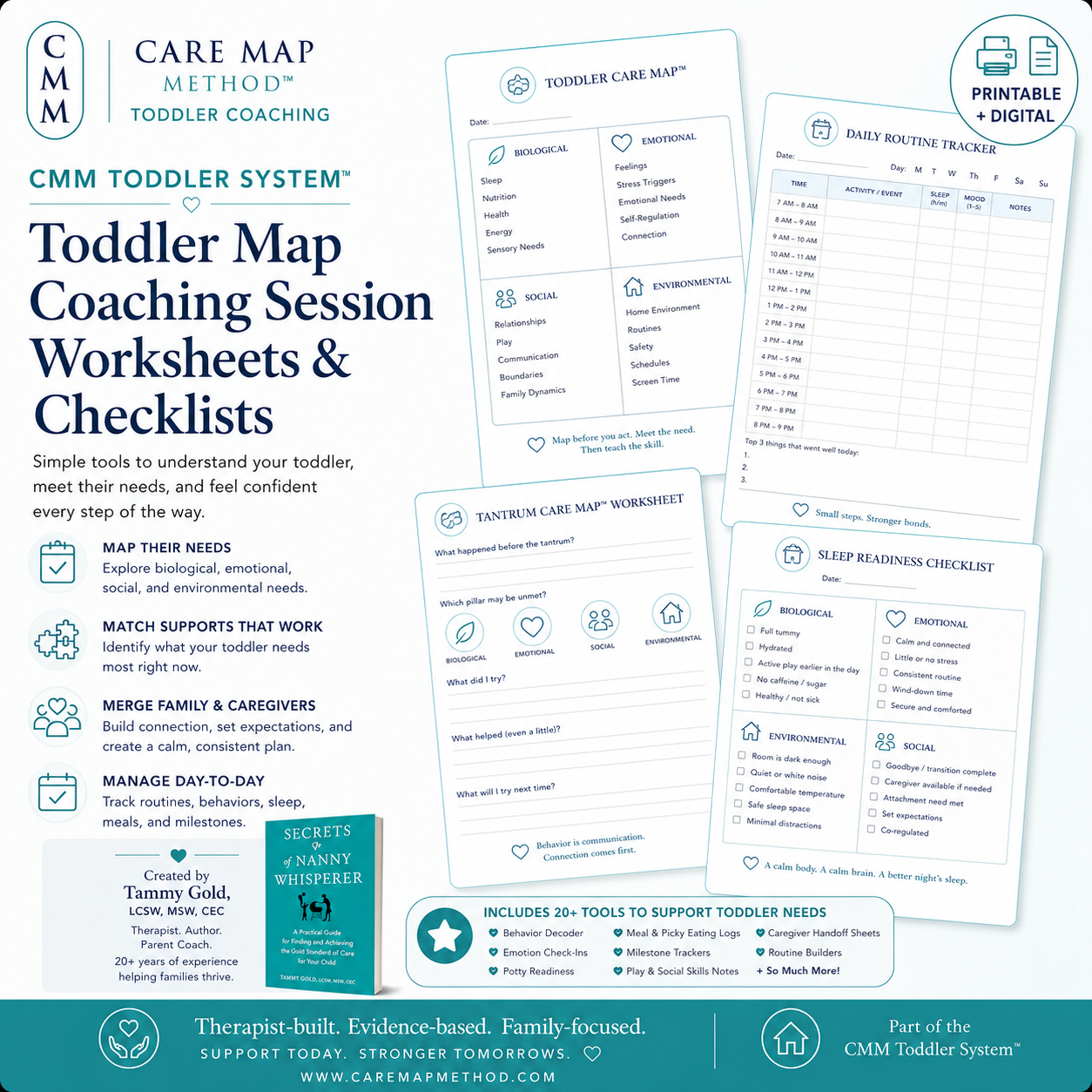
Toddler behavior is communication. The Care Map Method™ Toddler Coaching Session helps parents understand their child’s biological, emotional, social, and environmental needs and create practical strategies for tantrums, sleep, eating, routines, development, childcare, and family life.
The toddler years can be delightful, exhausting, funny, and confusing—sometimes within the same five minutes.
Your toddler may want to do everything independently while still needing help with almost everything. They may understand far more than they can communicate. They can move quickly from excitement to frustration, resist ordinary routines, and have powerful reactions to seemingly small changes.
Parents are often left wondering:
Is this typical toddler behavior?
Why are the tantrums getting worse?
Should my child be talking more?
Why is bedtime suddenly so difficult?
How do I set limits without constantly battling?
Is my child ready for preschool or daycare?
How can all caregivers respond consistently?
Generic parenting advice rarely accounts for the whole child. A strategy that works for one toddler may overwhelm another because children differ in temperament, language, sensory processing, developmental pace, routines, and family circumstances.
The Care Map Method™ Toddler Care Map Coaching Session helps parents understand what is happening beneath the behavior and create a practical plan for their individual child and family.
What is toddler parent coaching?
Toddler parent coaching is a structured, personalized service that helps parents understand their child’s development, behavior, routines, and care needs.
During a Care Map Method™ Toddler Coaching Session, we may address:
Tantrums and emotional regulation
Biting, hitting, throwing, or yelling
Sleep and bedtime struggles
Picky eating and mealtime stress
Toilet-learning readiness
Language and communication
Separation anxiety
Transitions and resistance
Boundaries and discipline
Toddler safety and childproofing
Nanny, babysitter, daycare, or preschool concerns
Parent and caregiver consistency
Sibling adjustment
Parent exhaustion and family stress
The goal is not to eliminate every difficult behavior. Toddlers are still learning how to communicate, wait, transition, tolerate frustration, and manage strong feelings.
The goal is to understand what the behavior may be communicating and teach the child the skills they are developmentally ready to learn.
Toddler behavior is communication
Toddlers do not usually have the language, impulse control, or emotional regulation skills to explain exactly what they need.
A toddler who screams at bedtime may be overtired, frightened by separation, overstimulated, resisting a transition, or reacting to an inconsistent routine.
A child who hits another child may be overwhelmed, frustrated, seeking space, imitating behavior, or unable to say, “I was using that.”
A child who refuses to get dressed may want control, dislike how the clothing feels, struggle with transitions, or simply need more time.
Understanding the reason behind a behavior does not mean allowing unsafe or inappropriate behavior. It helps parents choose a response that addresses both the behavior and the unmet need or developing skill underneath it.
Start with the B/E/S/E Toddler Care Map
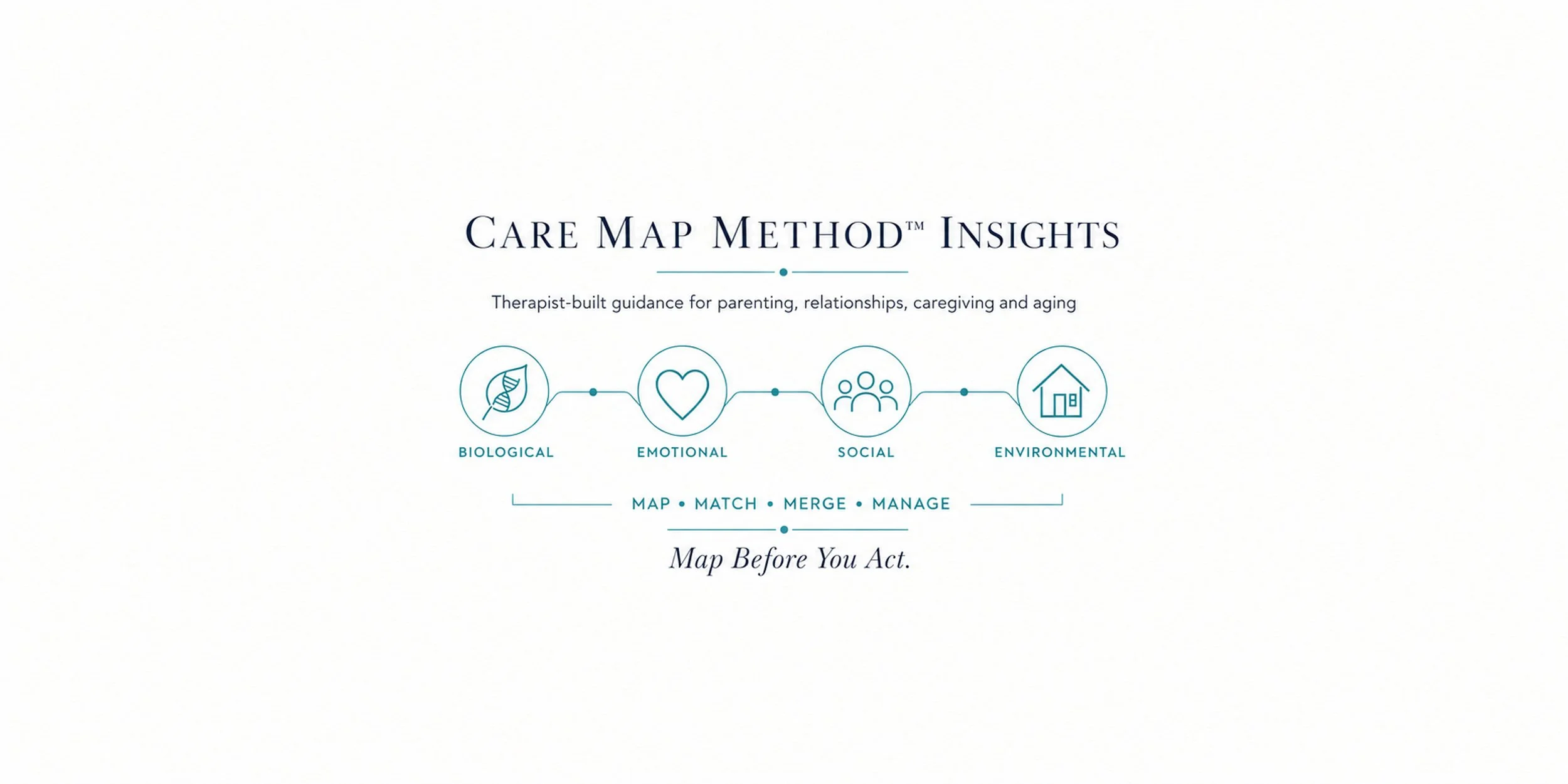
The Care Map Method™ looks at four connected areas of a toddler’s life: Biological, Emotional, Social, and Environmental needs.
Biological needs
A toddler’s physical state has a major influence on behavior.
Biological needs may include:
Sleep and nap patterns
Hunger and eating
Growth and nutrition
Physical activity
Illness, pain, or discomfort
Digestion and toileting
Speech, motor, and developmental progress
Sensory preferences and sensitivities
Medical and dental care
Before labeling a child as “difficult” or “defiant,” it is helpful to consider whether the child is tired, hungry, uncomfortable, overstimulated, or being asked to do something beyond their current developmental ability.
Persistent concerns about feeding, sleep, hearing, speech, movement, growth, toileting, or development should be discussed with the child’s pediatric healthcare provider.
Emotional needs
Toddlers experience strong feelings before they have the skills to manage them.
Emotional care may include:
Helping the child identify feelings
Offering comfort without removing every limit
Creating predictable responses
Supporting secure attachment
Preparing for separations and transitions
Teaching simple calming strategies
Understanding the child’s temperament
Providing choices within appropriate boundaries
Toddlers borrow regulation from the adults around them. This is called co-regulation. A calm, clear adult response helps the child gradually learn how to manage frustration, disappointment, and change.
Social needs
Toddlers are beginning to learn how relationships work.
They may be practicing how to:
Share space and toys
Take turns
Ask for help
Join play
Use words instead of hitting
Separate from a parent
Adapt to different caregivers
Interact with siblings
Follow simple group routines
Recover after conflict
Young toddlers often engage in parallel play—playing near other children rather than cooperatively with them. Social skills develop gradually and require patient teaching, modeling, and repetition.
Environmental needs
The environment can either support toddler success or create unnecessary conflict.
Environmental factors include:
Home safety and childproofing
Toy and activity organization
Noise, lighting, and stimulation
Daily routines
Visual schedules
Transition warnings
Child-accessible choices
Sleep spaces
Mealtime arrangements
Consistency between home and childcare
Sometimes changing the environment is more effective than repeatedly correcting the child.
For example, placing a visual routine near the front door may help with leaving the house. Offering two weather-appropriate outfits may reduce dressing battles. Creating a calm-down space may provide a safe place to recover from overwhelming feelings.
Use MAP, MATCH, MERGE, and MANAGE for toddler care
Once we understand the child’s full care picture, the Care Map Method™ provides a clear path forward.
MAP the Need
We identify the toddler’s biological, emotional, social, and environmental needs while also considering family stress, schedules, caregiver arrangements, and parent concerns.
The care map helps parents look for patterns:
Do tantrums happen before meals?
Is behavior harder after missed naps?
Does the child struggle during rushed transitions?
Is the same behavior happening at home and daycare?
Are different caregivers using different limits?
Does the child have the words needed to express the problem?
A behavior tracker can help parents identify what happens before, during, and after a difficult moment.
MATCH the Care
Next, we determine what kind of support fits each need.
Support may include:
A pediatrician
A speech-language pathologist
An occupational therapist
A developmental specialist
A feeding professional
A licensed mental health professional
A parent coach
A nanny or babysitter
A daycare or preschool program
Early-intervention services
Trusted family support
Not every toddler challenge requires a specialist. Coaching can help parents determine what can be addressed through changes in routines and responses—and what should be evaluated further.
MERGE the Support
Toddlers benefit when the important adults in their lives communicate clearly.
A shared toddler care plan may include:
Daily routines
Sleep and nap expectations
Food preferences and restrictions
Toilet-learning language
Approved discipline and redirection strategies
Comfort and calming methods
Safety expectations
Screen-time boundaries
Medication or health information
Communication between parents and caregivers
Responses to hitting, biting, tantrums, or separation distress
Parents, grandparents, nannies, babysitters, and daycare teachers do not need to respond identically in every situation. However, they should understand the child’s essential needs and the family’s central expectations.
MANAGE the Plan
Toddlers develop quickly. Their language, mobility, interests, sleep, emotions, and social needs can change within months.
Families should regularly ask:
What is improving?
What continues to be difficult?
Has the child developed new skills?
Are our expectations age-appropriate?
Are all caregivers communicating?
Is the environment still safe and supportive?
Do we need additional professional guidance?
Is this care arrangement still the right fit?
A Toddler Care Map is not a permanent set of rules. It is a flexible plan that grows with the child.
Understanding toddler tantrums
Tantrums are a common part of early development. They often occur when a toddler is tired, hungry, overstimulated, frustrated, or unable to communicate a need.
During a tantrum, the child’s thinking and language abilities may be temporarily less available. Long explanations and repeated questions are unlikely to help in the peak of the moment.
A helpful response may include:
Make sure the child and others are safe.
Lower your voice and reduce stimulation.
Use a short statement: “You are upset. I’m here.”
Hold the boundary: “I won’t let you hit.”
Allow time for the child’s body to settle.
Reconnect and teach after the child is calmer.
Parents do not need to fix every feeling. A child can be disappointed and still be safe, supported, and loved.
Discipline should teach—not frighten
Effective toddler discipline focuses on safety, connection, repetition, and skill-building.
Helpful strategies may include:
Clear and brief limits
Consistent follow-through
Redirection
Age-appropriate choices
Predictable routines
Transition warnings
Positive attention for helpful behavior
Modeling the desired behavior
Teaching simple replacement phrases
Repairing the relationship after difficult moments
Instead of only saying, “Stop hitting,” a parent might say:
“I won’t let you hit. Say, ‘My turn,’ or ask me for help.”
The limit remains firm, but the child also learns what to do next time.
Preparing for daycare, preschool, or a new caregiver
Starting daycare, preschool, or care with a nanny can be a major transition for a toddler.
A thoughtful transition plan may include:
Short introductory visits
A simple goodbye ritual
A familiar comfort object when permitted
Consistent pickup and drop-off language
A written description of routines and calming strategies
Gradually increasing care hours when possible
Clear communication between parents and caregivers
Patience with temporary changes in sleep or behavior
A child’s distress during separation does not automatically mean the placement is wrong. What matters is how the child is comforted, how the caregiver responds, and whether the child gradually begins to feel secure.
When might toddler coaching help?
A Care Map Method™ Toddler Coaching Session may be helpful if:
Tantrums are affecting daily family life
You are dealing with hitting, biting, or throwing
Bedtime or naps have become difficult
Meals feel like a constant battle
You are unsure how to set effective boundaries
You and your partner disagree about discipline
Your child is having difficulty separating
You are preparing for daycare or preschool
You are hiring or onboarding a nanny
Different caregivers use conflicting approaches
Your toddler is adjusting to a new sibling, home, or family routine
You want to understand whether a concern may require additional evaluation
You do not have to wait until family life feels unmanageable. Parent coaching can help you create a plan before ordinary toddler challenges become ongoing patterns of stress.
What happens during a CMM Toddler Care Map Coaching Session?
The session is personalized to the child, the family, and the current concerns.
Together, we can:
Complete a B/E/S/E Toddler Care Map
Identify possible triggers behind difficult behavior
Review sleep, eating, play, toileting, and daily routines
Explore temperament and sensory needs
Create age-appropriate behavior strategies
Develop scripts for tantrums, transitions, and limit-setting
Clarify responsibilities between parents and caregivers
Prepare for a nanny, daycare, preschool, or other transition
Identify areas that may need professional evaluation
Create a practical family action plan
Parents leave with clear priorities, personalized scripts, and concrete next steps they can begin using at home.
Frequently asked questions about toddler coaching
Is toddler coaching only for serious behavior problems?
No. Many parents use coaching for common developmental challenges such as tantrums, sleep, picky eating, separation anxiety, transitions, and limit-setting.
Can toddler coaching help with tantrums?
Yes. Coaching can help parents identify possible triggers, create a consistent response, teach replacement skills, and adjust routines or environments that may be contributing to the tantrums.
Can you help us prepare our toddler for preschool?
Yes. A Toddler Care Map can help parents evaluate readiness, prepare for separation, communicate with teachers, and create consistent routines between home and school.
Can both parents or caregivers participate?
Yes. Including both parents or other central caregivers can help create clearer expectations and more consistent responses.
Does toddler coaching replace medical or developmental evaluation?
No. Coaching provides education, planning, and parenting support. Medical, speech, feeding, hearing, sensory, or developmental concerns should be evaluated by an appropriately qualified professional.
Your toddler does not need a perfect parent
Toddlers need adults who are curious, responsive, consistent, and willing to adjust as the child grows.
You do not have to stop every tantrum or have the perfect routine. You need a clearer understanding of your child and a practical plan that your family can actually follow.
Map before you act.
Care Map Method™ Toddler Care Map Coaching Session
The Care Map Method™ Toddler Care Map Coaching Session helps parents understand what may be driving their toddler’s behavior and develop an individualized plan for home, childcare, and family life.
Your session may include:
A personalized B/E/S/E Toddler Care Map
Tantrum and behavior-trigger assessment
Sleep, mealtime, toileting, and routine review
Toddler communication and regulation strategies
Parent scripts for limits and transitions
Daycare, preschool, or nanny preparation
Parent and caregiver communication tools
A personalized action plan and next steps
Built by a therapist. Backed by science. Designed for real family life.
Schedule a Care Map Method™ Toddler Coaching Session
Care Map Method™ coaching provides education, care planning, and parenting support. It does not replace pediatric, medical, developmental, feeding, speech, occupational-therapy, or mental-health evaluation and treatment.


Preschool Parenting Support: Create a Personalized Care Map for Your Child
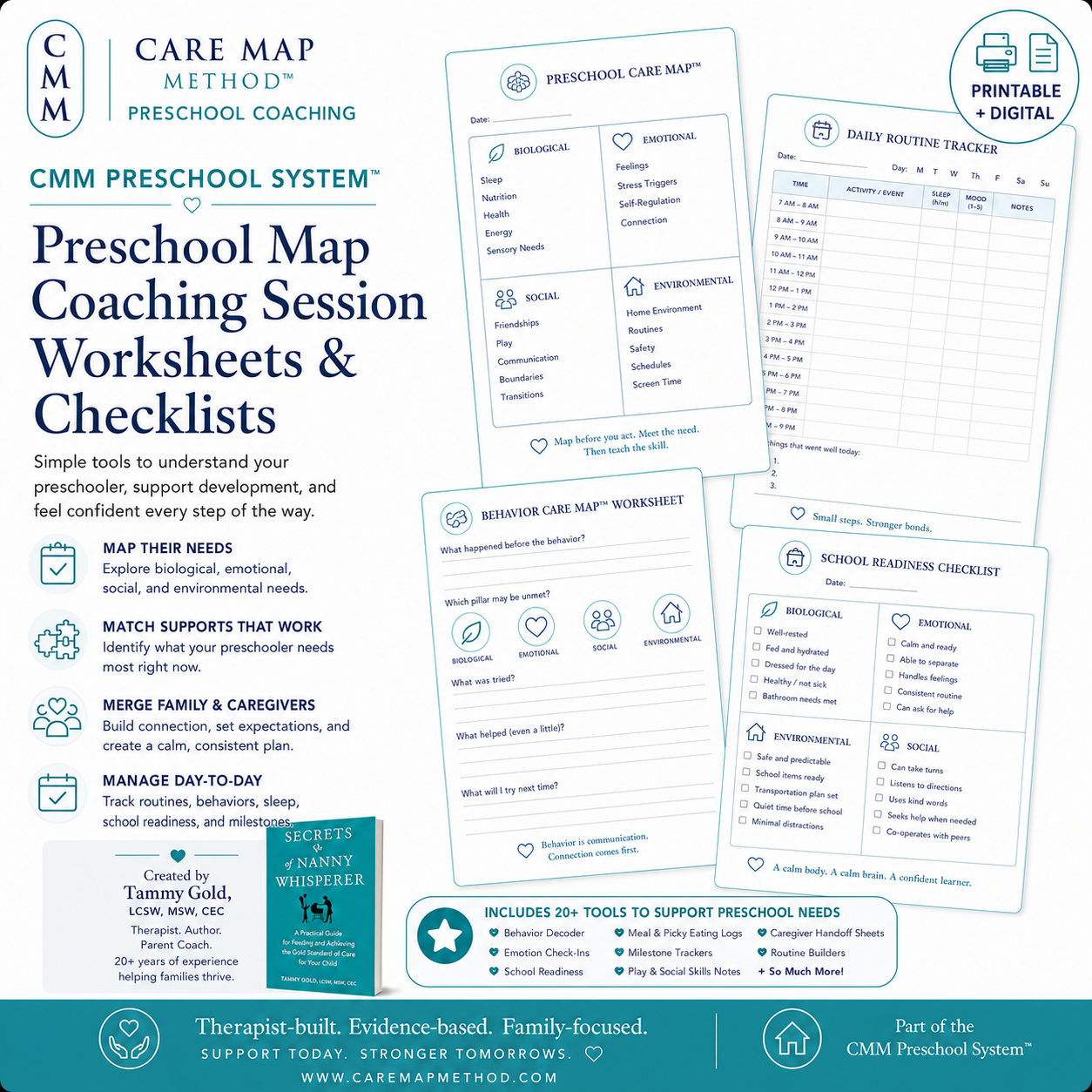
Preschoolers are developing independence, emotional regulation, communication, friendships, and school-readiness skills. The Care Map Method™ Preschool Coaching Session helps parents understand their child’s biological, emotional, social, and environmental needs and create a practical plan for behavior, routines, development, preschool, and family life.
The preschool years bring enormous growth.
Between approximately ages three and five, children develop more language, imagination, independence, physical ability, and interest in friendships. They may appear remarkably grown-up one moment and become completely overwhelmed the next.
A preschooler might tell an elaborate story but struggle to explain why they hit a friend. They may insist on doing everything independently but become upset when a task feels difficult. They may follow routines at school while resisting those same routines at home.
Parents often wonder:
Is this behavior developmentally typical?
Is my child ready for preschool or kindergarten?
How should I respond to meltdowns, defiance, or aggression?
Why does my child behave well at school but fall apart at home?
Should I be concerned about language, sensory needs, or social skills?
How can teachers, parents, and caregivers respond consistently?
The Care Map Method™ Preschool Care Map Coaching Session helps parents look beyond a single behavior and understand the whole child.
Instead of asking only, “How do I stop this behavior?” we explore a more helpful question:
What is this behavior communicating, and what skill or support does this child need?
What is preschool parent coaching?
Preschool parent coaching is a personalized service that helps parents understand their child’s behavior, development, routines, relationships, and learning environment.
A Care Map Method™ Preschool Coaching Session may address:
Meltdowns and emotional regulation
Defiance and power struggles
Hitting, yelling, grabbing, or impulsive behavior
Separation anxiety
Preschool adjustment
Kindergarten readiness
Friendship and social difficulties
Sleep and bedtime
Picky eating and mealtime stress
Toilet-learning challenges or regression
Language and communication
Sensory sensitivities
Sibling conflict
Parent and caregiver consistency
Choosing a preschool, nanny, or after-school caregiver
Coaching does not begin with the assumption that the child is misbehaving intentionally. We look at developmental ability, temperament, stress, routines, relationships, and environmental demands before creating a plan.
Preschool behavior is often a clue
A preschooler’s behavior can tell us something important—even when the behavior itself needs to be stopped.
A child who refuses to get dressed may be seeking control, struggling with a transition, disliking the clothing’s texture, or feeling anxious about school.
A child who pushes classmates may lack the language or impulse control to protect their space appropriately.
A child who behaves well at preschool but melts down after returning home may have spent the day working hard to follow directions, manage sensory stimulation, and navigate social demands.
Understanding what is beneath a behavior does not mean removing boundaries. It allows parents to respond with both firmness and insight.
The child still needs a clear limit—but may also need rest, practice, visual support, simpler directions, sensory accommodation, or help learning a replacement skill.
Start with the B/E/S/E Preschool Care Map
The Care Map Method™ examines four connected areas of a child’s life: Biological, Emotional, Social, and Environmental needs.
Biological needs
A preschooler’s physical condition can strongly influence behavior, attention, learning, and emotional regulation.
Biological needs may include:
Sleep and rest
Hunger and nutrition
Physical activity
Toileting
Hearing and vision
Speech and language development
Fine- and gross-motor development
Sensory needs
Illness, pain, or discomfort
Medical and dental care
A child who appears oppositional may be tired, hungry, uncomfortable, overstimulated, or unable to complete the task being requested.
Persistent concerns involving sleep, feeding, hearing, speech, movement, toileting, growth, or development should be discussed with the child’s pediatric healthcare provider or an appropriately qualified specialist.
Emotional needs
Preschoolers have strong feelings but are still developing the ability to understand and manage them.
Emotional support may include:
Naming feelings
Recognizing early signs of overwhelm
Practicing calming strategies
Creating predictable routines
Preparing for transitions
Offering appropriate choices
Setting calm and consistent limits
Supporting confidence and independence
Reconnecting after difficult moments
Understanding the child’s temperament
Children gradually learn regulation through repeated experiences of co-regulation with trusted adults. The goal is not to prevent every difficult feeling. It is to help the child experience feelings safely and build skills for handling them.
Social needs
Preschoolers are learning how to participate in relationships outside the family.
Developing social skills may include:
Joining play
Sharing space and materials
Waiting and taking turns
Expressing preferences
Respecting personal space
Asking for help
Handling disappointment
Repairing after conflict
Understanding simple group expectations
Developing friendships
A child may be social and confident in one setting but quiet or overwhelmed in another. Social development should be considered in the context of temperament, language, sensory needs, familiarity, and the demands of the environment.
Environmental needs
The environment can either support a preschooler’s developing abilities or repeatedly ask for more than the child can manage.
Environmental factors include:
Household routines
Preschool classroom size and structure
Noise, lighting, and activity level
Transition warnings
Visual schedules
Child-accessible organization
Opportunities for movement
Quiet recovery spaces
Screen use
Family schedules
Consistency between home, school, and caregivers
Sometimes the most effective intervention is an environmental adjustment.
A visual morning routine may reduce repeated reminders. A quiet decompression period after preschool may prevent an afternoon meltdown. Fewer toys available at once may improve play and reduce overwhelm.
Use MAP, MATCH, MERGE, and MANAGE for preschool care
The Care Map Method™ turns information about the child into an organized, practical plan.
MAP the Need
We assess the child’s biological, emotional, social, and environmental needs while considering family routines, school expectations, caregiver arrangements, and parent concerns.
We may look for patterns such as:
When and where does the behavior occur?
What happens immediately before it?
Is the child tired, hungry, rushed, or overstimulated?
Does the behavior happen at home, school, or both?
Are expectations appropriate for the child’s age and current skills?
Are different adults responding in different ways?
What helps the child recover?
This prevents families from treating every behavior as a separate problem when several behaviors may share the same underlying trigger.
MATCH the Care
Next, we identify the right type of support for each need.
Support might include:
A pediatrician
A preschool teacher
A speech-language pathologist
An occupational therapist
A developmental specialist
A feeding professional
A child mental health professional
An educational consultant
A parent coach
A nanny or babysitter
Early-childhood or school-district services
Not every challenge requires professional treatment. Coaching helps families determine what may improve with new strategies or routines and what warrants additional evaluation.
MERGE the Support
Parents, teachers, nannies, grandparents, and other caregivers should understand the child’s essential needs and the family’s central expectations.
A shared Preschool Care Map may include:
Daily routines
Sleep and mealtime information
Toileting language and expectations
Transition strategies
Calming and regulation tools
Responses to aggression or unsafe behavior
Social-development goals
Sensory preferences
Medical and safety information
Communication between home and school
Approved discipline and redirection approaches
Every adult will have an individual style. The goal is not rigid uniformity. It is enough consistency to help the child feel safe and understand what to expect.
MANAGE the Plan
Preschoolers change quickly. As their language, confidence, friendships, routines, and school expectations develop, their care plans should develop too.
Families can regularly review:
What is working?
What remains difficult?
Has the child gained new skills?
Are expectations still developmentally appropriate?
Are home and school communicating effectively?
Does the environment support the child?
Is the current school or care arrangement still a good fit?
Is additional professional guidance needed?
A Preschool Care Map is a living plan, not a permanent label.
Why preschoolers sometimes fall apart at home
Some children hold themselves together throughout the preschool day and release their accumulated emotions when they return to the safety of home.
This can look like:
Crying over a small request
Refusing ordinary routines
Fighting with siblings
Becoming unusually controlling
Increased clinginess
Hyperactive or silly behavior
Difficulty deciding what they want
A sudden meltdown
This does not necessarily mean the child is manipulative or that something is wrong at school. The child may simply be tired from managing transitions, noise, instructions, peer interactions, and separation.
A gentle after-school routine may include:
A warm greeting without many questions
Food and water
Physical connection or quiet companionship
Free movement or outdoor play
Reduced demands
A predictable transition into the evening
Parents can remain consistent with limits while acknowledging that the child’s capacity may be lower after a demanding day.
Teaching emotional regulation before the meltdown
Preschoolers cannot learn complex coping skills while they are completely overwhelmed. Regulation strategies should be practiced during calm moments.
Helpful skills may include:
Naming feelings
Taking slow breaths
Asking for help
Using a quiet space
Pushing against a wall
Squeezing a pillow
Getting a drink of water
Choosing between two solutions
Using a phrase such as “I need a break”
Practicing what to do when another child says no
During a meltdown, parents can use short, steady language:
“You’re upset. I’m here.”
“I won’t let you hit.”
“It’s okay to be angry. It’s not okay to hurt.”
“We can talk when your body is calmer.”
“You wanted more time. It is still time to leave.”
The adult’s job is to keep everyone safe, maintain the limit, and help the child return to regulation.
Is my child ready for preschool or kindergarten?
School readiness involves more than recognizing letters, numbers, shapes, and colors.
A child’s readiness may also include the ability to:
Separate from a parent with support
Communicate basic needs
Follow simple directions
Participate in a group for short periods
Manage toileting at the level expected by the program
Move between activities
Recover from disappointment with adult help
Interact safely with peers
Ask for assistance
Handle the sensory demands of the classroom
Children develop unevenly. A child may have advanced academic skills while needing more support with regulation or social interaction. Another child may be highly social but need help with language or fine-motor tasks.
The right question is not simply, “Is my child smart enough?” It is:
What setting and support will help this child function, learn, and feel secure?
Choosing the right preschool or caregiver
A preschool should be matched to the child—not selected only because it is popular, academically impressive, or convenient.
Parents may want to consider:
Classroom size
Child-to-teacher ratio
Teaching style
Daily schedule
Expectations for sitting and group participation
Opportunities for movement and outdoor play
Discipline practices
Communication with parents
Support for separation
Experience with sensory, language, or developmental differences
Teacher warmth and responsiveness
How the program handles conflict and strong emotions
Similarly, a nanny or babysitter should understand the child’s temperament, routines, communication style, and regulation needs.
The best placement is one in which the caregiver can respond to the whole child.
When might preschool coaching help?
A Care Map Method™ Preschool Coaching Session may be helpful when:
Meltdowns or power struggles are affecting family life
Your child is hitting, yelling, grabbing, or acting impulsively
You are concerned about social skills or friendships
Your child resists preschool or separation
Your child behaves differently at home and school
You are deciding between preschool programs
You are preparing for kindergarten
You and your partner disagree about discipline
Sleep, meals, or toileting have become stressful
Your child is adjusting to a sibling, move, divorce, or family change
Parents, teachers, and caregivers need a more consistent approach
You are unsure whether a concern requires professional evaluation
You do not have to wait for a crisis. A care map can help organize concerns and identify the next appropriate step.
What happens during a CMM Preschool Care Map Coaching Session?
The session is personalized to your child’s age, temperament, routines, school experience, and family needs.
Together, we can:
Complete a B/E/S/E Preschool Care Map
Identify possible triggers behind behavior
Review sleep, eating, toileting, play, and routines
Explore emotional regulation and sensory needs
Develop age-appropriate behavior strategies
Create scripts for limits, transitions, and social conflicts
Evaluate preschool or caregiver fit
Improve communication between home, school, and caregivers
Identify areas that may need professional evaluation
Develop a personalized family action plan
Parents leave with organized priorities, usable language, and practical next steps.
Frequently asked questions about preschool coaching
Is preschool coaching only for children with behavior problems?
No. Families may use coaching for ordinary developmental challenges, school transitions, routine difficulties, discipline questions, caregiver communication, or preschool selection.
Can coaching help with preschool meltdowns?
Yes. Coaching can help identify triggers, determine which skills the child needs, adjust routines or environmental demands, and create a consistent adult response.
Can you help us decide whether our child is ready for kindergarten?
Coaching can help parents organize observations about regulation, communication, social functioning, independence, routines, and classroom participation. Formal developmental or educational assessments should be completed by appropriately qualified professionals.
Can you help us choose a preschool?
Yes. The Care Map Method™ helps parents define what their individual child needs and use that profile to evaluate programs, teachers, classroom environments, and transition plans.
Can teachers, nannies, or other caregivers participate?
Yes. Including central caregivers can improve communication and create a more consistent plan across settings.
Does preschool coaching replace developmental or mental health care?
No. Coaching provides education, care planning, and parenting support. Medical, developmental, speech, sensory, educational, or mental health concerns should be evaluated by the appropriate professional.
Your child needs understanding and structure—not perfection
Preschoolers are learning how to function in a much larger world. They need room to develop while also receiving safe limits, predictable routines, and patient teaching.
Parents do not need a perfect response to every difficult moment. They need a clearer understanding of their child and a practical plan that can grow as the child does.
Map before you act.
Care Map Method™ Preschool Care Map Coaching Session
The Care Map Method™ Preschool Care Map Coaching Session helps parents understand their child’s behavior, development, emotional regulation, social needs, routines, and learning environment.
Your personalized session may include:
A complete B/E/S/E Preschool Care Map
Behavior and trigger assessment
Emotional-regulation and communication strategies
Sleep, mealtime, toileting, and routine review
Parent scripts for boundaries and transitions
Preschool selection or adjustment support
Kindergarten-readiness planning
Parent, teacher, and caregiver communication tools
A personalized action plan and next steps
Built by a therapist. Backed by science. Designed for real family life.
Schedule a Care Map Method™ Preschool Coaching Session
Care Map Method™ coaching provides education, care planning, and parenting support. It does not replace pediatric, medical, developmental, educational, speech, occupational-therapy, or mental-health evaluation and treatment.