

Therapy for Parents of Teens in Oregon
Does a question about school, homework, or weekend plans quickly turn into an argument with your teenager? You may want to stay connected while feeling unsure how to handle withdrawal, disagreement, or growing independence. Online therapy for parents of teens in Oregon focuses on your emotional health and the responses available to you. We can look at what happens before the conflict, what you are worried about, and how timing or repeated questions affect the exchange. Using Care Map Method, we consider biological, emotional, social, and environmental pressures, then practice an opening, a clear limit, or a way to return to the discussion after a pause. I’m Tammy Gold, LCSW. These sessions give you space to work through your own reactions while developing communication that fits your family and respects your teenager’s changing needs.
Stay connected while you work through difficult conversations
You ask about school, a phone, or a plan for the weekend, and suddenly you are arguing. You want to keep your teenager safe, but the conversation leaves both of you upset. Therapy for you as the parent can help you understand the pattern, manage your own reactions, and practice a way to be clear without turning every concern into a prolonged conflict.
You may alternate between being very firm and giving in because you are tired. Perhaps your teen’s withdrawal feels personal, or worry makes you ask the same question repeatedly. You might disagree with another caregiver about rules. We can look at what is happening in your family and choose one interaction to work on first.
Check benefits and availability
Map what happens around the conflict
We can consider biological, emotional, social, and environmental pressures: fatigue, your own stress, peer changes, the timing of a conversation, and the demands of the day. These questions help us understand context without excusing harmful behavior or assuming we know what your teen feels. We can identify what you have observed and what may need further assessment.
Practice an opening and a limit
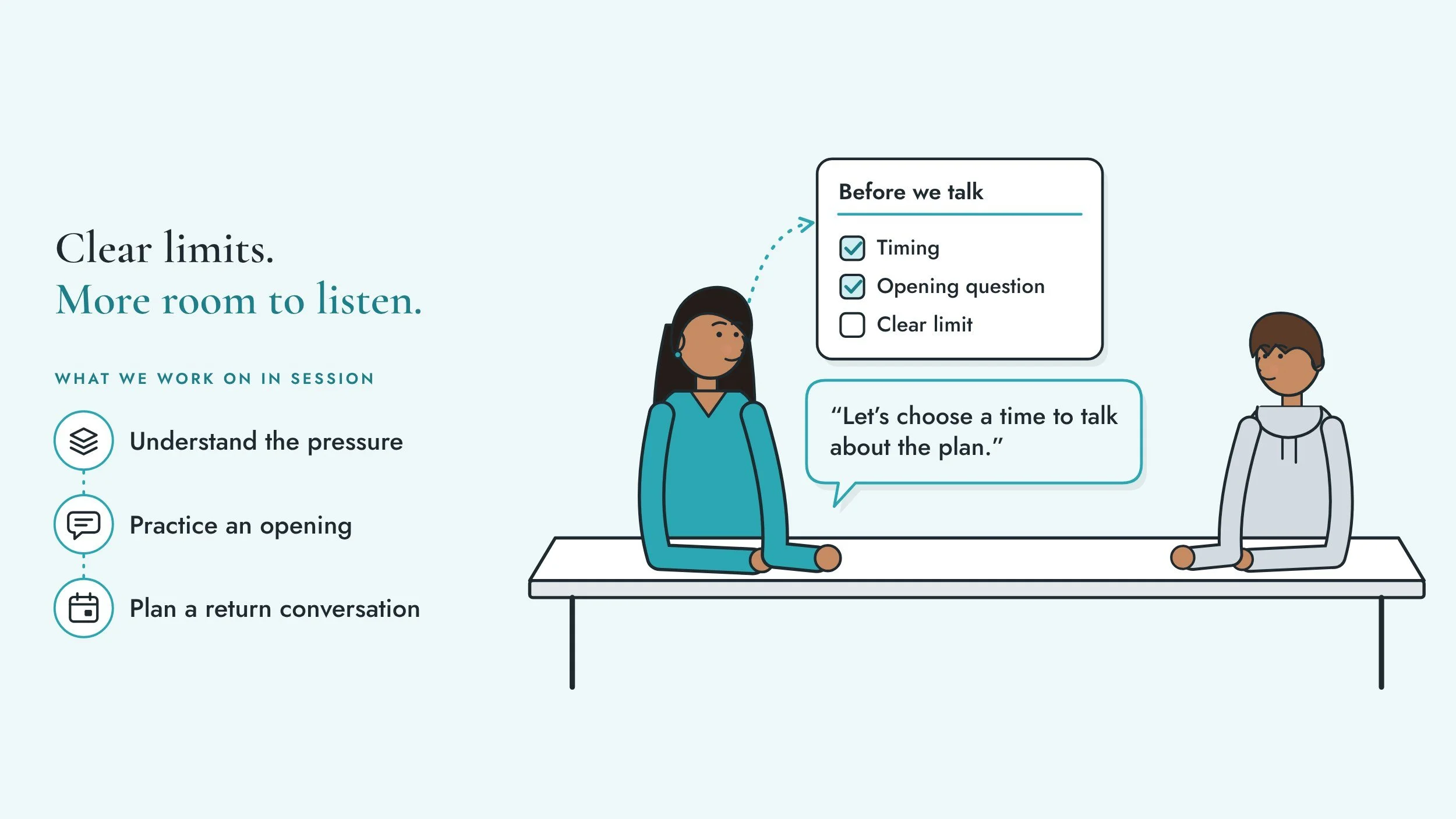
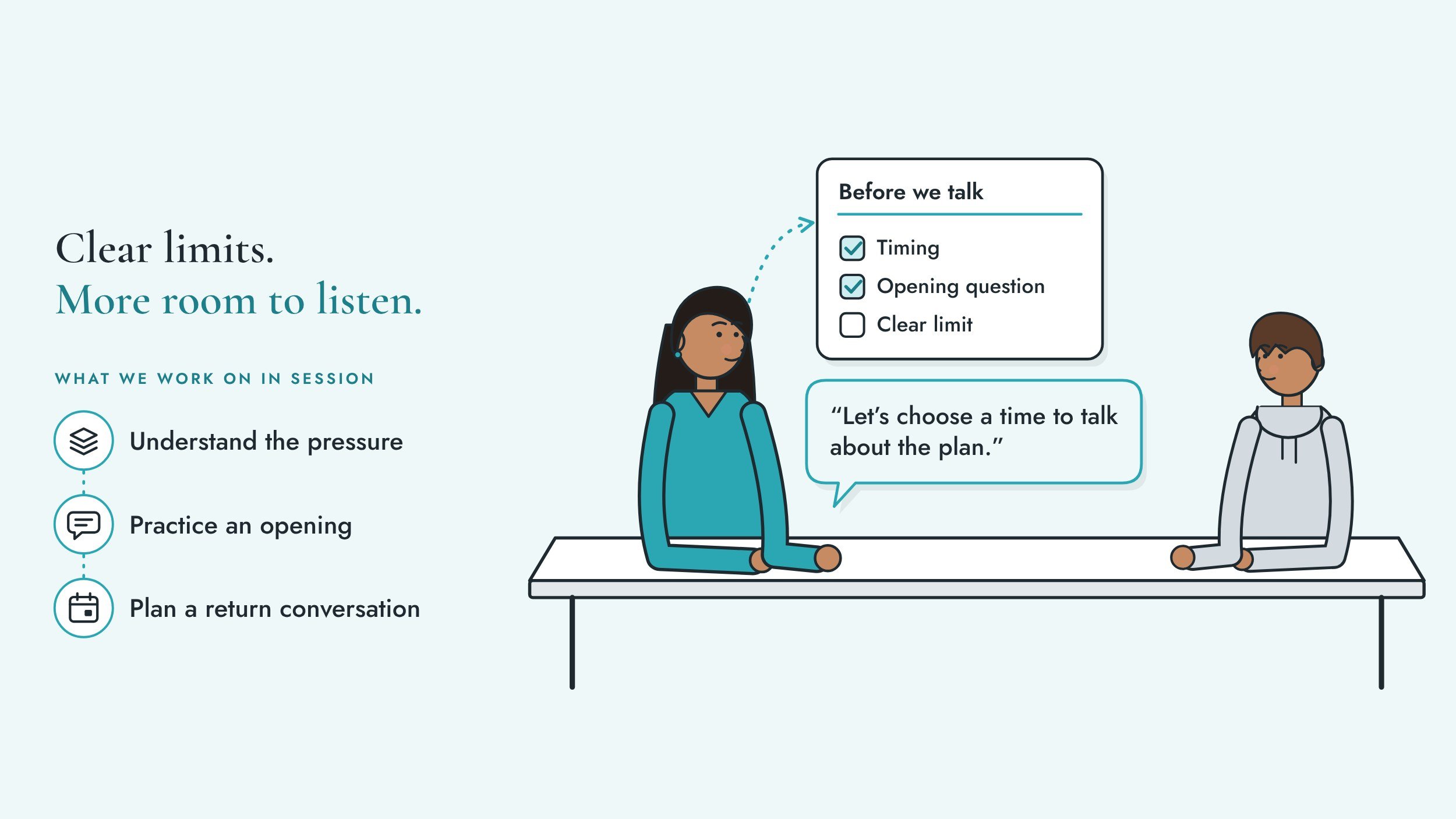
We can rehearse a question that invites information and a limit you can explain briefly. For example, a discussion about getting home on time may work better when it addresses one agreement rather than every concern about independence. We can explore what to do if your teen disagrees and how to keep your response consistent with your priorities.
Work on repair and parental worry
A hard interaction does not have to determine the rest of the day. We can practice acknowledging your part, returning to the practical issue, and choosing when to listen. We also make room for fear, grief about a changing relationship, and experiences from your own adolescence that may affect how you respond. Your emotional needs deserve attention alongside parenting strategies.
An example of the work
For example, if questions about homework lead to yelling, we could examine when you ask, what you are afraid will happen, and how the exchange escalates. You might practice a different opening and a brief return plan if either person needs a pause. We would review what actually happens at home.
What progress can look like
Progress may include fewer repeated questions, a clearer limit, a shorter recovery after disagreement, or a conversation in which you learn something new. The goal is to strengthen your choices and communication while recognizing your teen’s growing independence.
How Care Map Method supports our work
Map the emotion and trigger. We look at a recent moment and the biological, emotional, social, and environmental pressures around it. The aim is to understand your experience before choosing a response.
Match the need with a strategy. We identify what matters in that moment and select a skill or next step that fits. That might be a clearer request, a pause, a boundary, or space to process a loss.
Merge the skill into daily life. We can rehearse the words and decide when you might use them. Any practice between sessions is chosen together and adjusted to your circumstances.
Manage responses over time. We review what happened, what was difficult, and what needs to change. Therapy includes room for feelings and history as well as practical work.
About Tammy Gold
I’m Tammy Gold, MSW, LCSW, founder of Care Map Method™ and author of Secrets of the Nanny Whisperer. I earned my MSW at Columbia University and my BA at the University of Pennsylvania. My work with families informs a warm, active approach to therapy that makes room for your emotional experience and practical concerns.
Common questions
Does my teen have to attend? No. This page describes individual therapy for the parent. We focus on your emotional health, communication, and responses. Treatment for your teen would require a separate assessment and arrangement.
Can this help if my teen will not talk? We can explore how you approach contact, what you do when worried, and how to leave room for communication. Therapy cannot require or guarantee that your teen will open up.
Will you tell me which rules to use? We can consider your values, the concern involved, and what you can reasonably follow through on. Strategies should fit your family and any relevant clinical or safety needs.
What if another caregiver disagrees? We can work on your response and prepare a discussion about one shared priority. Sessions with multiple caregivers would require a separate conversation about the purpose and format of care.
Can I use Regence insurance? Check your exact Regence BlueCross BlueShield of Oregon product through my Headway profile. Network participation, clinical eligibility, and your financial responsibility need to be confirmed.
What is a useful first goal? Choose a recurring situation, such as homework reminders or curfew discussions, and describe what you would like to do differently. We can begin with a goal focused on your own response.
Take the next step
If this sounds familiar, you can explore online therapy with me while located in Oregon. Open my Headway profile to check your exact insurance benefits and appointment options. We will discuss your concerns, clinical needs, and goals to determine fit.