


Boundary Setting & Difficult Relationships Therapy
Stop repeating the same exhausting relationship patterns. Build clearer boundaries, stronger communication and a plan for difficult interactions.

Two family members having a calm conversation, representing therapy for boundaries and difficult relationships in CA, NJ & Oregon
Therapy for Boundaries & Difficult Relationships
Setting a boundary can sound simple until the relationship actually matters to you. You may know exactly what you want to say and still feel guilty, anxious, selfish, or afraid of the other person's reaction. If you have spent years keeping the peace, overexplaining, rescuing, or putting other people's needs first, even a reasonable limit can feel emotionally dangerous. Therapy can help you understand why the pattern is so powerful and practice a different way of relating.
Why boundaries can feel so difficult
Boundary problems often develop in relationships where love, responsibility, fear, guilt, and obligation are mixed together. You may be dealing with a parent who expects constant access, an adult child who relies heavily on you, a sibling who becomes angry when challenged, a partner who dismisses your needs, or a coworker who repeatedly crosses limits.
The issue is not always knowing what the boundary should be. The harder part is tolerating the discomfort that follows when you stop doing what everyone expects. Therapy can help you prepare for that discomfort so the boundary becomes more than a sentence you say once.
Therapy for people-pleasing and difficult relationships
We can look at the beliefs underneath the pattern: Do you feel responsible for everyone else's feelings? Do you equate conflict with rejection? Do you fear that saying no will end the relationship? Do you become so overwhelmed that you either give in or cut off completely?
Therapy can help you find a middle ground between over-accommodating and withdrawing. We can work on assertiveness, emotional regulation, guilt, communication, and realistic expectations about what another person may or may not change.
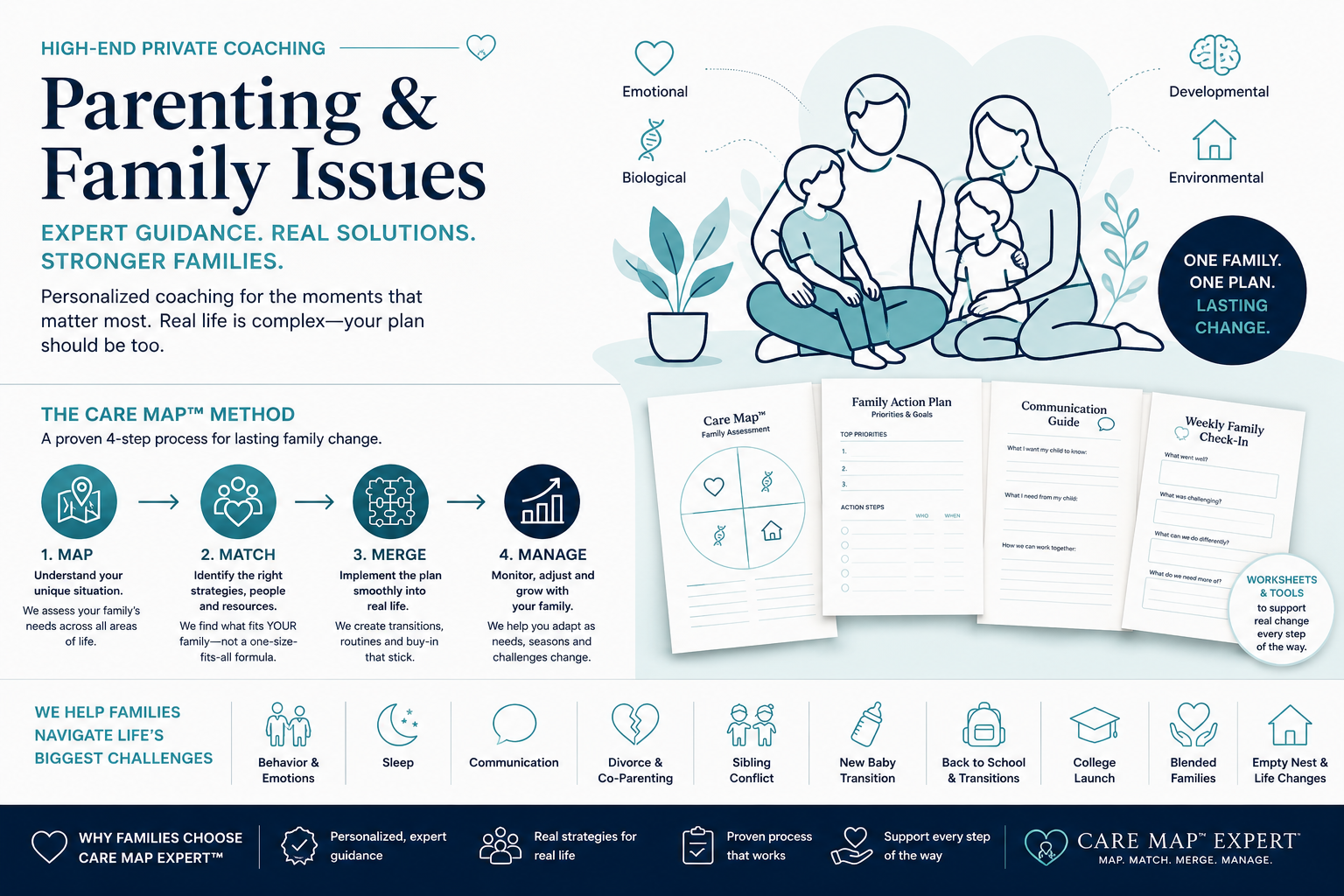
The Care Map Method: Map • Match • Merge • Manage
MAP — Understand the pattern. We identify where boundaries are being crossed, what triggers guilt or fear, and what roles you have been carrying in the relationship.
MATCH — Identify needs and goals. We clarify your values, limits, responsibilities and what you want the relationship to look like going forward.
MERGE — Improve communication and connection. We develop direct but respectful language, listening skills and ways to hold a boundary without unnecessary escalation.
MANAGE — Create practical next steps. We plan for follow-through, likely reactions, self-care, and the routines or scripts that make the boundary sustainable.
Boundaries are not the same as rejection
A healthy boundary is not a punishment. It is information about what you can participate in and what you cannot. In many relationships, clearer limits actually reduce resentment and create more room for genuine connection. Therapy can help you practice that distinction in a way that feels supportive rather than shaming.
Online therapy and insurance in NJ, CA & Oregon
I provide online psychotherapy for clients who are physically located in states where I am licensed and available to practice. I work with selected insurance plans through Headway. Coverage, eligibility, copays, deductibles and network participation vary by plan and member. Use the Headway booking link to verify benefits before scheduling.
Choose the Oregon, California or New Jersey module from the front of this document and place it here. For the highest-pay strategy, lead with the priority plan(s) for that state while keeping the copy accurate and conditional.
Ready for support and a plan?
If this situation is affecting your mood, sleep, work, relationships or sense of stability, you do not have to wait until it becomes a crisis. Therapy can be a safe, nonjudgmental place to unload what you are carrying while also developing tangible tools and a clearer path forward. Use the Headway link to check insurance eligibility and current appointment availability.
FAQ
Why is setting boundaries so difficult?
Boundaries can activate guilt, fear of conflict, old family roles, people-pleasing patterns and worries about rejection. Therapy can help you understand and tolerate those reactions.
Can therapy help with people-pleasing?
Yes. Therapy can address the beliefs and emotions that make it difficult to say no, disappoint others or prioritize your own needs.
How do I set a boundary without ending the relationship?
We can work on clear language, realistic expectations, emotional regulation and consistent follow-through while preserving as much respect and connection as the relationship allows.
Can we work on scripts for difficult conversations?
Yes. Practical scripts and rehearsal can be useful when you know what you want to say but struggle to communicate it under stress.
Is online therapy covered by insurance?
Coverage varies by plan and state. Headway can help verify current eligibility and benefits before you book.
Parenting Stress & Family Conflict Therapy
Individual therapy for the emotional and relational stress of divorce, separation, co-parenting conflict, boundaries and two-home transitions.
Parent reflecting after a difficult family conversation, representing therapy for parenting stress and family conflict in NJ, CA & Oregon
Therapy for Parenting Stress & Family Conflict
Parenting can be deeply meaningful and deeply stressful at the same time. You may love your child and still feel exhausted by conflict, worry, school problems, changing behavior, co-parenting differences, or the sense that every decision carries enormous weight. Therapy can give you a place to step out of the immediate crisis, understand what is driving the stress, and make a clearer plan for how you want to respond.
When parenting stress becomes an emotional overload
Parents often arrive in therapy after months of functioning in problem-solving mode. You may be managing schedules, academics, behavior, friendships, technology, mental health concerns, family expectations, or an adult child's struggle to become independent. You may also be carrying conflict with a partner or co-parent about what the child needs.
Over time, the stress can affect sleep, patience, work, relationships, and confidence. You may feel guilty for being frustrated or afraid that one wrong response will damage the relationship. Therapy offers a nonjudgmental place to talk honestly about those feelings while also developing practical strategies for the actual situation.
How therapy can help parents and families
The work is not about blaming parents or labeling children as the problem. Instead, we look at the interaction between stress, expectations, communication, developmental stage, family roles, and the environment around the family.
We can focus on difficult conversations, boundaries, emotional regulation, parent-child conflict, adult-child relationships, co-parenting differences, or family transitions. Depending on the situation, the most useful change may begin with how you understand the problem and how you respond to it.
The Care Map Method: Map • Match • Merge • Manage
MAP — Understand the pattern. We identify the recurring conflicts, stressors, family roles, triggers and practical circumstances contributing to the problem.
MATCH — Identify needs and goals. We clarify what you need, what your child or family member may need, what is realistic for this stage of life, and what a healthier outcome would look like.
MERGE — Improve communication and connection. We develop clearer language, boundaries, listening skills, repair strategies and ways to reduce reactivity during difficult moments.
MANAGE — Create practical next steps. We turn the work into routines, scripts, agreements and follow-through that fit your actual family life.
Support without shame or blame
Many parents are afraid therapy will become another place where they are told what they are doing wrong. My goal is different. I want the session to be a safe place where you can unload what you are carrying, feel understood, and leave with more clarity than you came in with. Parenting is complex; support should make the work feel more manageable, not more judged.
Online therapy and insurance in NJ, CA & Oregon
I provide online psychotherapy for clients who are physically located in states where I am licensed and available to practice. I work with selected insurance plans through Headway. Coverage, eligibility, copays, deductibles and network participation vary by plan and member. Use the Headway booking link to verify benefits before scheduling.
Ready for support and a plan?
If this situation is affecting your mood, sleep, work, relationships or sense of stability, you do not have to wait until it becomes a crisis. Therapy can be a safe, nonjudgmental place to unload what you are carrying while also developing tangible tools and a clearer path forward. Use the Headway link to check insurance eligibility and current appointment availability.
FAQ
Is this parenting coaching or psychotherapy?
This page describes psychotherapy. Care Map Method can be used as a structure within therapy, while non-insurance coaching or consulting should be clearly separated from clinical treatment.
Can therapy help when parenting stress affects my mood or relationships?
Yes. Therapy can address how parenting stress is affecting anxiety, irritability, sleep, confidence, relationships and your ability to cope.
Do you work with parents of teens or adult children?
Yes, depending on fit and availability. Therapy can focus on parent-teen stress, college transitions, adult-child conflict, boundaries and changing family roles.
Can we focus on family boundaries and communication?
Yes. Boundaries, difficult conversations, family roles and communication patterns are common areas of focus.
How do I check insurance eligibility?
Use the Headway booking link to verify current insurance eligibility, benefits and estimated out-of-pocket costs for your specific plan.