Book Online Therapy With Tammy Gold Through Alma or Headway
Find Tammy Gold, LCSW on Alma or Headway for online therapy in California, New Jersey, and Oregon. Review fit, insurance eligibility, and booking options.
Finding a therapist should not require guessing which link to use. I am Tammy Gold, LCSW, and I offer online therapy for adults located in California, New Jersey, and Oregon. You can view my profiles on Alma and Headway to explore fit and insurance options.
What we can work on
My work focuses on relationship stress, parenting strain, divorce adjustment, family conflict, caregiver distress, and the emotional impact of work and life transitions. In individual therapy, we can explore what you are experiencing, assess treatment needs, and turn your goals into concrete steps. Couples services require a separate discussion of fit and coverage.
Choose a platform that fits your plan
Open my Alma or Headway profile and select the state where you will be during sessions. Review the insurance options for your exact plan. A carrier appearing on a platform does not mean every plan or every provider participates. If both platforms appear to support your plan, confirm the appropriate booking route before scheduling the same care in two places.
Know what to check before booking
Review current availability, estimated cost, deductible or copay information, and whether the service you want is covered. Have your insurance card ready for the platform’s secure intake process. For a general booking question, you can email tammy@caremapmethod.com; please use the platform’s secure process for insurance details and sensitive health information.
A practical approach to therapy
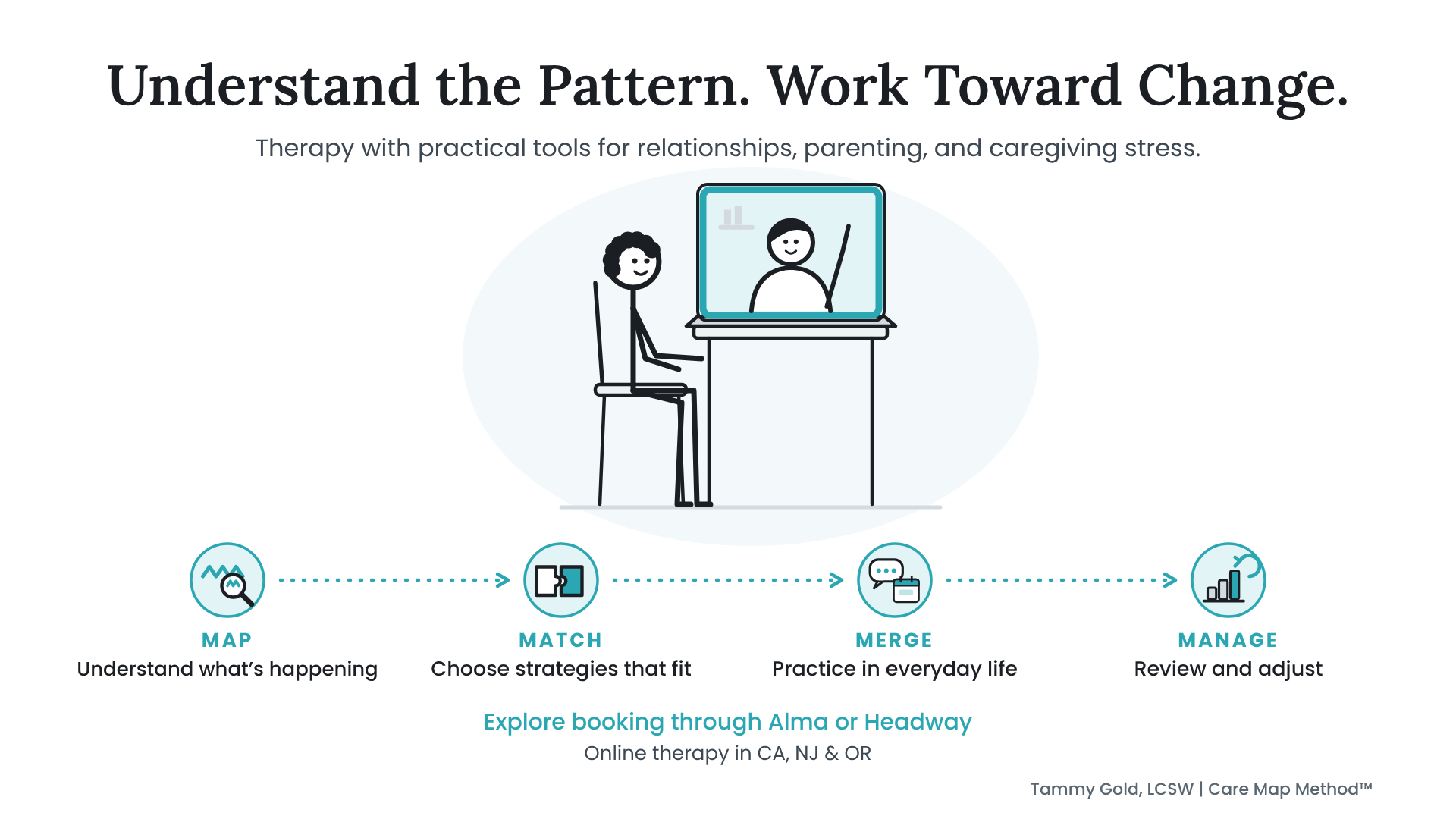
The Care Map Method™ gives us a structure to Map what is happening, Match treatment strategies to your needs, Merge insight into everyday conversations and routines, and Manage progress. It considers Biological, Emotional, Social, and Environmental needs alongside clinical assessment and your treatment goals.
What your first therapy session can include
You do not need a polished explanation of why you are seeking help. We can discuss the situation that brought you here, your emotional symptoms, relevant history, and the changes you would like to see. You might want help with a difficult family relationship, adjusting after divorce, or feeling overwhelmed by caregiving. We can consider whether my approach fits your needs and agree on an initial focus. The assessment also helps determine whether insurance-funded treatment is appropriate.
What practical work can look like
For relationship stress, we might examine one recurring interaction and practice language for a clearer request. For caregiver distress, we might explore guilt around a limit and prepare a conversation about support. For divorce adjustment, we might work on what happens emotionally before and after contact with a former partner. These are examples of possible work, not promised results. Your treatment plan should reflect your circumstances, clinical needs, and the pace at which you feel able to work.
Prepare your questions before choosing a booking link
Write down where you will be physically located during sessions, the exact name of your insurance plan, and whether you want individual therapy or another service. Review the relevant profile and its current scheduling options. If the platform cannot confirm your plan, ask for clarification before treating an estimate as settled. For general booking questions, email tammy@caremapmethod.com or call 310-721-1584. Share member numbers and sensitive health information through the secure intake process rather than ordinary email.
How we decide what is helping
We can revisit your goals and ask what is changing outside sessions. Perhaps you are making a decision with more clarity, recovering more easily after conflict, or recognizing when you need support. If an approach does not fit, we can discuss what to adjust. The structure of Map, Match, Merge, and Manage helps organize that conversation, while clinical assessment guides the treatment. You are welcome to ask how an exercise connects to your goals.
About Tammy Gold
I am Tamara “Tammy” Gold, MSW, LCSW, CEC, a licensed therapist and certified coach with a clinical MSW from Columbia University. I founded the Care Map Method™ and have more than 20 years of direct work with families. These sessions focus on your individual mental health and treatment goals.
Take the next step
If this concern is affecting your daily life, view my profile to explore fit and current booking options. Check your exact plan and estimated costs before scheduling. You can also read the online therapy booking guide for help choosing a platform.
Check insurance and booking through Headway
Frequently asked questions
Is Alma or Headway my therapist?
I provide your therapy. Alma and Headway support provider discovery and administrative processes such as insurance verification and billing.
Which platform costs less?
There is no single answer for every client. Your exact plan, benefits, and provider participation determine the estimate and final responsibility. Check the relevant platform before booking.
Can I use these links while visiting another state?
Please confirm your physical location before scheduling. This page offers care for clients located in California, New Jersey, or Oregon; another state requires separate confirmation of authorization.
Can I book couples therapy using the same insurance assumptions?
Please ask about joint-session availability and coverage separately. These pages describe individual psychotherapy; couples services may have different clinical, billing, and coverage requirements.
Do I need to book on both platforms?
Please confirm one appropriate booking route for your care. If you already have an appointment or existing treatment relationship, clarify any platform change before creating another booking.
What should I prepare for an online session?
Plan to join from a private place in an authorized state with a dependable connection. Review the intake instructions and ask about any technology or accessibility needs before your appointment.

My Adult Child Only Calls When They Need Something
Therapy for parents struggling with adult-child boundaries, resentment, guilt and one-sided relationships in New Jersey.
Therapy for parents struggling with adult-child boundaries, resentment, guilt and one-sided relationships in New Jersey.
When Helping Stops Feeling Like a Choice
You love your adult child and want to help. But perhaps the calls increasingly come when money is needed, childcare falls through, a crisis needs solving or something has gone wrong. When you want closeness, consideration or simple connection, the relationship may feel very different.
It can be painful to admit that helping has begun to feel one-sided. Many parents then feel guilty for having resentment at all.
Helping, Rescuing and Boundaries
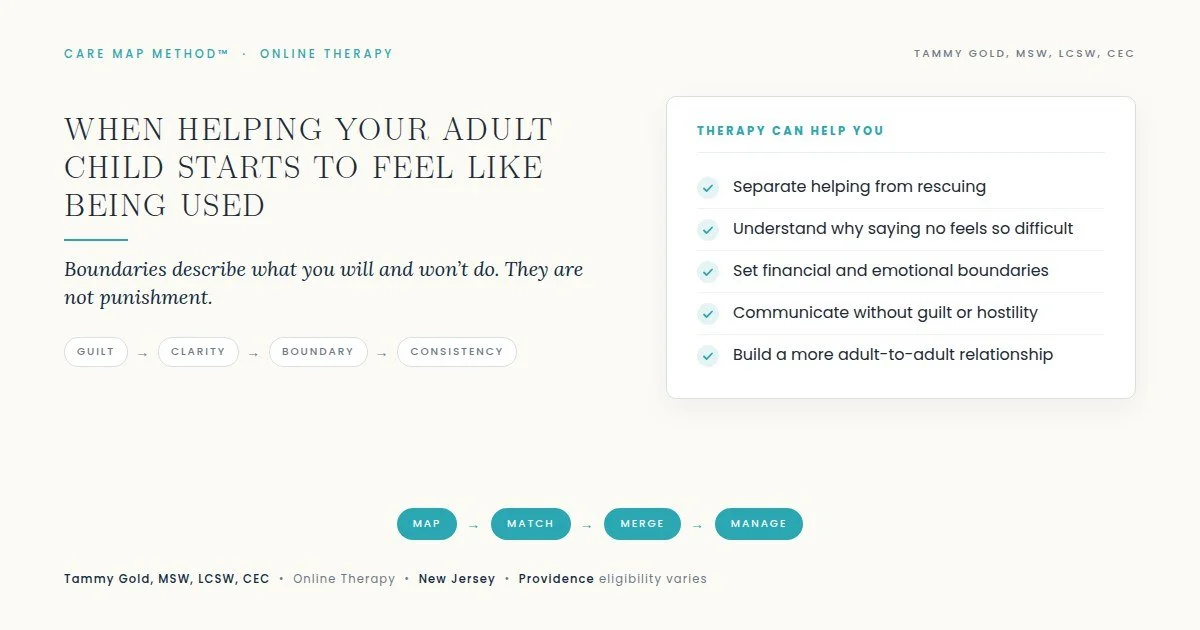
Therapy can help you separate generosity from obligation and support from rescuing. We can examine what you fear will happen if you say no, what expectations have developed over time and whether your current pattern is sustainable.
A boundary is not a punishment. It describes what you will and will not do. It can involve money, availability, childcare, crisis calls, housing, transportation or the way you are spoken to.
Building an Adult-to-Adult Relationship
The parent-child relationship changes when a child becomes an adult. Therapy can help you identify where old roles are still operating and practice language that respects your adult child's autonomy while also protecting your own needs.
MAP → MATCH → MERGE → MANAGE
MAP the current exchange and emotional pattern. MATCH your support to what you are genuinely willing and able to provide. MERGE boundaries into clear communication. MANAGE the boundary consistently even when guilt or pushback appears.
Providence and Online Therapy in New Jersey
Providence eligibility depends on the individual plan and current network participation. Verify benefits and availability before scheduling online therapy in New Jersey.
About Tammy Gold, MSW, LCSW, CEC
I am a licensed clinical social worker, certified coach, author and creator of the Care Map Method™. I have worked with families and relationships for more than two decades. My therapy style is warm, nonjudgmental, active and practical: one safe place to feel heard and supported while also developing language, boundaries and next steps you can use in real life.
Frequently Asked Questions
How do I set a boundary with an adult child without losing them?
A boundary can focus on what you will do rather than controlling them. Therapy can help you make it specific, respectful and sustainable.
Is it wrong to stop giving my adult child money?
Financial support is a personal and family decision. Therapy can help you clarify your limits, fears and goals.
What if my child becomes angry when I say no?
Therapy can help you prepare for pushback and remain consistent without escalating the conflict.
Does Providence cover this therapy?
Eligibility varies by plan and current participation. Verify benefits before scheduling.
Check insurance eligibility and request an online therapy session. Therapy is available for eligible clients physically located in New Jersey. Insurance eligibility, benefits and platform availability vary by plan.
Therapy on Headway, Grow & Alma Email: Info@caremapmethod.com Text: 818.308.1358

Boundary Setting & Difficult Relationships Therapy
Stop repeating the same exhausting relationship patterns. Build clearer boundaries, stronger communication and a plan for difficult interactions.

Two family members having a calm conversation, representing therapy for boundaries and difficult relationships in CA, NJ & Oregon
Therapy for Boundaries & Difficult Relationships
Setting a boundary can sound simple until the relationship actually matters to you. You may know exactly what you want to say and still feel guilty, anxious, selfish, or afraid of the other person's reaction. If you have spent years keeping the peace, overexplaining, rescuing, or putting other people's needs first, even a reasonable limit can feel emotionally dangerous. Therapy can help you understand why the pattern is so powerful and practice a different way of relating.
Why boundaries can feel so difficult
Boundary problems often develop in relationships where love, responsibility, fear, guilt, and obligation are mixed together. You may be dealing with a parent who expects constant access, an adult child who relies heavily on you, a sibling who becomes angry when challenged, a partner who dismisses your needs, or a coworker who repeatedly crosses limits.
The issue is not always knowing what the boundary should be. The harder part is tolerating the discomfort that follows when you stop doing what everyone expects. Therapy can help you prepare for that discomfort so the boundary becomes more than a sentence you say once.
Therapy for people-pleasing and difficult relationships
We can look at the beliefs underneath the pattern: Do you feel responsible for everyone else's feelings? Do you equate conflict with rejection? Do you fear that saying no will end the relationship? Do you become so overwhelmed that you either give in or cut off completely?
Therapy can help you find a middle ground between over-accommodating and withdrawing. We can work on assertiveness, emotional regulation, guilt, communication, and realistic expectations about what another person may or may not change.
The Care Map Method: Map • Match • Merge • Manage
MAP — Understand the pattern. We identify where boundaries are being crossed, what triggers guilt or fear, and what roles you have been carrying in the relationship.
MATCH — Identify needs and goals. We clarify your values, limits, responsibilities and what you want the relationship to look like going forward.
MERGE — Improve communication and connection. We develop direct but respectful language, listening skills and ways to hold a boundary without unnecessary escalation.
MANAGE — Create practical next steps. We plan for follow-through, likely reactions, self-care, and the routines or scripts that make the boundary sustainable.
Boundaries are not the same as rejection
A healthy boundary is not a punishment. It is information about what you can participate in and what you cannot. In many relationships, clearer limits actually reduce resentment and create more room for genuine connection. Therapy can help you practice that distinction in a way that feels supportive rather than shaming.
Online therapy and insurance in NJ, CA & Oregon
I provide online psychotherapy for clients who are physically located in states where I am licensed and available to practice. I work with selected insurance plans through Headway. Coverage, eligibility, copays, deductibles and network participation vary by plan and member. Use the Headway booking link to verify benefits before scheduling.
Choose the Oregon, California or New Jersey module from the front of this document and place it here. For the highest-pay strategy, lead with the priority plan(s) for that state while keeping the copy accurate and conditional.
Ready for support and a plan?
If this situation is affecting your mood, sleep, work, relationships or sense of stability, you do not have to wait until it becomes a crisis. Therapy can be a safe, nonjudgmental place to unload what you are carrying while also developing tangible tools and a clearer path forward. Use the Headway link to check insurance eligibility and current appointment availability.
FAQ
Why is setting boundaries so difficult?
Boundaries can activate guilt, fear of conflict, old family roles, people-pleasing patterns and worries about rejection. Therapy can help you understand and tolerate those reactions.
Can therapy help with people-pleasing?
Yes. Therapy can address the beliefs and emotions that make it difficult to say no, disappoint others or prioritize your own needs.
How do I set a boundary without ending the relationship?
We can work on clear language, realistic expectations, emotional regulation and consistent follow-through while preserving as much respect and connection as the relationship allows.
Can we work on scripts for difficult conversations?
Yes. Practical scripts and rehearsal can be useful when you know what you want to say but struggle to communicate it under stress.
Is online therapy covered by insurance?
Coverage varies by plan and state. Headway can help verify current eligibility and benefits before you book.