Infant Care Coaching: Create a Personalized Care Plan for Your Baby and Family
Every baby—and every family—is different. The Care Map Method™ Infant Coaching Session helps parents understand their baby’s biological, emotional, social, and environmental needs and create a practical plan for feeding, sleep, soothing, development, childcare, and family support.
Bringing home a baby can be joyful, exhausting, and overwhelming—all at the same time.
New parents are often surrounded by advice about feeding, sleep, schedules, soothing, development, childcare, and what they “should” be doing. But much of that advice is generic, conflicting, or disconnected from the realities of the individual baby and family.
One baby may settle easily but struggle with feeding. Another may feed well but wake frequently. A parent may understand what the baby needs but lack enough practical support to meet those needs consistently.
The Care Map Method™ Infant Coaching Session helps parents step away from one-size-fits-all advice and look at the whole picture.
Instead of beginning with, “What schedule should my baby follow?” we begin with a more useful question:
What does this baby—and this family—need right now?
What is infant care coaching?
Infant care coaching is a structured, personalized service that helps parents understand their baby’s needs, organize daily care, identify areas of stress, and create practical routines and support systems.
During a Care Map Method™ Infant Coaching Session, we explore:
Feeding and sleeping patterns
Crying, soothing, and regulation
Infant temperament and sensory preferences
Bonding and attachment
Age-appropriate development and play
Parent exhaustion and emotional well-being
Family routines and division of responsibilities
Childcare and caregiver support
Home organization and infant safety
Communication between parents and caregivers
Infant coaching does not replace pediatric medical care. It provides education, planning, problem-solving, and family support around the day-to-day experience of caring for a baby.
Why generic infant advice does not always work
Parents are frequently told to follow a particular schedule, sleep approach, feeding system, or parenting philosophy. But a plan that works beautifully for one baby may be completely wrong for another.
Babies differ in their:
Temperament
Feeding needs
Sleep patterns
Sensory sensitivity
Ability to transition between activities
Response to noise, light, touch, and movement
Need for physical closeness
Developmental pace
Medical history
Adaptability to different caregivers
Families also differ. Work schedules, culture, finances, living arrangements, parental health, sibling needs, and available support all influence what is realistic.
A useful infant-care plan must consider both the baby and the family caring for that baby.
Start with the Care Map Method™ B/E/S/E assessment
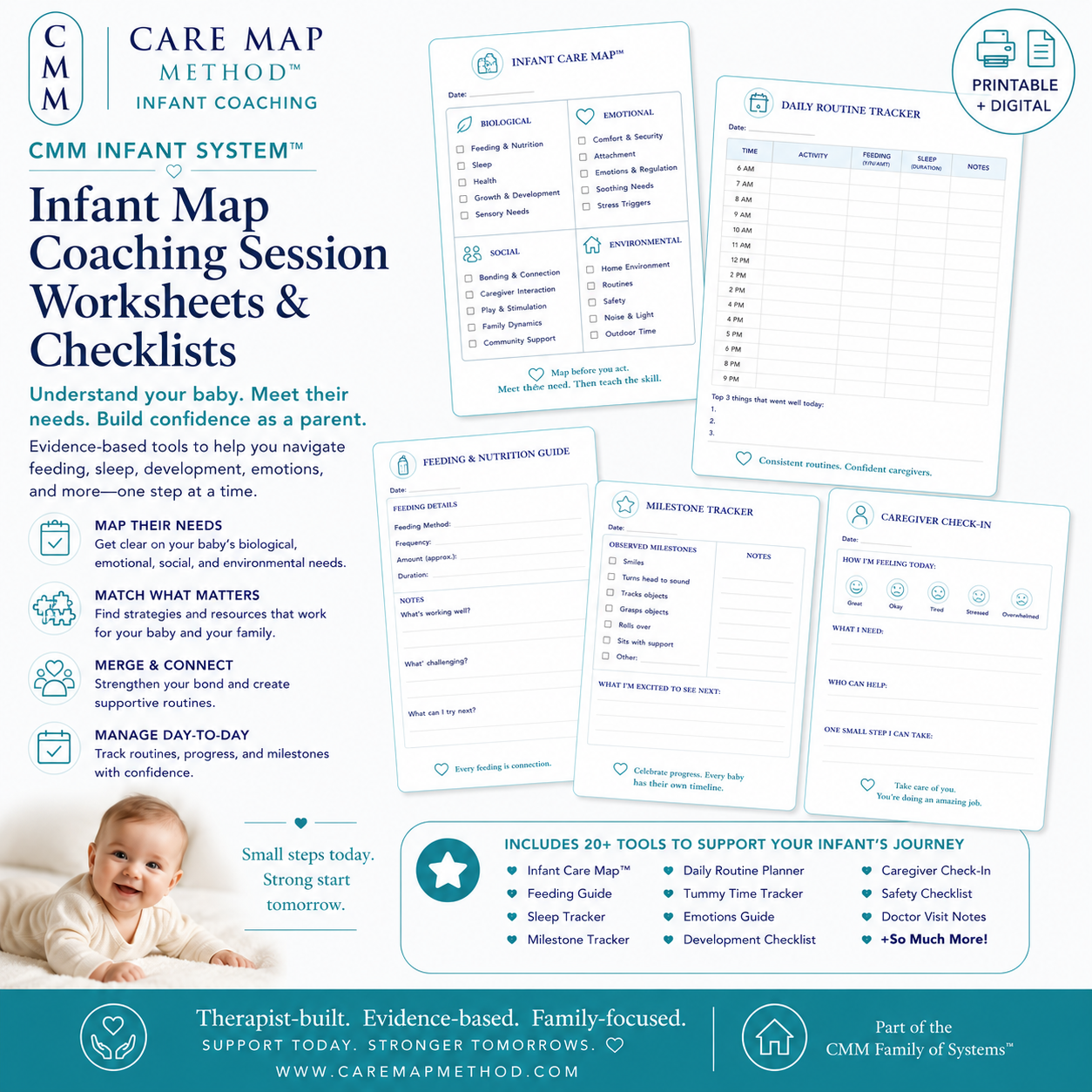
The Care Map Method™ examines four connected areas of care: Biological, Emotional, Social, and Environmental needs.
Biological needs
A baby’s biological care includes the physical foundations of well-being:
Feeding patterns and concerns
Sleep and wake windows
Diapering and digestion
Growth and pediatric care
Physical comfort
Motor development
Signs of illness or discomfort
Age-appropriate routines
Parents may benefit from keeping simple records of feeding, sleep, crying, and other patterns. These observations can help the family—and the baby’s pediatrician—understand what may be contributing to a concern.
Questions that involve feeding difficulties, poor weight gain, illness, breathing, persistent pain, unusual lethargy, or developmental concerns should always be discussed with the baby’s pediatric healthcare provider.
Emotional needs
Babies communicate their emotional and regulatory needs through facial expressions, body movement, sounds, crying, and changes in alertness.
Emotional care includes:
Responsive caregiving
Comfort and soothing
Secure attachment
Recognizing hunger, fatigue, and overstimulation
Supporting co-regulation
Creating predictable responses
Understanding the baby’s individual temperament
Responsive care does not require parents to prevent every cry. It means becoming curious about what the baby may be communicating and responding as consistently and sensitively as possible.
Parents’ emotional health matters too. Exhaustion, anxiety, postpartum depression, birth trauma, and lack of support can make caregiving much harder. Supporting the parent is part of supporting the baby.
Social needs
Even very young babies benefit from warm and responsive social interaction.
An infant’s social world may include:
Parents
Siblings
Grandparents
Extended family
Nannies or babysitters
Daycare teachers
Healthcare professionals
Family friends and community support
The goal is not to surround the baby with constant activity. It is to build a small, safe network of caregivers who understand the baby’s cues, routines, and needs.
Social care also includes helping parents decide how to manage visitors, family expectations, differing parenting opinions, and transitions between caregivers.
Environmental needs
A baby’s environment can influence sleep, feeding, regulation, development, and safety.
Environmental factors include:
Safe sleep arrangements
Noise and light
Room temperature
Feeding and changing areas
Developmentally appropriate play spaces
Household routines
Travel and transportation
Pets and siblings
Childproofing as mobility develops
Consistency between home and childcare
The goal is not to create a perfect home. It is to create an environment that is safe, manageable, and responsive to the family’s real needs.
Apply MAP, MATCH, MERGE, and MANAGE to infant care
Once we understand the full care picture, the Care Map Method™ provides a practical path forward.
MAP the Need
We identify the baby’s biological, emotional, social, and environmental needs while also considering the parents’ capacity, concerns, schedules, and support.
The care map may uncover patterns that are easy to miss when everyone is tired. For example, a “sleep problem” may be connected to feeding, overstimulation, inconsistent routines, caregiver transitions, or an environmental factor.
MATCH the Care
Next, we determine what type of support fits each need.
Depending on the family, support may include:
A pediatrician
A lactation consultant
A postpartum mental health professional
A sleep specialist
A developmental professional
A postpartum doula
A nanny or babysitter
A daycare program
Trusted family assistance
Parent coaching
The goal is not to hire every possible professional. It is to match the right support to the actual need.
MERGE the Support
When several adults care for a baby, they need clear and consistent communication.
A practical infant care plan may include:
Feeding instructions
Sleep and soothing routines
Safe sleep expectations
Medication or health information
Emergency contacts
Preferred communication methods
Daily caregiver notes
Responsibilities for each parent or caregiver
A transition plan for returning to work or beginning childcare
Consistency does not mean that every caregiver must do everything identically. It means that everyone understands the essential expectations for the baby’s safety, comfort, and care.
MANAGE the Plan
Babies change quickly. A plan that works at eight weeks may need to be adjusted at four months.
Families can review:
What is working?
What continues to feel difficult?
Has the baby’s feeding or sleep pattern changed?
Are the parents receiving enough rest and support?
Is the childcare arrangement meeting the baby’s needs?
Are all caregivers communicating effectively?
Does the home environment need to change as the baby develops?
The infant care plan should grow along with the baby.
Common reasons parents seek infant coaching
A Care Map Method™ Infant Coaching Session may be helpful when:
You feel overwhelmed by conflicting infant-care advice
Your baby’s routines feel unpredictable
Feeding, sleep, or soothing is creating family stress
You are unsure how to recognize your baby’s cues
You and your partner disagree about infant care
You need help dividing responsibilities
You are returning to work
You are choosing a nanny, babysitter, or daycare
You need to prepare a caregiver for your baby
Your family has limited support
You want a practical care plan before the baby arrives
Your first months of parenthood feel harder than expected
Parents do not need to be in crisis to benefit from coaching. Planning early can prevent confusion and help the entire family feel more confident.
What happens during a Care Map Method™ Infant Coaching Session?
The session is tailored to the baby’s age, needs, family structure, and current challenges.
Together, we can:
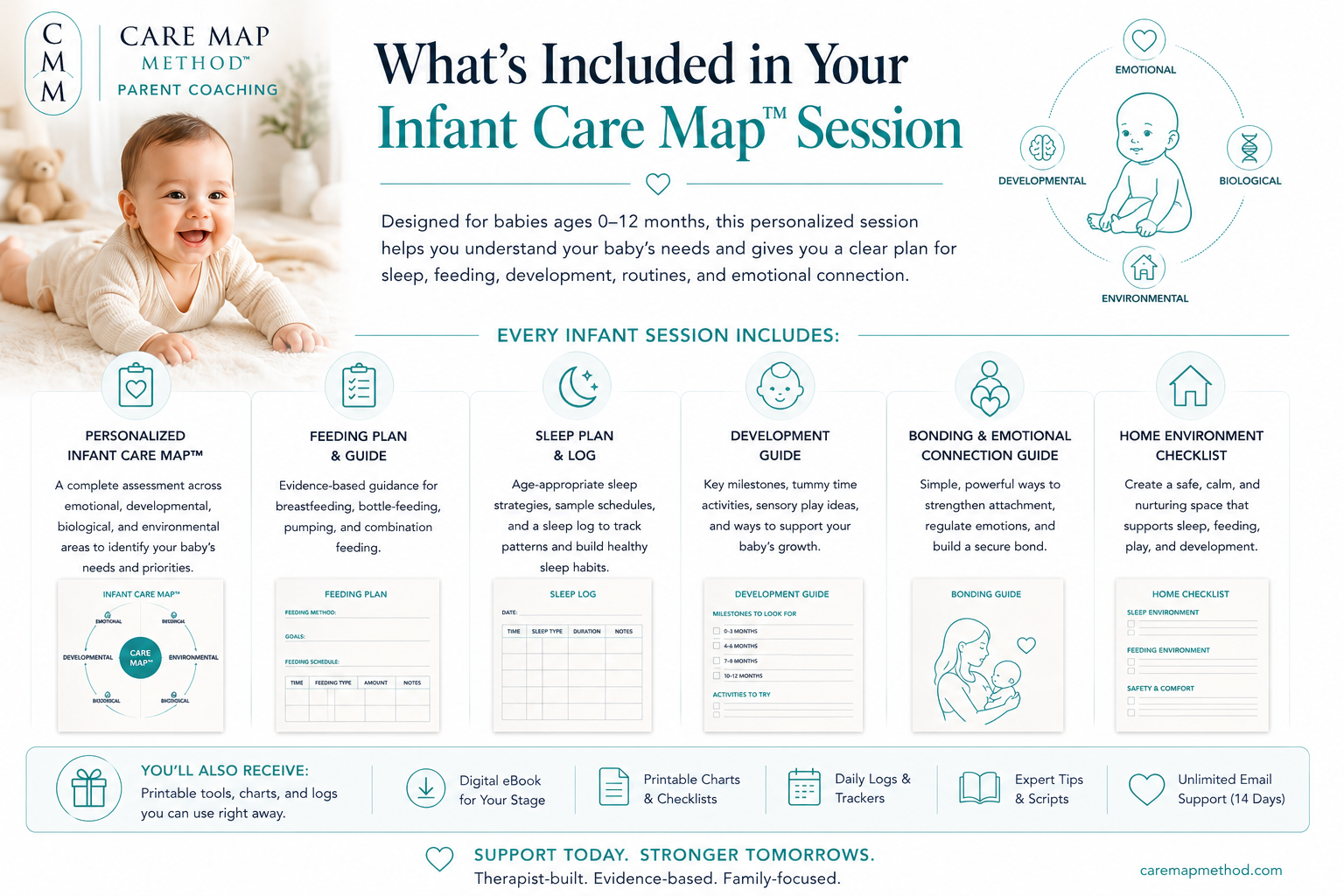
Complete a Biological, Emotional, Social, and Environmental care assessment
Identify the family’s most urgent concerns
Review feeding, sleep, soothing, development, and daily routines
Explore infant temperament and individual cues
Identify appropriate professional or caregiving support
Prepare for a nanny, daycare, babysitter, or return-to-work transition
Develop caregiver instructions and communication tools
Clarify responsibilities between parents and other caregivers
Create a personalized Infant Care Map and next-step plan
Families leave with organized priorities and practical tools—not another overwhelming list of parenting rules.
Frequently asked questions about infant coaching
Is infant coaching the same as medical care?
No. Infant coaching supports parents with education, planning, routines, caregiver communication, and family decision-making. Medical, feeding, growth, or developmental concerns should be evaluated by the appropriate licensed healthcare professional.
Can infant coaching help us choose childcare?
Yes. The Care Map Method™ can help parents identify what their baby needs from a nanny, babysitter, postpartum caregiver, or daycare program. Families can then use those needs to guide interviews, trials, reference checks, onboarding, and caregiver communication.
Can both parents attend the session?
Yes. Including both parents or other central caregivers can help clarify expectations, reduce conflict, and create a more consistent plan.
Is the session only for first-time parents?
No. Infant coaching can help first-time parents, experienced parents, families with multiple children, grandparents providing care, and parents managing new or complex caregiving arrangements.
Can we have a session before our baby is born?
Yes. A prenatal infant-planning session can help families prepare feeding and sleep areas, divide responsibilities, anticipate support needs, select caregivers, and create a flexible plan for the early weeks.
You do not need a perfect routine—you need the right plan
Caring for an infant involves constant learning and adjustment. The goal is not to follow every piece of advice or create a flawless schedule.
The goal is to understand your baby, support the people providing care, and build a plan that works for your actual family.
Map before you act.
Care Map Method™ Infant Coaching Session
The Care Map Method™ Infant Coaching Session gives parents a personalized, therapist-developed framework for understanding their baby and organizing care.
Your session may include:
A complete B/E/S/E Infant Care Map
Feeding, sleep, soothing, and routine review
Infant temperament and cue guidance
Parent and family support planning
Nanny, babysitter, or daycare preparation
Caregiver communication tools
A personalized list of priorities and next steps
Built by a therapist. Backed by science. Designed for real family life.
Schedule a Care Map Method™ Infant Coaching Session
Care Map Method™ coaching provides education, planning, and family support. It does not diagnose or treat medical, developmental, feeding, sleep, or mental health conditions.