

Therapy for People Pleasing and Boundaries
You can care about someone and still need a limit. Therapy can help you understand people-pleasing patterns, communicate your needs and work through the feelings that follow.
Knowing your limit and still finding it hard to say
You may know that you cannot take on another task and hear yourself agreeing anyway. Perhaps you rewrite a simple message to make sure nobody feels disappointed. You may feel responsible for keeping the peace at work, with friends or in your family, even when doing so leaves you exhausted or resentful.
Therapy for people-pleasing can help you understand what makes a reasonable limit feel difficult. The goal is not to become uncaring or stop considering other people. It is to make more room for your needs and choices, so that kindness does not consistently depend on ignoring your own capacity.
Understanding how the pattern developed
People-pleasing patterns may have helped you maintain connection, avoid conflict or meet expectations earlier in life. You might have learned to notice everyone else's mood before identifying your own. In some environments, being agreeable was rewarded or felt safer than expressing disagreement. Those strategies can continue even when your circumstances have changed.
We can explore the pattern without blaming your family or treating your past as the only explanation. Culture, identity, financial dependence and current power differences also matter. A boundary with a close friend is not the same as a boundary with someone who controls your income or housing.
What boundaries can and cannot do
A boundary communicates what you need, what you can offer or what you will do in a situation. It cannot force another person to agree or behave differently. You may be able to decline a request, limit a conversation or change your availability, but the other person may still feel disappointed.
Therapy can help you prepare for that discomfort. We can distinguish guilt that signals a genuine conflict with your values from guilt that appears whenever you prioritize yourself. We can also consider whether the boundary is realistic, proportionate and safe, and what follow-through would look like if the situation continues.
Practicing language that sounds like you
A useful conversation does not need to sound like a script from a book. We can work with your own words and the relationship involved. If you tend to overexplain, we might practice a shorter response. If you withdraw until you feel angry, we might focus on recognizing the need earlier and communicating it before resentment builds.
For example, a friend may repeatedly call during your workday. A starting point could be naming when you are available and offering a time that works. We would also explore the fear underneath that response, such as worrying that being unavailable will be interpreted as not caring.
Using the Care Map Method in relationship work
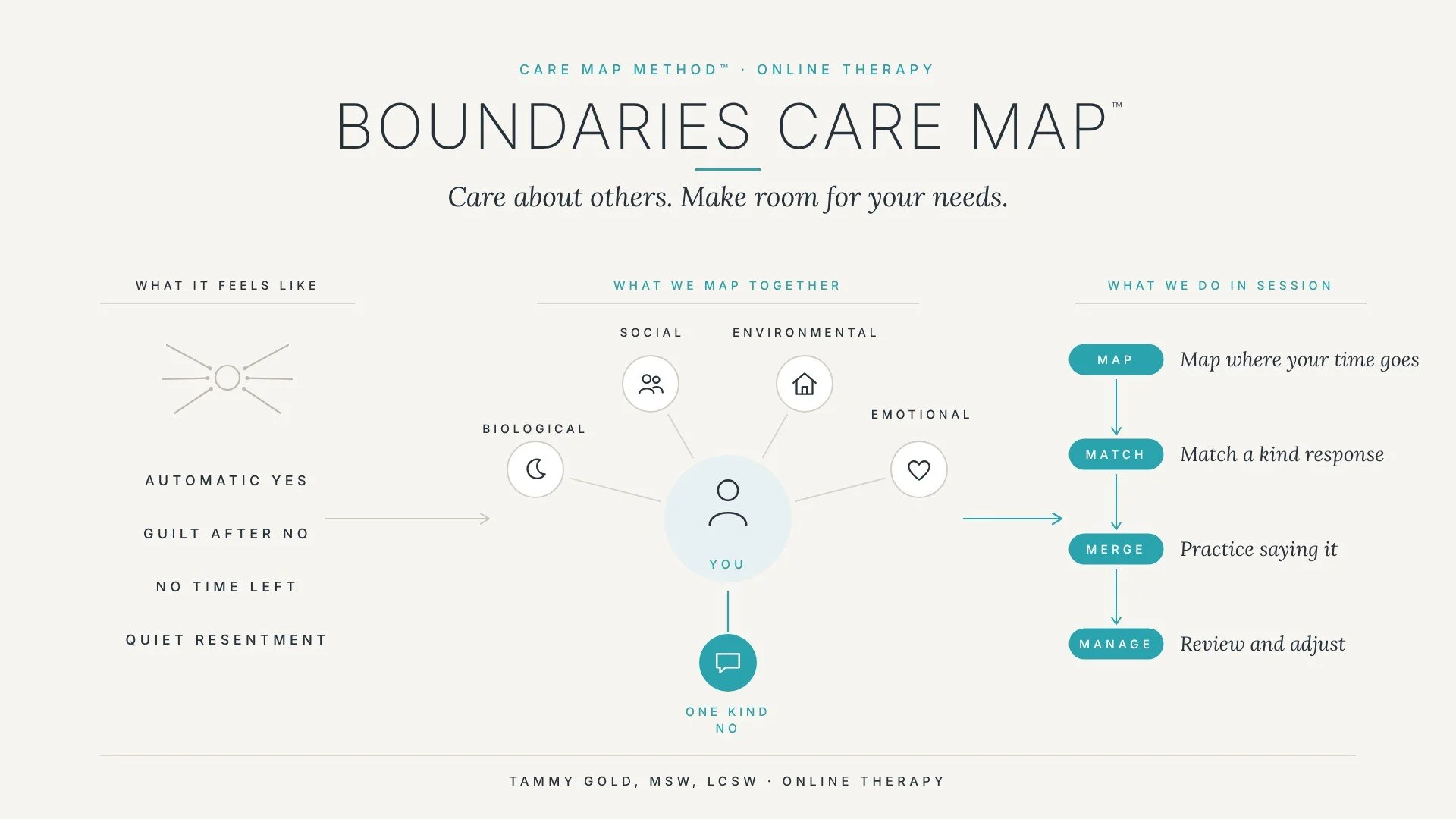
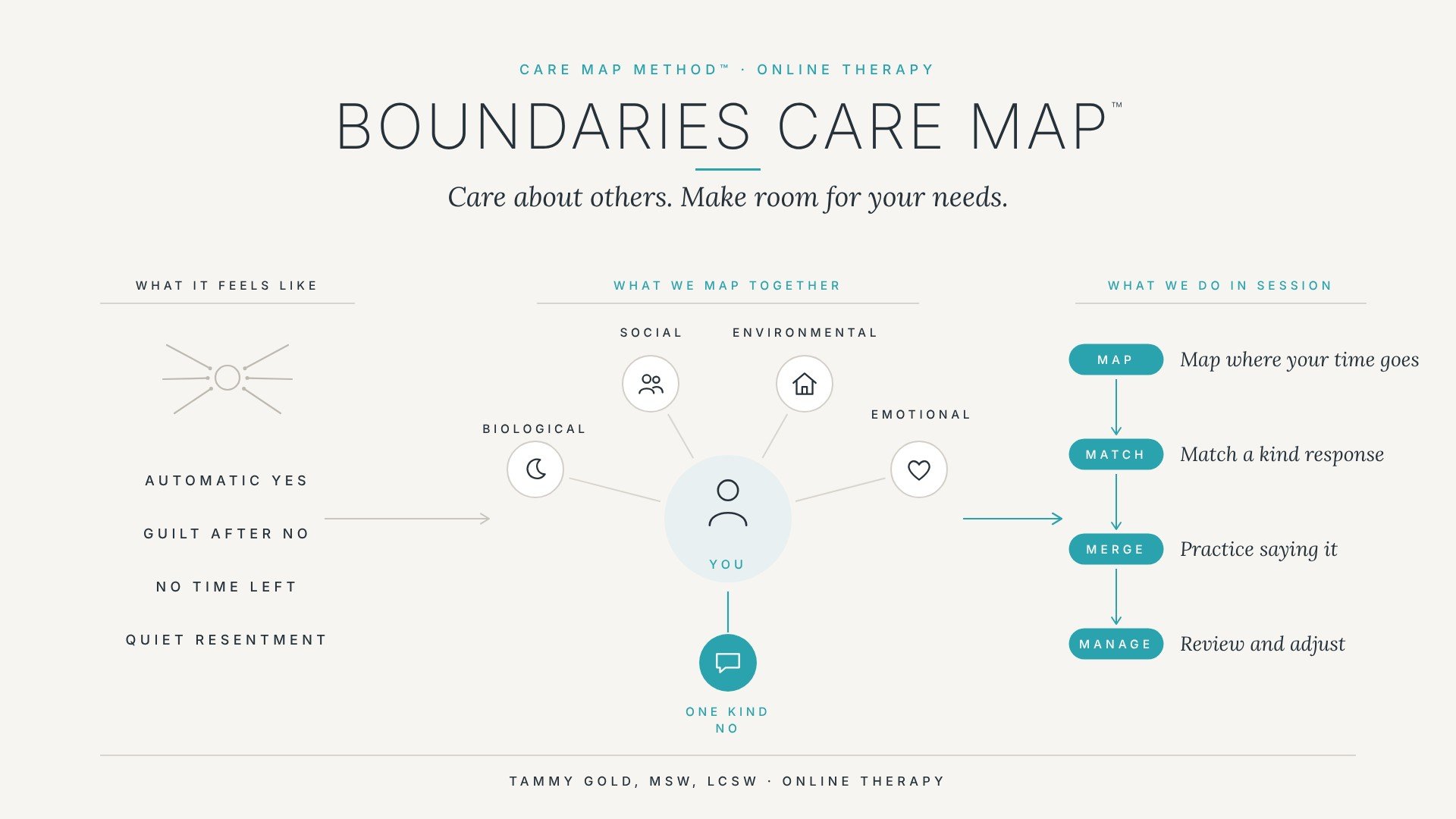
We MAP the recurring interaction, including what is asked of you, what you feel and how you respond.
We MATCH the work to the barriers involved, such as fear of conflict, difficulty recognizing needs or uncertainty about your rights in the relationship.
We MERGE practice into real conversations and MANAGE what happens afterward.
The work includes what happens inside you as well as what you say. You may need support tolerating someone else's disappointment, recognizing anger before it becomes overwhelming or allowing a relationship to be less close than you once hoped. This is individualized therapy rather than a rulebook for how every relationship should work.
Building relationships with room for both people
A relationship can contain care, disagreement and limits at the same time. We can consider whether your current patterns allow that. Some people discover that a relationship improves when they become clearer. Others learn that the connection depended heavily on their willingness to keep giving. Either possibility can bring strong feelings.
Progress may mean recognizing a choice before automatically saying yes, asking for time to consider a request or recovering more quickly from guilt. We can evaluate changes together and adjust the pace. If there are threats, coercion or safety concerns, those require specific attention rather than generic advice to be more assertive.
About Tamara Gold
I am Tamara “Tammy” Gold, MSW, LCSW, CEC, a Columbia University-trained therapist, certified coach and author of Secrets of the Nanny Whisperer. My work with individuals and families informs a warm, collaborative approach that connects emotional understanding with practical next steps. Treatment is individualized to your needs; results and timelines vary.
Online appointments and insurance
Online appointments depend on your physical location at each session, clinical fit and current availability. Review my booking profiles to confirm whether I can serve you in your state. Selected insurance plans may be available through Headway or Alma. Coverage, medical-necessity requirements and your costs depend on your individual plan; a life problem alone does not establish insurance coverage.
Frequently asked questions
Is people-pleasing a mental health diagnosis?
No. It describes a pattern that may be associated with anxiety, relationships, past experiences or other concerns. Assessment helps us understand the context and whether a clinical diagnosis is relevant.
Can I set boundaries without being selfish?
We can explore what fairness and responsibility mean in your situation. Considering your limits is not automatically selfish, but the effects of a boundary still deserve thought. Therapy helps you make a deliberate choice rather than acting only from guilt.
What if someone gets angry when I say no?
Their reaction matters, especially if anger involves threats or retaliation. We can assess the relationship and your options before practicing a response. A general communication script is not a substitute for attending to safety.
Will I need to cut people off?
No predetermined outcome is required. Boundaries can involve smaller changes in time, topics, expectations or responsibilities. Some situations call for more distance, but the decision should reflect your circumstances.
Can therapy help with boundaries at work?
Yes. We can discuss workload, role expectations, communication and your emotional response. Employment rules and legal rights may need separate advice from an appropriately qualified professional.
Why do I still feel guilty after setting a reasonable limit?
Feelings do not always change as quickly as behavior. We can examine what the guilt means, whether you need to repair anything and how to tolerate discomfort without immediately undoing the boundary.
Take the next step
If this sounds like the kind of support you need, review current appointment options and check insurance eligibility through my Headway or Alma profile. You can bring questions about fit, fees and the process before scheduling. You do not need a perfect explanation of the problem to begin.