Why Couples Keep Having the Same Fight (And How to Finally Break the Cycle)
Learn why couples repeat the same arguments and discover a therapist-developed framework to improve communication, rebuild trust, and strengthen relationships.
Every couple argues.
The healthiest couples are not the ones who never experience conflict—they're the ones who understand why conflict happens and know how to repair it before resentment begins to grow.
Many couples tell me:
"We keep having the exact same argument."
The topic changes.
Money.
Parenting.
Household responsibilities.
Intimacy.
In-laws.
Work.
Yet somehow the conversation always ends in the same place:
Someone feels unheard.
Someone shuts down.
Someone becomes defensive.
Both partners leave feeling misunderstood.
If this sounds familiar, you're not alone.
You're Probably Arguing About Something Deeper
Most disagreements aren't really about dishes or text messages.
Those topics simply activate something much deeper underneath.
For example:
One partner hears criticism.
The other partner feels ignored.
One worries about abandonment.
The other worries about never being "good enough."
Without understanding those deeper emotional drivers, couples unknowingly repeat the same pattern over and over.
Changing the topic rarely changes the outcome.
Understanding the pattern does.
The Four Areas Every Couple Should Map Before Trying to Fix the Problem
One of the biggest mistakes couples make is trying to solve the disagreement before understanding what each partner actually needs.
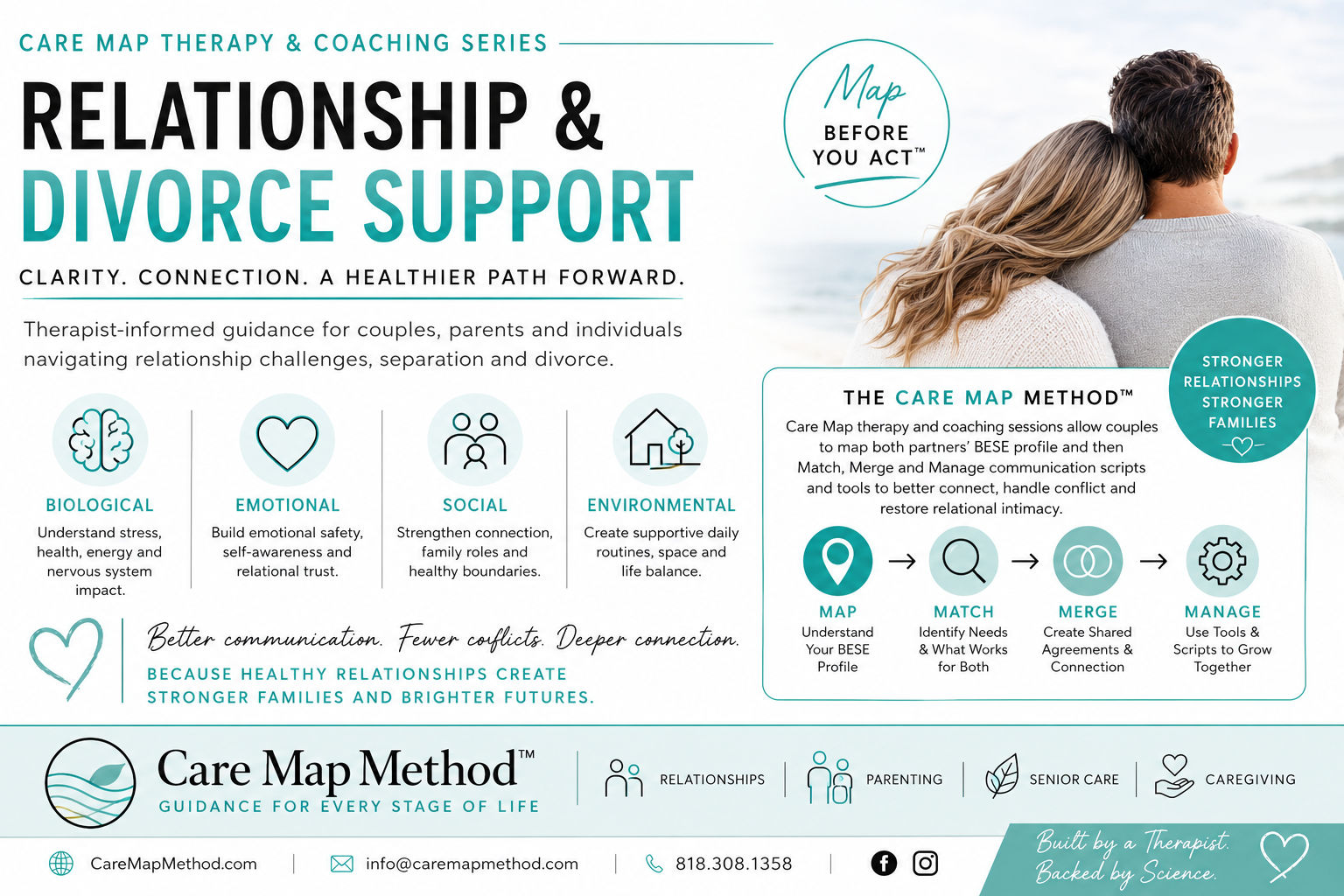
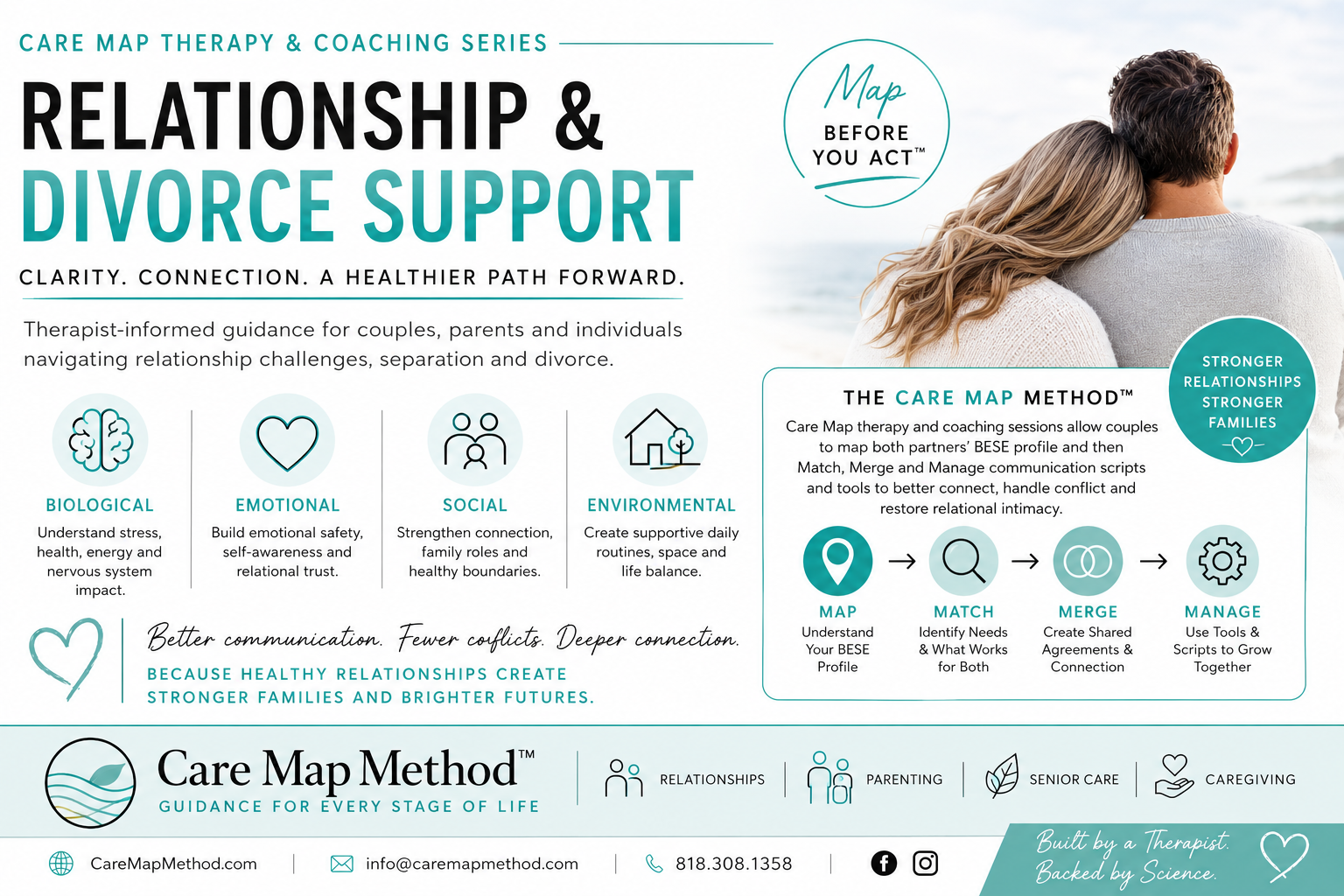
At Care Map Method™, we begin by helping couples Map Before They Act™.
Instead of asking,
"Who's right?"
we ask,
"What is each person's experience?"
We organize those experiences using four interconnected areas.
Biological
Stress affects communication.
Sleep deprivation, chronic illness, ADHD, hormones, menopause, medications, chronic pain, and nervous system overload all influence how people react during conflict.
A partner who feels emotionally reactive may actually be physiologically overwhelmed.
Emotional
Every person carries different attachment experiences, fears, insecurities, and expectations into a relationship.
Questions include:
What emotions are showing up?
What feels threatening?
What emotional needs are not being met?
What assumptions are being made?
Social
Relationships never exist in isolation.
Work demands.
Children.
Caregiving.
Financial stress.
Friendships.
Extended family.
These external pressures influence how couples interact long before an argument begins.
Environmental
The environment shapes communication more than most people realize.
Do conversations happen only when everyone is exhausted?
Is there privacy?
Is one partner constantly multitasking?
Does the home feel calm—or chaotic?
Changing the environment often changes the conversation.
Once You Map the Problem, You Can Actually Solve It
Most couples skip directly to solutions.
Instead, our relationship coaching follows four simple steps.
MAP
Understand each partner's Biological, Emotional, Social and Environmental profile.
MATCH
Identify communication strategies that work for both people—not just one.
MERGE
Create shared agreements about expectations, responsibilities, conflict repair, parenting, finances, and emotional support.
MANAGE
Practice communication tools consistently until healthier patterns become automatic.
Healthy relationships are built through repetition—not perfection.
The Goal Isn't Winning
Many couples unknowingly approach conflict as though someone has to lose.
Healthy relationships work differently.
The goal isn't proving who is correct.
The goal is understanding one another well enough to solve the problem together.
When couples shift from:
Me vs. You
to
Us vs. The Problem
everything changes.
Small Changes Create Big Results
Research consistently shows that relationships improve through many small positive interactions rather than one dramatic breakthrough.
Small habits matter.
Listening before responding.
Expressing appreciation.
Repairing conflict quickly.
Checking assumptions.
Asking curious questions.
Choosing empathy over defensiveness.
These daily moments gradually rebuild trust.
When It Might Be Time to Seek Professional Support
Sometimes communication patterns become so deeply established that couples benefit from a structured, neutral process.
Seeking support doesn't mean your relationship has failed.
It often means you're choosing to invest in your future together before problems become harder to repair.
Therapy or relationship coaching can help couples:
Improve communication
Reduce recurring conflict
Navigate parenting challenges
Strengthen emotional intimacy
Rebuild trust
Prepare for marriage
Navigate separation respectfully
Co-parent more effectively after divorce
The Care Map Method™ Difference
Traditional couples counseling often begins with the conflict itself.
The Care Map Method™ begins with understanding the people experiencing the conflict.
By mapping each partner's Biological, Emotional, Social, and Environmental influences first, couples gain greater insight into why conflicts develop and how to create solutions that fit their unique relationship.
Because healthier relationships don't happen by accident.
They happen when you Map Before You Act™.
Ready to Strengthen Your Relationship?
Whether you're preparing for marriage, navigating parenting, rebuilding after betrayal, considering separation, or simply feeling disconnected, relationship therapy and coaching can provide practical tools that create lasting change.
Care Map Therapy & Coaching
✓ Couples Therapy
✓ Marriage Counseling
✓ Relationship Coaching
✓ Divorce & Co-Parenting Support
✓ Communication Skills
✓ Parenting Partnerships
Map Before You Act™
Why do couples keep having the same argument?
Repeated arguments are often maintained by deeper emotional triggers, unmet needs, defensive reactions, assumptions, and communication patterns rather than the surface topic alone.
Can couples therapy help communication?
Yes. Couples therapy can help partners slow down conflict, identify the pattern, hear each other more accurately, communicate needs more clearly, and practice repair.
What if my partner will not attend?
Individual therapy can still help you understand the relationship pattern, regulate your reactions, communicate differently, clarify boundaries, and make more thoughtful decisions.
Is couples therapy only for relationships in crisis?
No. Couples may seek therapy for recurring conflict, disconnection, parenting stress, intimacy concerns, life transitions, premarital preparation, or to strengthen a relationship before problems escalate.
Will the therapist take sides?
The goal is not to declare one partner right and the other wrong. The work focuses on understanding the relationship system, helping both people feel heard, and identifying healthier patterns.
Can therapy help couples affected by parenting stress?
Yes. Parenting can create exhaustion, resentment, role imbalance, disagreement about discipline, and reduced time for connection. Therapy can help couples rebuild teamwork and communication.
What does Map, Match, Merge, and Manage look like for couples?
MAP identifies the conflict cycle. MATCH clarifies each partner’s needs and goals. MERGE builds healthier communication and repair. MANAGE creates tools and agreements that can be used between sessions.
How long does couples therapy take?
The length varies based on the concerns, goals, severity of conflict, participation, and whether there are complicating factors. Some couples seek focused short-term work, while others benefit from longer support.