

Therapy for Overthinking and Self Doubt
hinking through a problem can help, but reviewing it repeatedly can leave you more anxious. Explore therapy for overthinking conversations, decisions and other people’s reactions.
When thinking stops bringing you closer to an answer
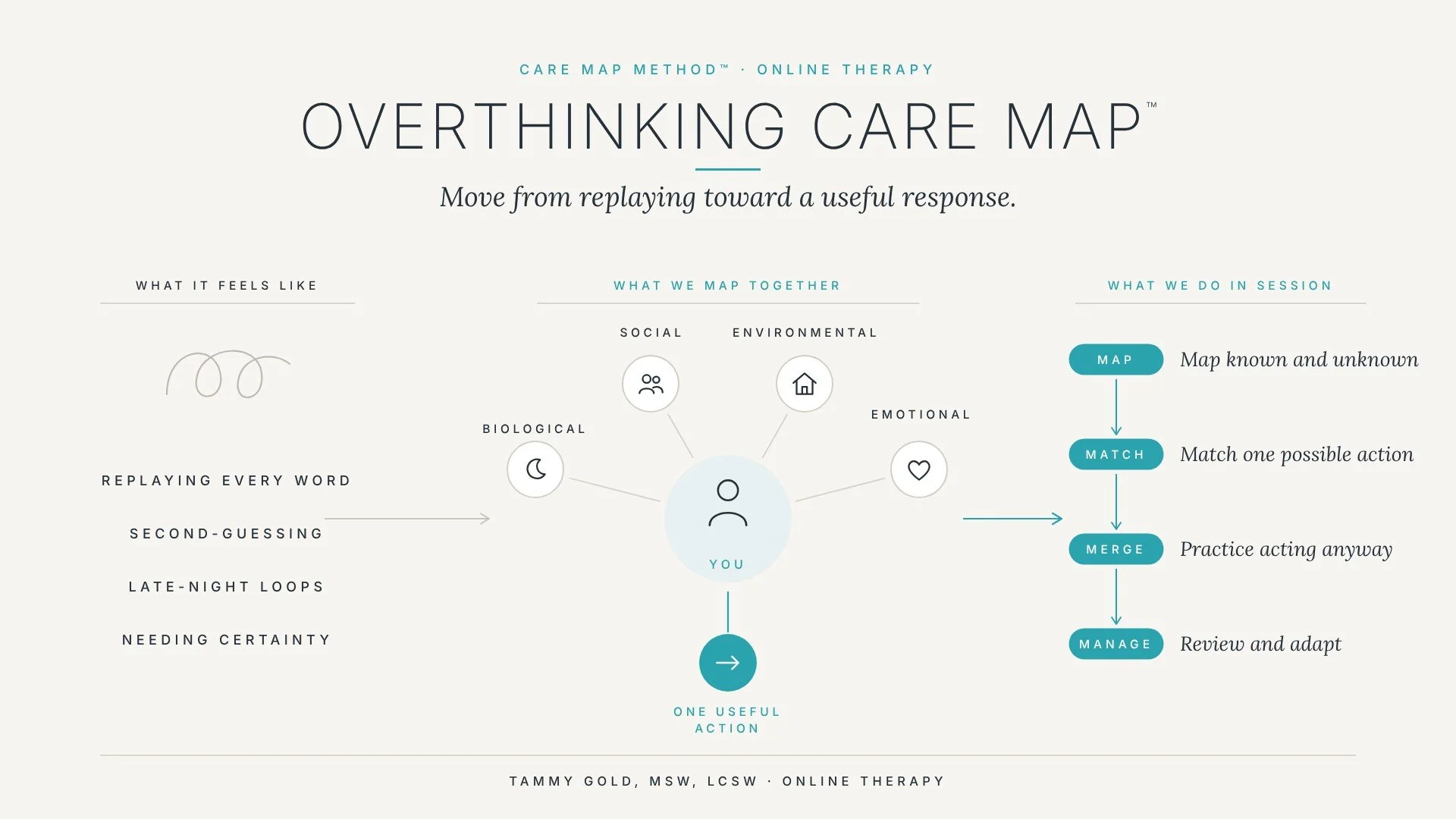
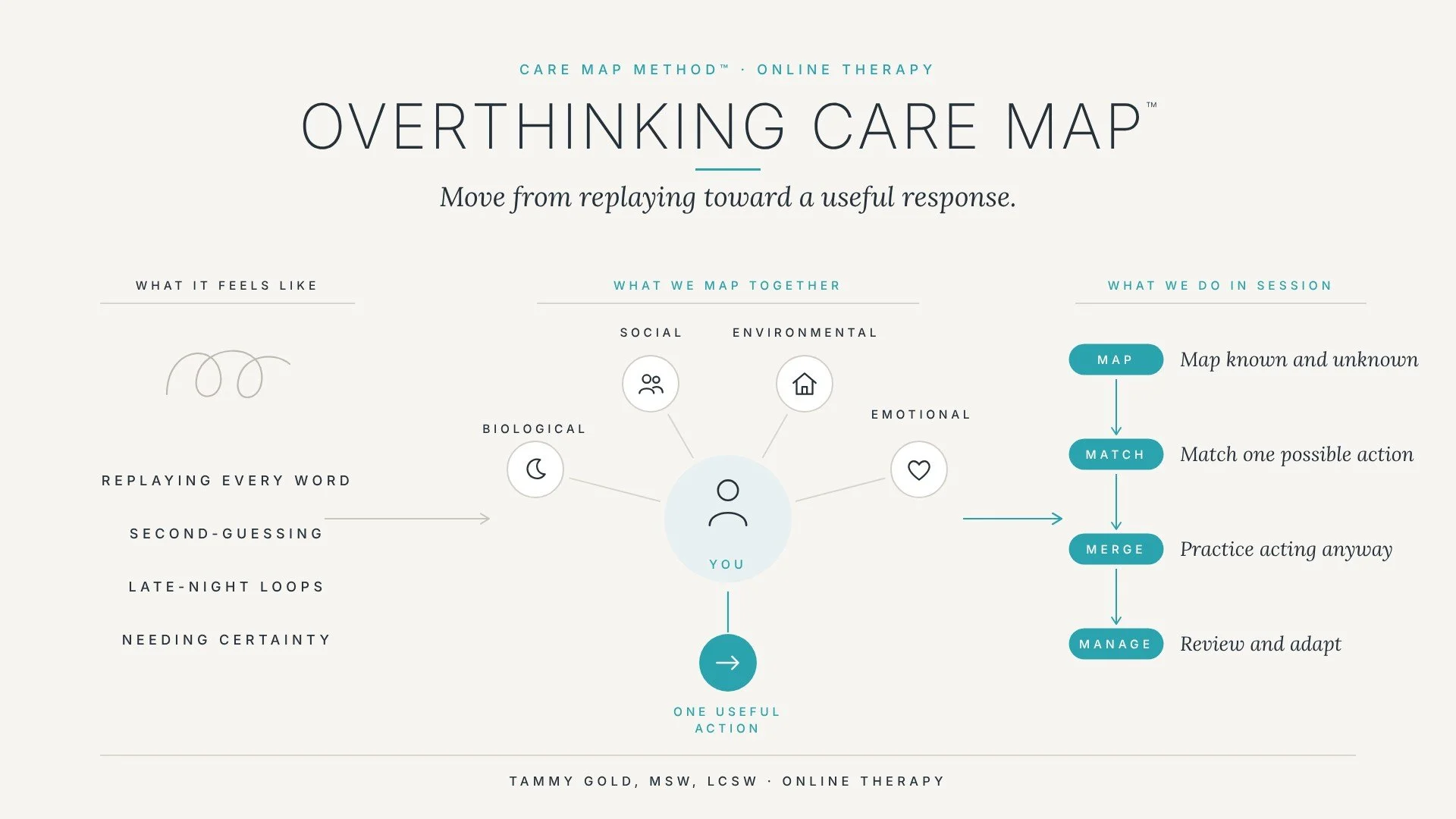
You replay what you said, revisit a decision or imagine how a conversation could go wrong. At first the thinking may feel useful. You are trying to prepare, avoid a mistake or understand another person. But after a while you may notice that you have more questions, less confidence and no clearer idea of what to do.
Therapy for overthinking can help you understand the pattern and its effect on your life. We can look at what starts the reviewing, what keeps it going and what you hope it will accomplish. The aim is not to stop all thought or replace every worry with a positive statement.
The different forms overthinking can take
You may review the past, predict future problems or repeatedly question your own choices. Some people seek reassurance from friends, search online or rewrite messages until they feel acceptable. Others keep concerns private and spend hours trying to reach certainty on their own. The same outward behavior can serve different purposes for different people.
We will assess the broader picture, including mood, sleep, concentration, anxiety and daily functioning. Repetitive thoughts can appear in several clinical contexts, so a webpage cannot determine what diagnosis or treatment is appropriate. If a specialized approach is needed, we can discuss that directly.
Understanding the question beneath the question
A repeated thought such as whether you sounded foolish may carry a deeper fear of rejection. Reconsidering a work decision may involve uncertainty about competence or responsibility. Sometimes the concern also reflects a genuine unresolved situation that needs action. We can make room for those possibilities without assuming every thought is meaningless.
In sessions we might distinguish a problem with an available next step from a question that cannot be settled with more mental reviewing. We can also examine self-criticism and the belief that enough preparation should prevent all regret. A more useful goal may be responding thoughtfully while accepting that some uncertainty remains.
Working with an everyday example
Imagine that you send a message and do not receive an immediate reply. You read it again, notice a phrase you wish you had changed and begin drafting an apology. Checking temporarily reduces tension, but soon you need to check again. Your attention moves away from the rest of your day.
We could examine the assumptions, the urge to repair and the effect of repeated checking. We might discuss a way to respond that fits the situation and your treatment plan. The work would also consider what the uncertainty means to you, rather than simply instructing you to stop looking at your phone.
Bringing insight into ordinary routines
Using the Care Map Method™, we MAP triggers and responses, MATCH the work to your clinical needs, MERGE what is useful into everyday situations and MANAGE the results. That might include noticing when you begin reviewing, identifying a concrete action or changing how you respond to self-critical thoughts.
Between-session practice should be manageable and purposeful. It should not become another task you feel compelled to perform perfectly. We can discuss what happened, including when a strategy did not help. Learning about the pattern is useful information, not evidence that you have failed therapy.
Progress without requiring a perfectly quiet mind
Some difficult thoughts may still occur even when the work is helping. Progress can involve spending less time following them, recovering attention more readily or making a decision without repeatedly asking for confirmation. We will define goals around your functioning and priorities, rather than promising that worry will disappear.
We can also address relationships and situations that keep uncertainty high. If someone communicates inconsistently or a role lacks clear expectations, your environment may need attention too. Therapy can help you make more deliberate choices about both your response and the circumstances around you.
About Tamara Gold
I am Tamara “Tammy” Gold, MSW, LCSW, CEC, a Columbia University-trained therapist, certified coach and author of Secrets of the Nanny Whisperer. My work with individuals and families informs a warm, collaborative approach that connects emotional understanding with practical next steps. Treatment is individualized to your needs; results and timelines vary.
Online appointments and insurance
Online appointments depend on your physical location at each session, clinical fit and current availability. Review my booking profiles to confirm whether I can serve you in your state. Selected insurance plans may be available through Headway or Alma. Coverage, medical-necessity requirements and your costs depend on your individual plan; a life problem alone does not establish insurance coverage.
Frequently asked questions
Is overthinking a diagnosis?
No. It is a common description of repeated thought patterns. Assessment considers whether anxiety, mood, obsessive-compulsive symptoms, stress or another concern may be involved. Treatment should follow that assessment.
Can therapy help me stop replaying conversations?
We can work on the meaning you assign to interactions, repeated reviewing and the impact on your day. Goals may include spending less time reviewing and responding more flexibly, rather than never remembering a conversation.
Why does reassurance only help for a little while?
Reassurance may reduce discomfort briefly without resolving the underlying uncertainty or pattern. We can examine how it functions in your situation and whether a different response would be more useful.
Will you teach me to think positively?
Therapy is not limited to replacing a negative thought with a positive one. We can consider accuracy, uncertainty, emotional meaning, behavior and the real conditions around the concern.
What if I really made a mistake?
We can separate appropriate repair or learning from prolonged punishment of yourself. A mistake may call for action, but repeated self-criticism does not necessarily make the action more effective.
Can we discuss sleep problems related to worry?
Yes. Sleep and worry can affect one another. We can assess the pattern and discuss whether medical evaluation or specialized sleep treatment would be useful alongside therapy.
Take the next step
If this sounds like the kind of support you need, review current appointment options and check insurance eligibility through my Headway or Alma profile. You can bring questions about fit, fees and the process before scheduling. You do not need a perfect explanation of the problem to begin.
My Adult Child Will Not Speak to Me
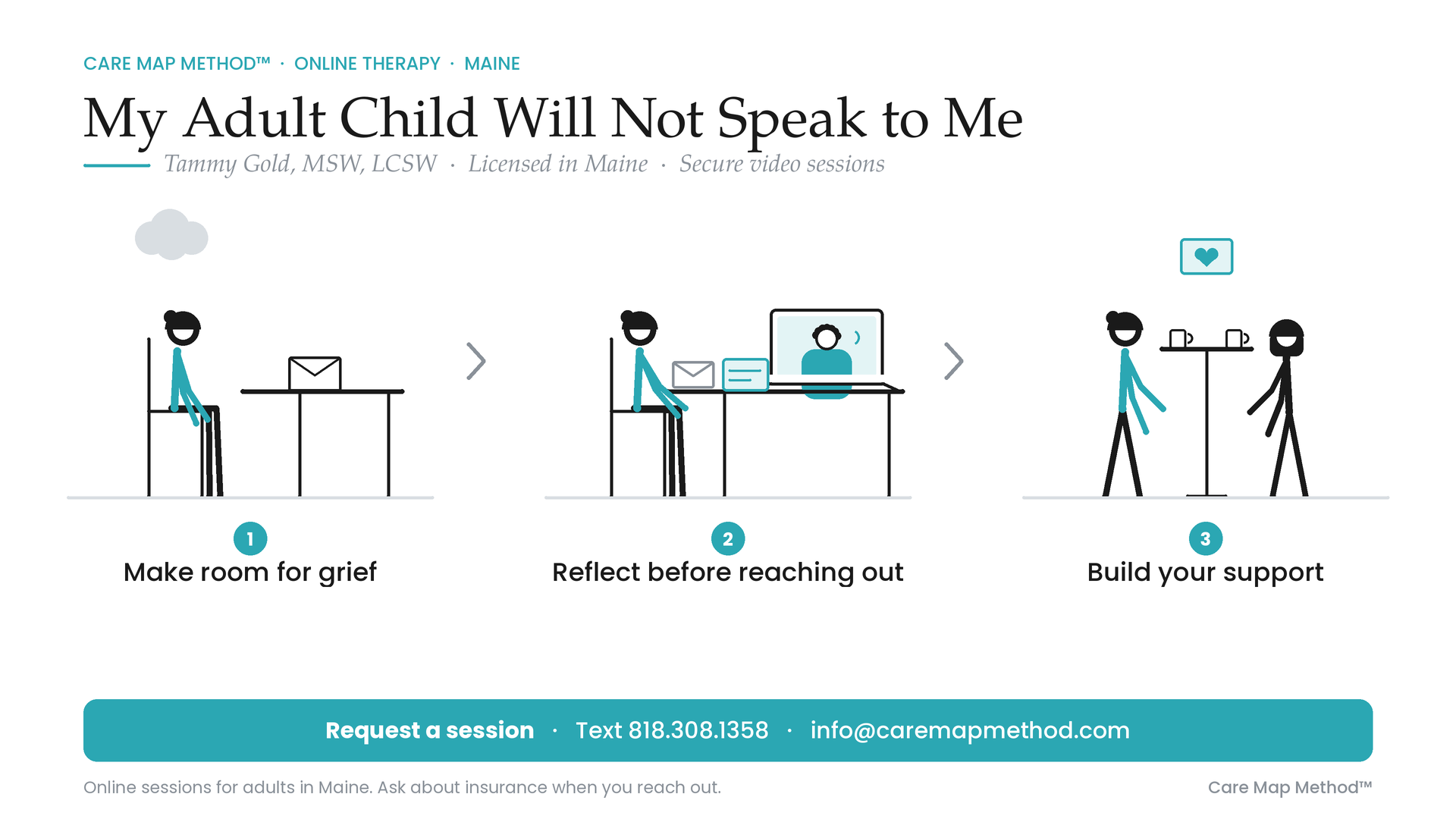
When an adult child stops communicating, grief can mix with confusion, anger, shame, and hope. You may reread messages, wonder whether to reach out again, or feel unable to talk openly with friends. Individual therapy gives you space to process the loss and examine your own experience without assuming either person is entirely to blame. I offer online therapy for adults located in Maine. We can explore accountability, boundaries, daily coping, and what respectful contact might look like if it is appropriate. Therapy cannot promise reconciliation. Use my Alma profile to check availability and your specific insurance benefits.
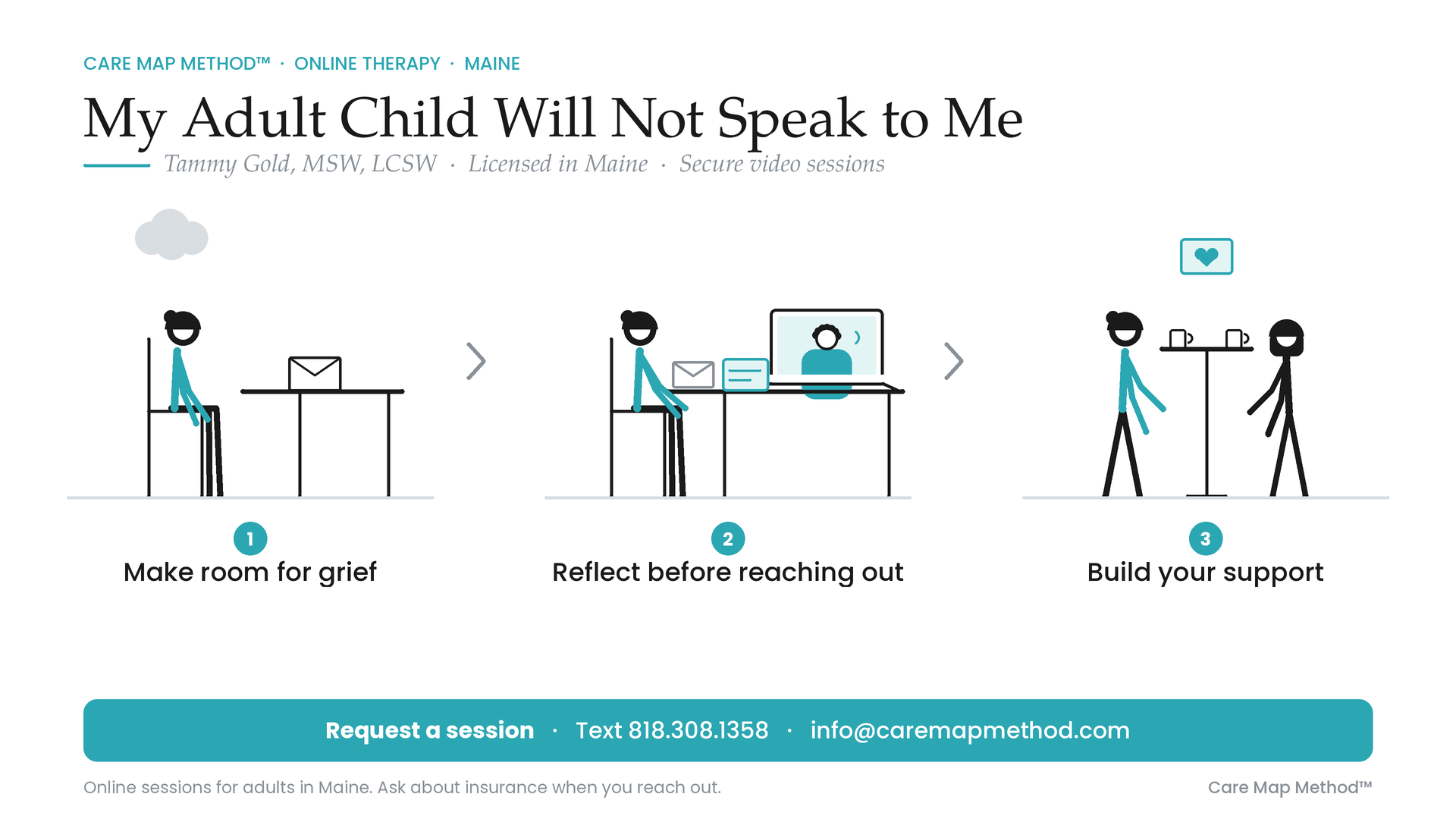
An adult setting aside an unsent letter while talking with a therapist on a laptop; another small scene shows the adult reconnecting with a supportive friend.
When there is no clear ending and no clear way forward
You may still think of your adult child throughout the day while having little or no contact. Holidays, photographs, or an ordinary family question can bring a fresh wave of sadness. You might alternate between wanting to explain yourself and feeling afraid that any message will make things worse.
I am Tammy Gold, LCSW. I offer online individual therapy for adults physically located in Maine. We can make room for the grief, uncertainty, and complicated feelings without rushing you toward forgiveness, repeated contact, or a particular family outcome.
Explore your experience without deciding the whole story
We can discuss how the estrangement affects mood, sleep, concentration, relationships, and daily life. We can also explore the history you bring, what your child has communicated, what you understand, and what remains unclear. Taking your pain seriously does not require dismissing their perspective.
Depending on your needs, sessions may involve grief, responsibility, limits, or the urge to keep seeking an answer. We can distinguish reflection that helps you learn from repetitive self-blame that keeps you stuck. We will not diagnose an absent family member or assume that a particular message will bring them back.
Use Care Map Method to organize what needs attention
Alongside clinical assessment, the Biological, Emotional, Social, and Environmental lens helps us consider how you are sleeping and functioning, the feelings involved, your support system, and situations such as holidays or social media that intensify distress.
MAP the trigger, such as seeing a photograph or receiving no reply. MATCH the need with a strategy for grief, support, accountability, or a boundary. MERGE that strategy into daily life, perhaps by preparing for a holiday or changing a checking habit. MANAGE communication and responses by reviewing what supports you and respects the other person’s limits. The framework is not a reconciliation protocol.
Consider contact carefully and rebuild support
Before sending a message, try writing an unsent version. What is its purpose? Does it acknowledge anything you can take responsibility for? Does it ask your child to manage your distress? Has your child requested no contact? We can examine these questions without assuming sending the message is the right next step.
Progress may involve fewer hours spent checking for a reply, more support outside the relationship, or greater ability to tolerate uncertainty. You can grieve and still participate in your own life. We will review what is helping you function and cope, while recognizing that renewed contact depends on more than your individual therapy work.
Insurance and next steps
I offer online individual therapy through Alma for eligible clients located in Maine. Use my profile to check your specific insurance plan, estimated cost, and appointment options. Network participation and benefits vary. Insurance coverage depends on assessment and the service provided; a concern named on this page does not automatically establish a covered diagnosis.
You do not need to have the whole situation figured out before reaching out. We can begin by understanding what is most difficult and deciding whether this service is a good fit.
Frequently asked questions
Can therapy make my adult child reconnect?
No. Therapy cannot guarantee contact or reconciliation. It can support your coping, reflection, accountability, boundaries, and choices about communication. Your adult child’s decisions and stated limits remain outside your control.
Do you take the parent’s side?
I work with you as the client while remaining open to complexity and missing information. We can take your pain seriously and explore responsibility without treating therapy as a judgment about who is entirely right or wrong.
What will we discuss first?
We begin with what is happening now, how it affects you, relevant history, supports, symptoms, and safety. You do not need to bring every message or prove your account. We can decide together what information is useful.
Can I use my insurance?
My Alma profile can check your exact Maine plan and estimated costs. Coverage depends on benefits, participation, clinical assessment, and the psychotherapy service. Support for estrangement does not automatically mean family mediation or reunification services are covered.
Can my adult child join later?
Any involvement would need a separate discussion of consent, goals, confidentiality, and suitability. We do not assume that inviting them is appropriate or that individual therapy automatically becomes family therapy.
How do I start individual support?
Use “View Maine Availability on Alma” to explore an appointment. A general description of your concern is enough for an initial inquiry. You can begin even if you are unsure what you want to do about the relationship.
About Tammy Gold
Tamara “Tammy” Gold, MSW, LCSW, CEC, is a Columbia University–trained clinical social worker, University of Pennsylvania graduate, certified coach, and founder of Care Map Method™. She is the author of Secrets of the Nanny Whisperer and brings more than 20 years of direct family work. Her therapy style is warm, collaborative, and practical, with attention to emotions, history, and everyday functioning.