

Therapy for Perfectionism and Imposter Syndrome
High standards can become exhausting when every mistake feels personal. Explore therapy for self-criticism, imposter feelings and the pressure to keep proving yourself.
Young adult reviewing a draft and notebook during an online therapy conversation.
When doing well never feels like enough
You finish a project and immediately notice what could have been better. Praise feels temporary or hard to believe. A small mistake can overshadow months of competent work. You may worry that other people will discover you are less capable than they think, even when there is evidence that you are doing the job.
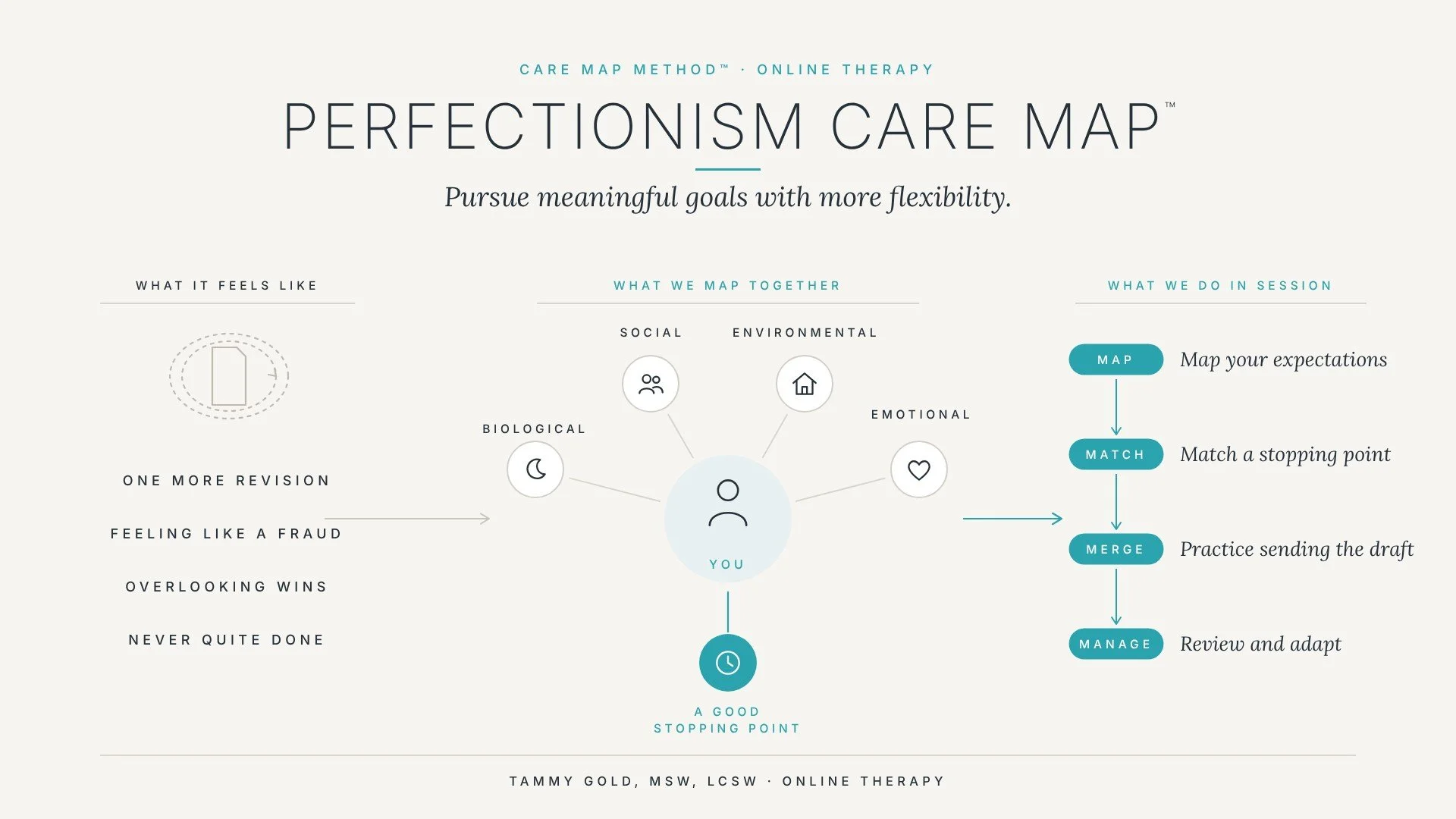
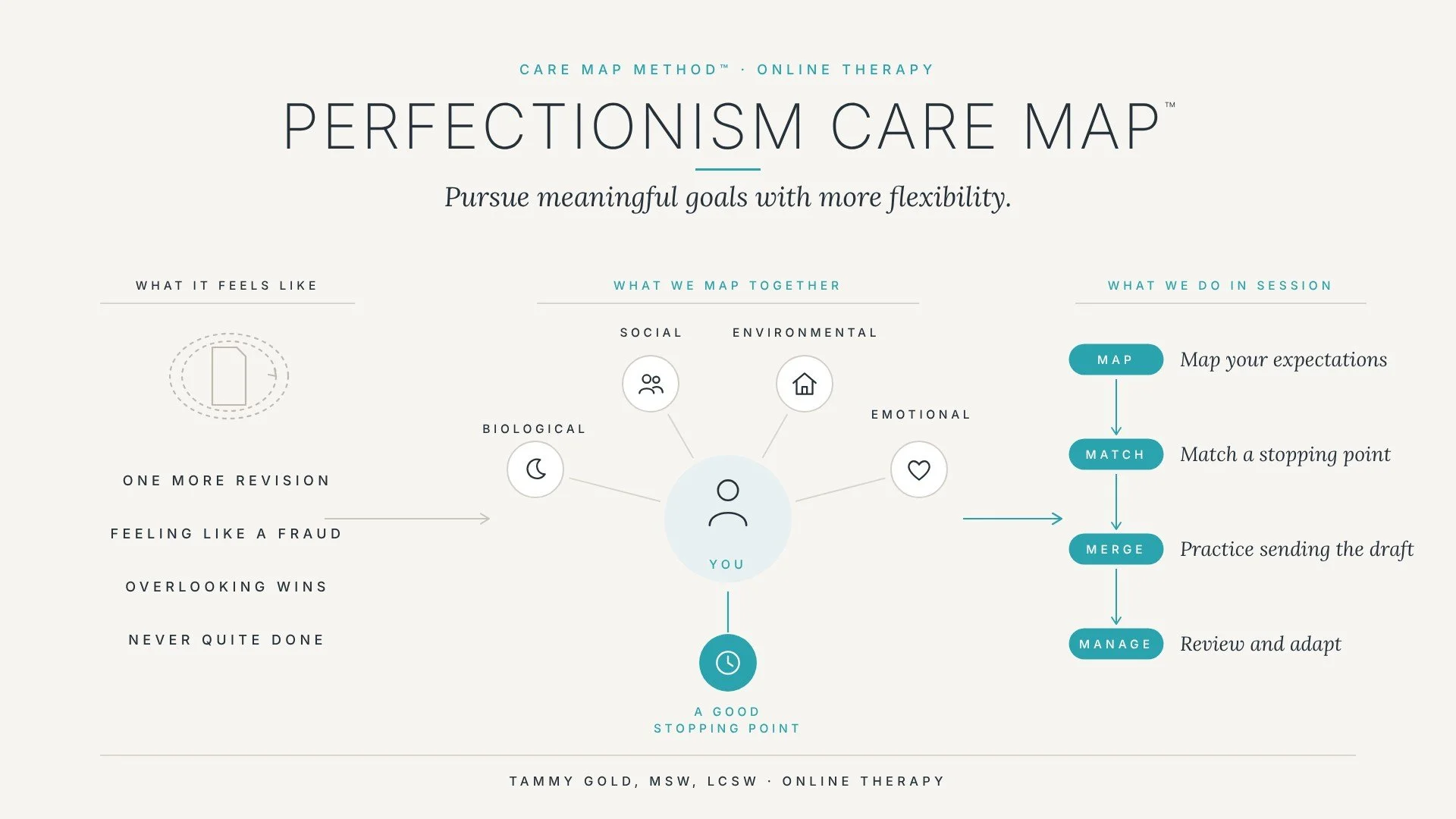
Therapy for perfectionism can help you understand the rules you use to evaluate yourself and the cost of trying to meet them. The aim is not to remove ambition or make you indifferent to quality. It is to explore whether your standards allow learning, rest and ordinary human limits.
How perfectionism can affect everyday life
Perfectionism does not always look organized. You may delay starting because the first attempt will not meet your expectations. You might check repeatedly, spend too long on minor decisions or avoid opportunities where you cannot be certain of success. Relationships can become strained when you apply the same rigid standards to yourself or other people.
We can look at how these patterns affect sleep, mood, work and connection. The important question is not simply whether you have high standards. It is whether the way you pursue them is narrowing your life, increasing distress or preventing you from acting on what matters.
Understanding imposter feelings without making them a diagnosis
Imposter syndrome is a familiar phrase for feeling fraudulent or undeserving despite achievements. It is not itself a formal diagnosis. The experience may also reflect an unfamiliar role, inconsistent feedback, exclusion or an environment in which your contributions are not recognized. We should not assume the problem exists only inside you.
In therapy we can examine what you believe competence should look like, how you interpret praise and what you do when you feel uncertain. We can also consider the effects of identity, culture, discrimination and earlier expectations. The work should make room for your actual context rather than ask you to think your way out of unfair conditions.
What we can work on together
We may explore self-critical thinking, fear of disappointment, repeated checking or difficulty accepting a result that is adequate for its purpose. We can practice responding to feedback, making decisions with incomplete information and separating responsibility from the belief that you must prevent every negative outcome.
The Care Map Method™ helps us MAP the pattern, MATCH the work to your clinical needs, MERGE useful changes into real situations and MANAGE what happens next. If the pattern suggests a need for more specialized assessment or treatment, we can discuss that rather than assume perfectionism is a complete explanation.
A practical example of changing the standard
Imagine that a short email takes forty minutes because you keep revising its tone. You worry that a slightly awkward sentence will make you look incompetent. In therapy we could explore the feared outcome, what level of care the task actually requires and what happens emotionally when you consider stopping.
A planned experiment might involve choosing a reasonable review limit for an appropriate low-stakes task. The point would not be proving that mistakes never happen. It would be learning how you respond to uncertainty and whether the extra checking is serving the purpose you believe it does. Any practice would be adapted to your situation and treatment plan.
Progress that includes being a person
You may continue to care deeply about your work while becoming less willing to sacrifice sleep, relationships or health to every detail. Progress might include finishing something sooner, asking for clarification without shame or recovering from criticism without turning it into a judgment about your entire worth.
We can also explore who you are outside achievement. Rest, enjoyment and connection do not have to be rewards you earn only after a perfect performance. Therapy can help you examine that belief while respecting the real responsibilities and ambitions in your life. We will review whether the work is helping and adjust the plan together.
About Tamara Gold
I am Tamara “Tammy” Gold, MSW, LCSW, CEC, a Columbia University-trained therapist, certified coach and author of Secrets of the Nanny Whisperer. My work with individuals and families informs a warm, collaborative approach that connects emotional understanding with practical next steps. Treatment is individualized to your needs; results and timelines vary.
Online appointments and insurance
Online appointments depend on your physical location at each session, clinical fit and current availability. Review my booking profiles to confirm whether I can serve you in your state. Selected insurance plans may be available through Headway or Alma. Coverage, medical-necessity requirements and your costs depend on your individual plan; a life problem alone does not establish insurance coverage.
Frequently asked questions
Will therapy make me less motivated?
The aim is not to remove meaningful goals. We can explore how to pursue them with more flexibility and less distress. Your own priorities help guide the work, including what you want to preserve about your ambition.
Is imposter syndrome a diagnosis?
No. It is an informal description of certain beliefs and feelings about competence or belonging. Assessment considers the broader symptoms and circumstances rather than using that phrase as a clinical diagnosis.
Can perfectionism lead to procrastination?
It can contribute when the fear of an imperfect result makes starting or finishing difficult. Other factors can also affect procrastination, so we will examine the pattern rather than assume a single cause.
Can we address overchecking at work?
Yes. We can assess what the checking accomplishes, how much it interferes and what clinical approach fits. Some patterns may call for specialized assessment or care, which we can discuss.
What if my job really requires accuracy?
Accuracy matters in many roles. We can distinguish required safeguards from extra reviewing driven by anxiety. Therapy should account for professional standards rather than encourage careless work.
Can I work on self-worth as well as work performance?
Yes. We can explore how you evaluate yourself across relationships, rest, achievements and setbacks. The work can include developing a broader sense of identity while addressing the concerns that brought you in.
Take the next step
If this sounds like the kind of support you need, review current appointment options and check insurance eligibility through my Headway or Alma profile. You can bring questions about fit, fees and the process before scheduling. You do not need a perfect explanation of the problem to begin.
Online Therapy in Maine for Parenting and Relationship Stress
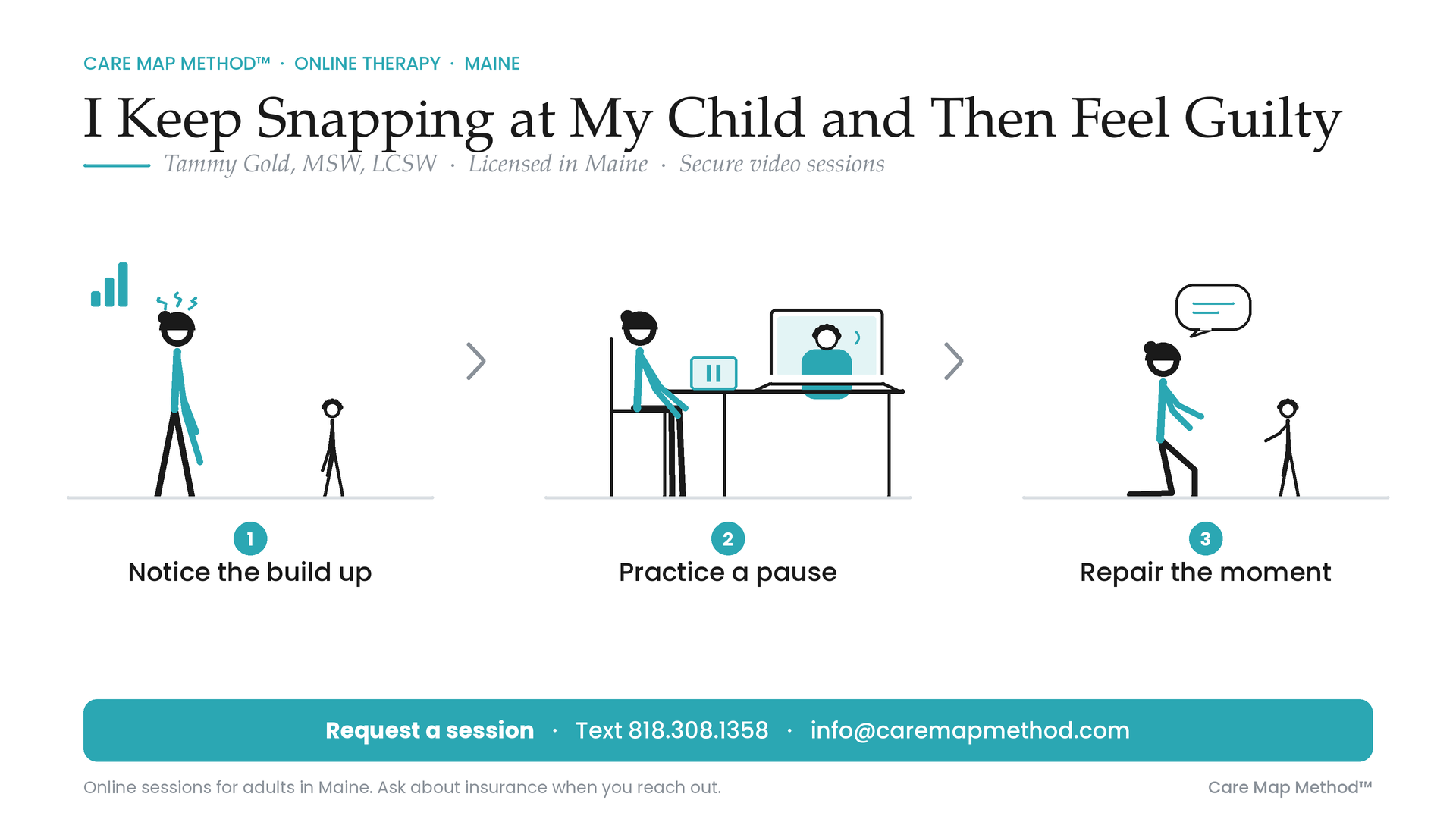
You promise yourself you will be more patient, then a rushed morning or repeated request ends in snapping. Later, guilt takes over. You may care deeply about your child and still need support with the pressures affecting your reactions. In online individual therapy for parents in Maine, we can explore what builds up before these moments, identify the feelings and needs underneath them, and practice responding and repairing. This is therapy for the parent’s well-being, with room for your history, stress, and relationships. View my Alma profile to check availability and your specific insurance eligibility.
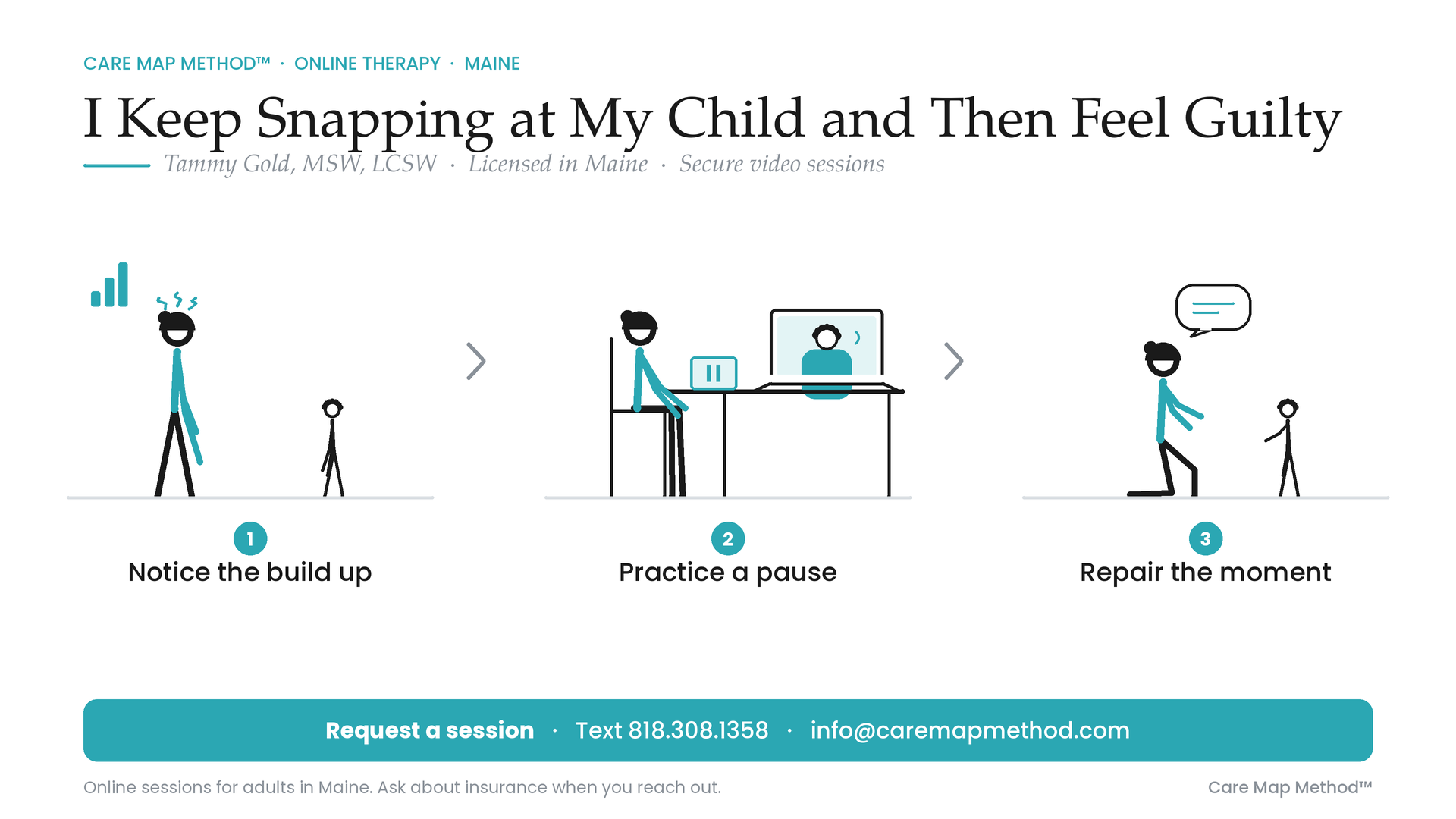
A parent pausing before responding, then sitting at a child’s level for a brief repair conversation; a separate small therapy scene shows the parent rehearsing words.
You care about your child and want a different response
You hear yourself raising your voice, and it is not how you wanted the morning to go. Perhaps everyone is late, you barely slept, and the same request has been ignored again. Afterward, you replay the interaction and worry about what it says about you as a parent.
I am Tammy Gold, LCSW. I offer online individual therapy for parents physically located in Maine. We can make room for the guilt without using it to define you. We also take the interaction seriously and work on what could help you respond differently.
Look at what builds before the moment
Parenting stress can involve competing demands, relationship tension, worry about your child, limited support, and expectations you place on yourself. We will also consider symptoms, health concerns, and relevant history rather than assume the problem is simply a lack of parenting techniques.
In sessions, we might review the hour before an outburst. What demands were arriving? What did you tell yourself about the behavior? Were you feeling ignored, unsupported, or afraid of losing control? Understanding that sequence can help us identify an earlier point to intervene. We can also explore the family patterns you hope to change and the support you need to do that.
Use the map to choose a manageable skill
Care Map Method™ organizes the concern alongside clinical assessment. Biological, Emotional, Social, and Environmental pressures include sleep and energy, guilt or frustration, family roles, and the daily setting in which difficult moments happen.
MAP the trigger and emotion before snapping. MATCH the need with a strategy, such as a pause, a shorter instruction, or a request for support. MERGE the strategy into one predictable situation, like leaving for school. MANAGE your responses by reviewing what happened and adjusting. We can explore deeper feelings as well as practical changes. The aim is not to expect perfect patience.
Practice repair and review realistic change
A repair might sound like: “I raised my voice. That was my responsibility. The limit still matters, and I want to say it differently.” We can adapt the language to your child’s age and the situation. Repair includes taking responsibility without making the child manage your guilt.
For a starting reflection, note one early sign that you are overloaded and one person or resource you might ask for help. We can review whether reactions become less intense or frequent, whether you notice overload sooner, and whether you recover and repair more effectively. If anger is becoming unsafe, we will address safety and appropriate support directly.
Insurance and next steps
I offer online individual therapy through Alma for eligible clients located in Maine. Use my profile to check your specific insurance plan, estimated cost, and appointment options. Network participation and benefits vary. Insurance coverage depends on assessment and the service provided; a concern named on this page does not automatically establish a covered diagnosis.
You do not need to have the whole situation figured out before reaching out. We can begin by understanding what is most difficult and deciding whether this service is a good fit.
Frequently asked questions
Does snapping mean I am a bad parent?
A difficult interaction does not define your whole relationship. It still deserves attention, especially if it repeats or feels out of control. We can explore your distress, accountability, and the support and skills you need.
Is this therapy for me or my child?
This page describes individual psychotherapy for the adult parent. We can discuss your parenting experiences and emotional responses. Assessment or treatment of your child would be a separate service and is not included automatically.
What happens during the first session?
We discuss current stress, symptoms, relevant history, family context, supports, and safety. You can share a recent parenting moment without preparing a complete explanation. We begin agreeing on priorities and whether the service fits.
Can I use insurance through Alma?
Check your specific Maine plan through my Alma profile. Coverage depends on active network participation, benefits, assessment, and the service provided. Parenting stress alone does not automatically establish an insurance-covered diagnosis or service.
Do you give parenting advice or explore emotions?
Our psychotherapy work can include emotional exploration, assessment, coping, and practical rehearsal. The balance depends on your needs. Standalone parenting coaching or childcare consulting is a different service with separate arrangements.
How do I request an appointment?
Use “View Maine Availability on Alma” to explore scheduling and benefits. If you need another time, use the profile’s contact option. Please keep detailed clinical information out of an initial general inquiry.
About Tammy Gold
Tamara “Tammy” Gold, MSW, LCSW, CEC, is a Columbia University–trained clinical social worker, University of Pennsylvania graduate, certified coach, and founder of Care Map Method™. She is the author of Secrets of the Nanny Whisperer and brings more than 20 years of direct family work. Her therapy style is warm, collaborative, and practical, with attention to emotions, history, and everyday functioning.
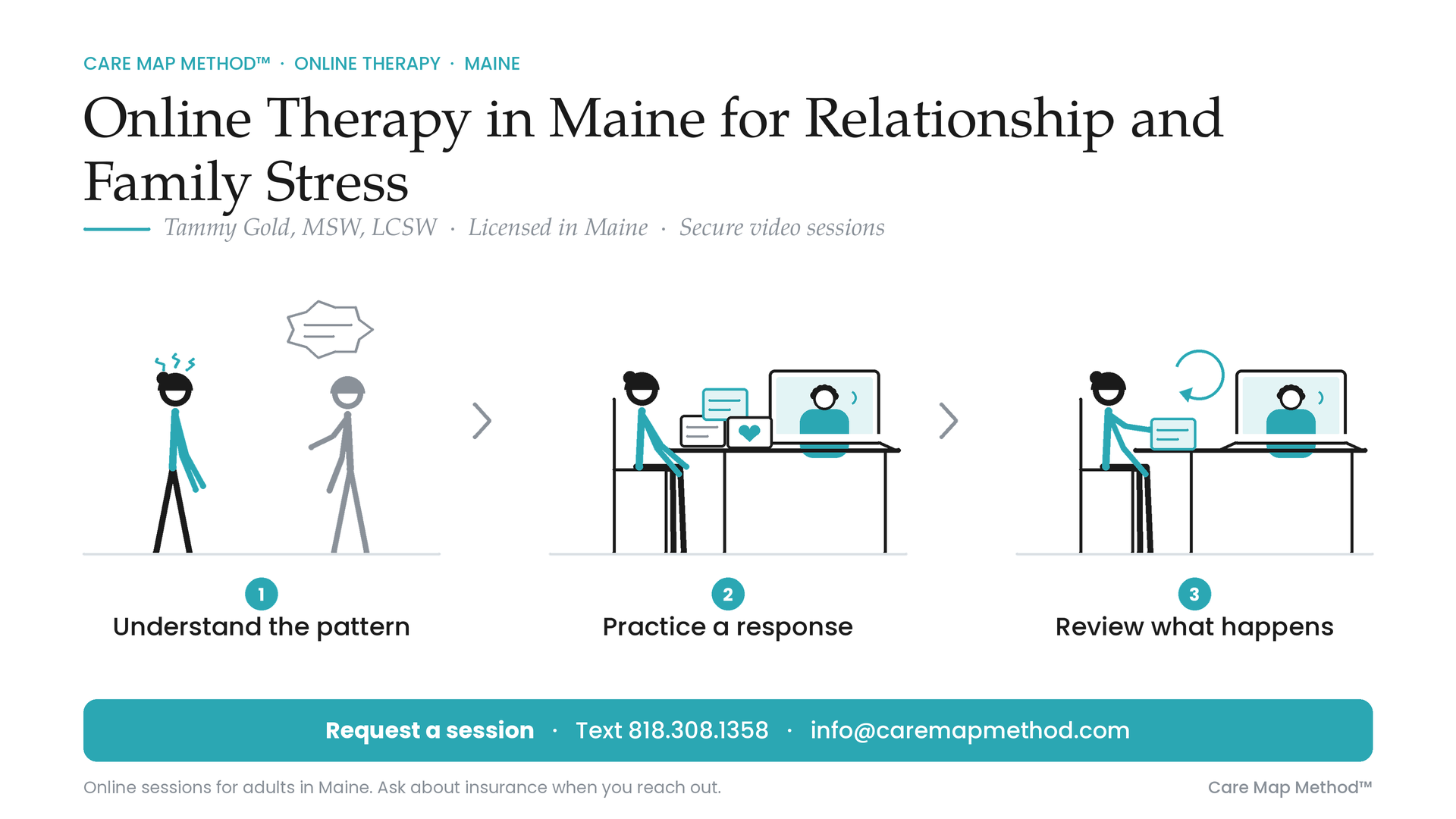
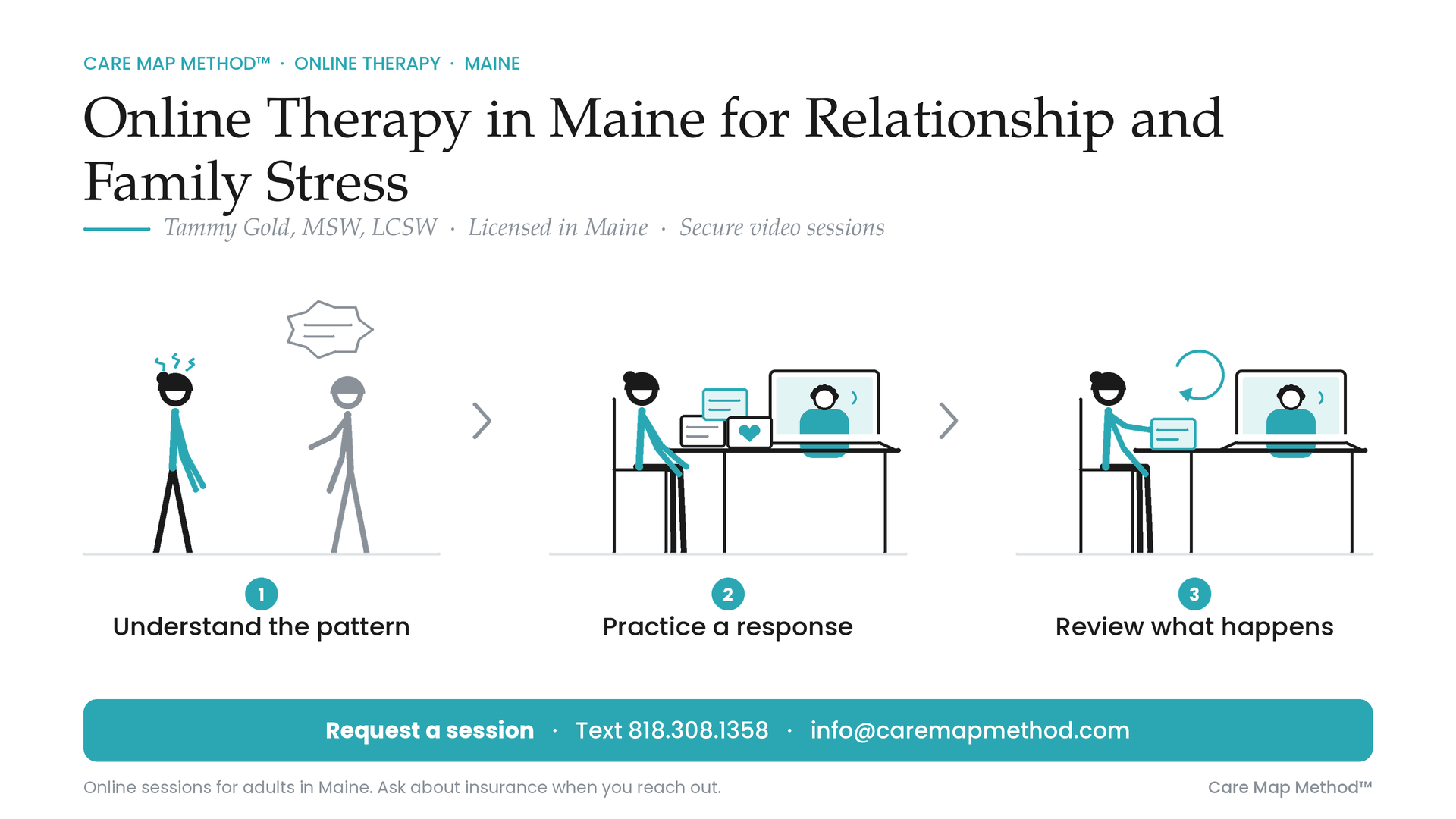
Online Therapy in Maine for Relationship and Family Stress
You may be keeping everything moving while feeling increasingly overwhelmed inside. Perhaps the same argument keeps returning, parenting takes more patience than you have left, or caring for a parent leaves little time for your own needs. I offer online individual therapy for adults located in Maine. Together, we can understand the pressures behind difficult moments and practice communication, boundaries, and coping skills that fit your life. My approach combines room for your emotions and history with practical work you can try between sessions. View my Alma profile to explore availability and check your specific insurance benefits.
When your responsibilities leave little room for you
You finish the day, but your mind is still running. You replay a conversation, worry about someone you love, or wonder why a small request brought such a strong reaction. You may look capable to everyone else while feeling worn down, resentful, or disconnected.
I am Tamara “Tammy” Gold, MSW, LCSW, CEC. I provide online individual therapy for adults physically located in Maine. You can come for support with your own distress even when the problem involves a partner, child, sibling, parent, or coworker. We begin with your experience and what you would like to change.
What we can work on together
Our work may focus on recurring arguments, parenting overwhelm, caregiver guilt, difficulty saying no, divorce adjustment, or stress during a major family transition. We can explore how these concerns affect your mood, sleep, concentration, relationships, and daily functioning.
In a session, we might examine one recent interaction rather than trying to solve your entire family situation at once. What did you hear? What did it mean to you? What did you need? We can practice turning “Nobody helps me” into a specific request, or prepare a boundary you have been avoiding. Your history and emotions matter throughout this work.
A practical framework for understanding the pattern
I use Care Map Method™ as an organizing framework alongside clinical assessment and individualized psychotherapy. Biological, Emotional, Social, and Environmental factors help us consider the whole situation, including sleep, health pressures, feelings, relationships, routines, and available support.
MAP the emotion and trigger: identify what happened and the meaning you attached to it. MATCH the need with a strategy: choose a coping skill, request, or boundary that addresses the concern. MERGE the strategy into daily life: rehearse the words and decide when to use them. MANAGE communication and responses: review what happened and adjust. The framework supports our work; it is not a guarantee or a separately validated treatment.
A place to begin and a way to review progress
Before your first session, consider finishing this sentence: “One situation I would like to handle differently is…” Choose a recent example and describe what happens before, during, and after it. You do not need a polished explanation or a diagnosis to reach out.
We will agree on priorities and revisit whether therapy is helping. Progress might include recovering sooner after an argument, communicating a need more directly, or noticing overwhelm before it becomes snapping. We can also review symptoms and daily functioning. If something is not helping, I want us to discuss it and change the approach.
Insurance and next steps
I offer online individual therapy through Alma for eligible clients located in Maine. Use my profile to check your specific insurance plan, estimated cost, and appointment options. Network participation and benefits vary. Insurance coverage depends on assessment and the service provided; a concern named on this page does not automatically establish a covered diagnosis.
You do not need to have the whole situation figured out before reaching out. We can begin by understanding what is most difficult and deciding whether this service is a good fit.
Do I need a major crisis to start therapy?
No. Ongoing worry, resentment, relationship strain, or difficulty coping can be reasons to seek an assessment. We will discuss what is happening, how it affects your life, and whether individual psychotherapy is a suitable service.
Can I attend without my partner or family?
Yes. Individual therapy can address your emotions, coping, communication, and decisions even when another person is not attending. We cannot control that person’s behavior or promise family agreement.
What happens in the first session?
We discuss your concerns, relevant history, current supports, symptoms, safety, and goals. You can ask questions about my approach. We begin deciding what to focus on and whether we are a good fit.
Can I use insurance through Alma?
Visit my Alma profile and enter your specific plan to check eligibility and estimated cost. State participation, network status, benefits, and the service provided matter. A carrier’s name alone does not establish coverage.
Do I need to live in a particular Maine city?
Sessions are online for eligible adults physically located in Maine at the time of the appointment. You need a private setting and a reliable connection. Tell me about travel before a session so we can check whether care can continue.
How do I request an appointment?
Use the “View Maine Availability on Alma” button to explore scheduling and insurance options. If the available times do not work, use the contact option on my profile to ask about availability. Avoid sending sensitive clinical details in a general inquiry.
About Tammy Gold
Tamara “Tammy” Gold, MSW, LCSW, CEC, is a Columbia University–trained clinical social worker, University of Pennsylvania graduate, certified coach, and founder of Care Map Method™. She is the author of Secrets of the Nanny Whisperer and brings more than 20 years of direct family work. Her therapy style is warm, collaborative, and practical, with attention to emotions, history, and everyday functioning.