

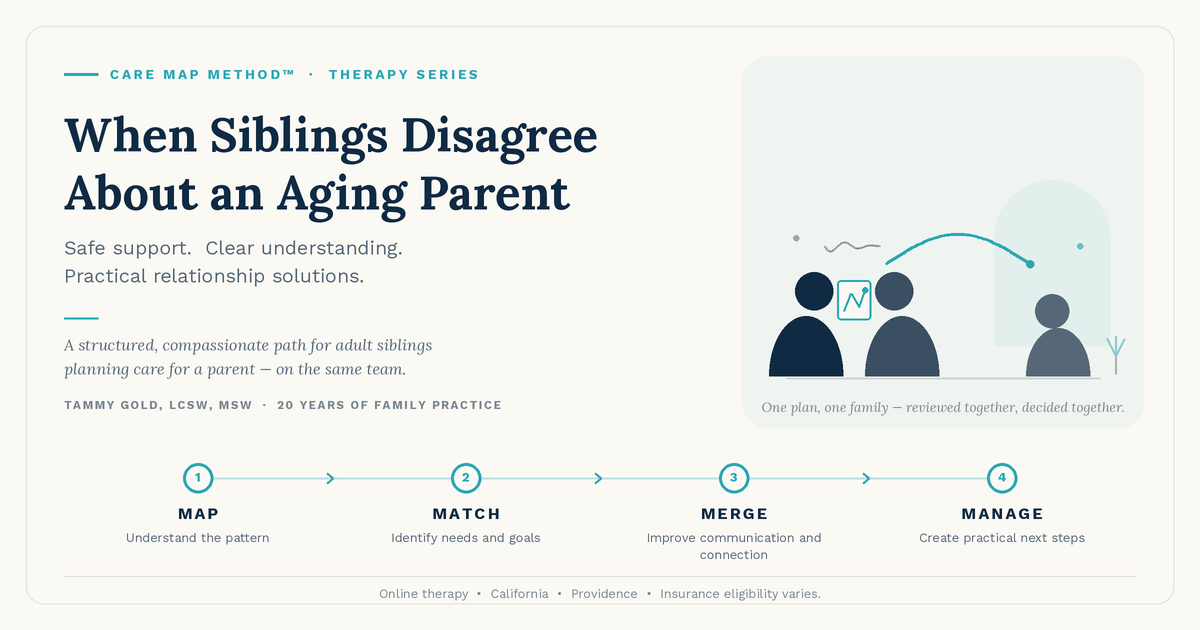
Providence Therapy in California for Sibling Conflict Over an Aging Parent
Online therapy in California for siblings arguing about an aging parent, caregiver burden, eldercare decisions, and family communication. Verify Providence benefits.
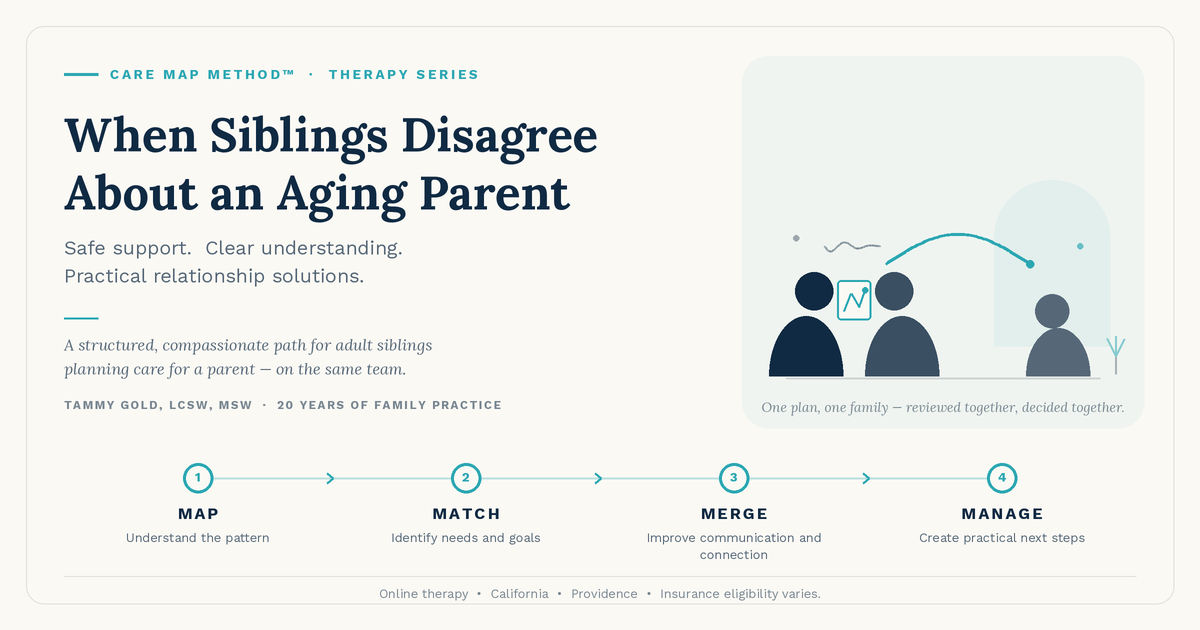
Providence therapy in California for sibling conflict, aging-parent care decisions, caregiver stress, and family communication.
Providence Therapy in California for Sibling Conflict Over an Aging Parent
A parent’s decline can reopen old sibling roles and create urgent disagreements about safety, money, housing, medical care, driving, and who should do what. One sibling may feel abandoned with the work. Another may feel criticized or excluded. Everyone may believe they are protecting the parent, yet the family becomes less able to make decisions together.
You do not have to carry this alone. My goal is to provide a warm, confidential, and nonjudgmental space where you can unpack what is happening without shame, blame, or pressure. Therapy can offer emotional support and practical direction at the same time.
Therapy creates a structured space to separate the care problem from the sibling history. We identify facts, fears, capacities, and practical limits. Each person’s concern can be heard while the family develops clearer communication, roles, and next steps. The goal is not perfect agreement; it is a safer, more workable process.
ONLINE THERAPY IN CALIFORNIA
Insurance may be available through Headway depending on your plan, eligibility, state, and session type. Verify benefits before booking.
What clients can work toward
Reduce blame among siblings
Clarify realistic roles and responsibilities
Make decisions from the full care picture
Protect the parent and the sibling relationships
Therapy is not only a place to talk about what went wrong. It is a place to feel heard, understand the pattern, practice healthier responses, and build a plan that can be used in daily life. Progress depends on the circumstances and cannot be guaranteed, but the work can become clearer, more intentional, and more supported.
Frequently asked questions
Can therapy help siblings agree about eldercare?
Therapy may not produce complete agreement, but it can improve communication, clarify facts and capacities, reduce blame, and create a more workable decision process.
Does Providence cover this type of therapy?
Benefits vary by plan, clinical eligibility, state, and platform. Verify current coverage before scheduling.
Can I attend without my siblings?
Yes. Individual therapy can help you manage caregiver stress, set limits, prepare conversations, and decide what you can realistically provide.
How do we divide caregiving fairly?
Fair does not always mean equal. Roles should reflect time, distance, finances, skills, health, and willingness. A structured care map can make those differences visible.
What if a parent refuses help?
Therapy can help the family assess risk, respect autonomy where possible, communicate concerns, and decide what actions are appropriate within legal and ethical limits.
When is specialized eldercare guidance needed?
Professional medical, legal, financial, or care-management expertise may be needed for capacity, safety, placement, benefits, or complex medical decisions.
Final booking call to action
You deserve one place where you can be honest without worrying about judgment, shame, or blame. Together, we can understand what is happening, identify what needs to change, and create practical steps toward a healthier relationship and a more manageable life.
Verify your insurance and request an online therapy appointment through my Psychology Today / Headway booking path.
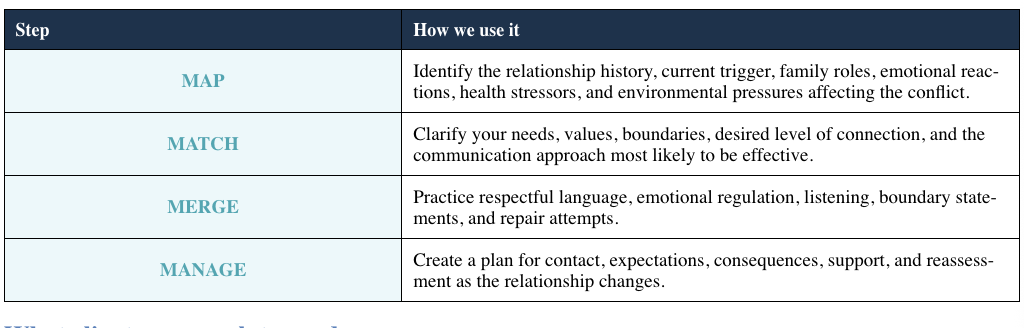
Providence therapy in California for sibling conflict, aging-parent care decisions, caregiver stress, and family
Caring for Children and Aging Parents at the Same Time
Adults caring for children and aging parents often face competing needs, financial pressure, guilt, and relationship strain. Learn how to create a more workable family care plan.
The sandwich generation describes adults who are supporting children while also helping aging parents or other older relatives. The term sounds simple, but the lived experience can involve dozens of competing responsibilities: school schedules, college planning, work deadlines, medical appointments, insurance questions, sibling disagreements, household needs, and unpredictable emergencies.
The central problem is often not a lack of love. It is that several people legitimately need you at the same time, while your own needs remain last on the list.
Why this stage is uniquely demanding
Middle adulthood was once imagined as a relatively stable period. In reality, it may involve parenting teenagers or young adults, caring for parents with increasing medical or cognitive needs, maintaining a career, managing a household, and navigating changes in marriage, health, and identity.
Each role has different emotional expectations. Children may need encouragement and independence. Aging parents may need protection while resisting loss of control. Employers may expect consistent performance regardless of what is happening at home. You may feel pulled in opposite directions all day.
The invisible mental load
The sandwich generation often carries a large amount of cognitive labor: remembering who needs what, anticipating problems, researching options, following up with professionals, and managing communication among family members.
This mental load can be exhausting even when the visible tasks seem manageable. You may sit at work while thinking about a parent's fall risk, then attend a child's event while worrying about an unanswered medical message. Your body is in one place while your mind is coordinating several systems.
Common emotional patterns
Several emotional experiences are especially common:
Guilt that someone is always receiving less attention than they need
Resentment followed by shame for feeling resentful
Anxiety about a parent’s safety or decline
Fear that caregiving will interfere with work or financial stability
Conflict with a spouse about time, money, privacy, or unequal labor
Anger toward siblings who appear less involved
Sadness about a child leaving home while a parent becomes more dependent
Loss of identity outside the roles of employee, parent, partner, and caregiver
How the pressure affects couples
Sandwich-generation stress can expose existing differences in how partners define responsibility. One partner may feel morally obligated to provide extensive hands-on care. The other may worry about finances, the children, or the impact on the household.
These disagreements are not always evidence that one partner is caring and the other is selfish. They may reflect different fears, family histories, and thresholds for risk. Productive conversations focus on specific capacities and consequences rather than accusations about character.
Mapping competing needs instead of reacting to emergencies
A useful first step is to stop treating every demand as equally urgent. The Care Map Method™ organizes needs across biological, emotional, social, and environmental domains and then separates immediate safety issues from important but nonurgent concerns.
For an aging parent, an immediate issue may be medication confusion or unsafe driving. For a teenager, it may be a mental health concern or school crisis. Other needs may be important but schedulable. A written map allows the family to see where professional support, shared responsibility, or a change in expectations is required.
A practical family capacity assessment
Ask these questions before agreeing to a new responsibility:
What exactly is being requested?
How often will it occur, and for how long?
What will I have to stop doing in order to take this on?
Could another person, service, or professional complete part of it?
Is this a true emergency, or has the family delayed planning until the issue feels urgent?
What boundary would make this responsibility manageable?
Reducing guilt through clearer roles
Guilt often grows in vague situations. When no one has defined who is responsible for what, the most responsive person may feel accountable for everything.
Clear roles do not eliminate sadness or difficult decisions, but they reduce confusion. A family care plan might specify who attends medical appointments, who manages finances, who handles weekly calls, and what will trigger a move to more professional support. Parenting responsibilities can be mapped in the same way so that one system does not silently consume all available energy.
Protecting your work and financial stability
Many adults underestimate the professional cost of ongoing caregiving. Missed work, reduced concentration, unplanned travel, and frequent interruptions can affect income and career progression.
Protecting your employment is not a sign that you care less. Your financial stability may be essential to your children, your future, and your ability to assist an aging parent. Therapy can help you make decisions that account for long-term consequences rather than responding solely to immediate guilt.
How therapy can help
Therapy can help sandwich-generation adults clarify priorities, communicate with spouses and siblings, set limits, process anticipatory grief, and recognize when they have moved from healthy responsibility into chronic overfunctioning.
It can also provide a consistent space in which you are not required to care for anyone else. That alone can be meaningful when nearly every relationship has become organized around another person's needs.
Creating a sustainable next step
You do not need to solve every future problem today. Begin by identifying the most unstable part of the system. It may be a parent's home safety, a sibling communication problem, a teenager's needs, or your own exhaustion.
Addressing one clearly defined pressure point is often more effective than attempting to become more efficient at carrying an impossible load.
Ready for support?
If you are caring for children and aging parents while trying to preserve your work, health, and relationships, therapy can help you clarify priorities and reduce the strain. Tammy Gold, MSW, LCSW, CEC, provides confidential virtual therapy for adults located in California, New Jersey, and Oregon.
Book through Psychology Today: https://www.psychologytoday.com/us/therapists/tamara-jill-gold-los-angeles-ca/17
Learn more: CareMapMethod.com
About Tammy Gold
Tammy Gold, MSW, LCSW, CEC, is the founder of Care Map Method™, a licensed clinical social worker in California, New Jersey, and Oregon, a certified coach, and the author of Secrets of the Nanny Whisperer. Her work centers on relationships, caregiving, burnout, parenting transitions, workplace stress, women’s midlife concerns, and practical support during major life changes.
Educational notice: This article is for general educational purposes and is not a substitute for individualized medical or mental health care. If you are experiencing an emergency or immediate safety concern, contact emergency services or an appropriate crisis resource in your area.
What are common signs of caregiver burnout?
Signs may include exhaustion, irritability, resentment, guilt, sleep problems, reduced concentration, withdrawal, health changes, hopelessness, and feeling unable to keep up with care demands.
How can therapy help caregiver burnout?
Therapy can help caregivers process emotions, identify unsustainable demands, set boundaries, communicate with family, ask for help, and develop a more realistic care plan.
Is it normal to feel resentful while caregiving?
Yes. Resentment can develop when responsibilities are excessive, support is limited, boundaries are unclear, or the caregiver’s own needs are repeatedly postponed. Feeling resentment does not mean you do not love the person.
What if my siblings will not help?
Therapy or coaching can help you clarify what you need, prepare a family conversation, define responsibilities, set limits, and decide what you can realistically continue providing.
How do I know when more professional care is needed?
Consider changes in safety, cognition, mobility, medication, nutrition, hygiene, isolation, wandering, falls, caregiver capacity, and whether current arrangements are sustainable.
Can I care for someone without losing myself?
That is a central goal. Sustainable caregiving requires support, boundaries, realistic expectations, shared responsibility where possible, and attention to the caregiver’s health and identity.
What Care Map worksheet pairs with caregiver burnout?
A Caregiver Burnout Snapshot, Family Capacity Assessment, Weekly Care Plan, Boundary Planner, or Biological-Emotional-Social-Environmental Care Map can help organize the situation.
When is caregiver burnout an emergency?
Seek urgent professional help when there is immediate danger, inability to provide safe care, abuse or neglect concerns, severe medical or psychiatric symptoms, or thoughts of harming yourself or someone else.
Why High-Functioning Adults Still Feel Anxious, Exhausted, and Overwhelmed
This should be the first therapy-focused blog because it aligns with the clients most likely to find you through Psychology Today and book through Headway: capable adults managing work, parenting, relationships, caregiving, and major life transitions while privately feeling depleted.
You may be meeting deadlines, caring for your family, managing appointments, answering messages, and keeping everyone else organized.
From the outside, you appear capable.
Inside, however, you may feel anxious, emotionally depleted, irritable, or unable to fully relax.
This experience is common among high-functioning adults. You may continue performing well even while your internal stress level keeps rising. Because your responsibilities are still being handled, other people may not recognize how overwhelmed you feel.
You may even question whether you are “struggling enough” to need therapy.
Therapy is not reserved for people who have stopped functioning. It can also help people who are functioning at a high level but paying an increasingly significant emotional and physical price.
What Does “High-Functioning Anxiety” Mean?
“High-functioning anxiety” is not a formal diagnosis. It is a phrase often used to describe people who appear organized, productive, or successful while experiencing persistent anxiety beneath the surface.
You may be:
dependable and responsible
highly prepared
sensitive to mistakes
uncomfortable disappointing others
constantly anticipating what could go wrong
reluctant to ask for help
unable to rest without feeling guilty
mentally reviewing conversations and decisions
functioning through exhaustion
These qualities may help you succeed professionally or manage a complicated family life. Over time, however, the same patterns can contribute to chronic tension, emotional fatigue, sleep problems, resentment, and burnout.
Why Capable Adults Often Miss the Signs
High-functioning adults are often accustomed to solving problems.
When stress increases, they may respond by becoming even more organized, productive, or controlling. They create more lists, work longer hours, take on additional responsibilities, and try harder to prevent mistakes.
This can temporarily create a sense of control.
But increased effort does not always address the underlying anxiety. It may instead reinforce the belief that everything will fall apart unless you personally manage every detail.
Because you continue functioning, it can be difficult to recognize that your coping system is becoming unsustainable.
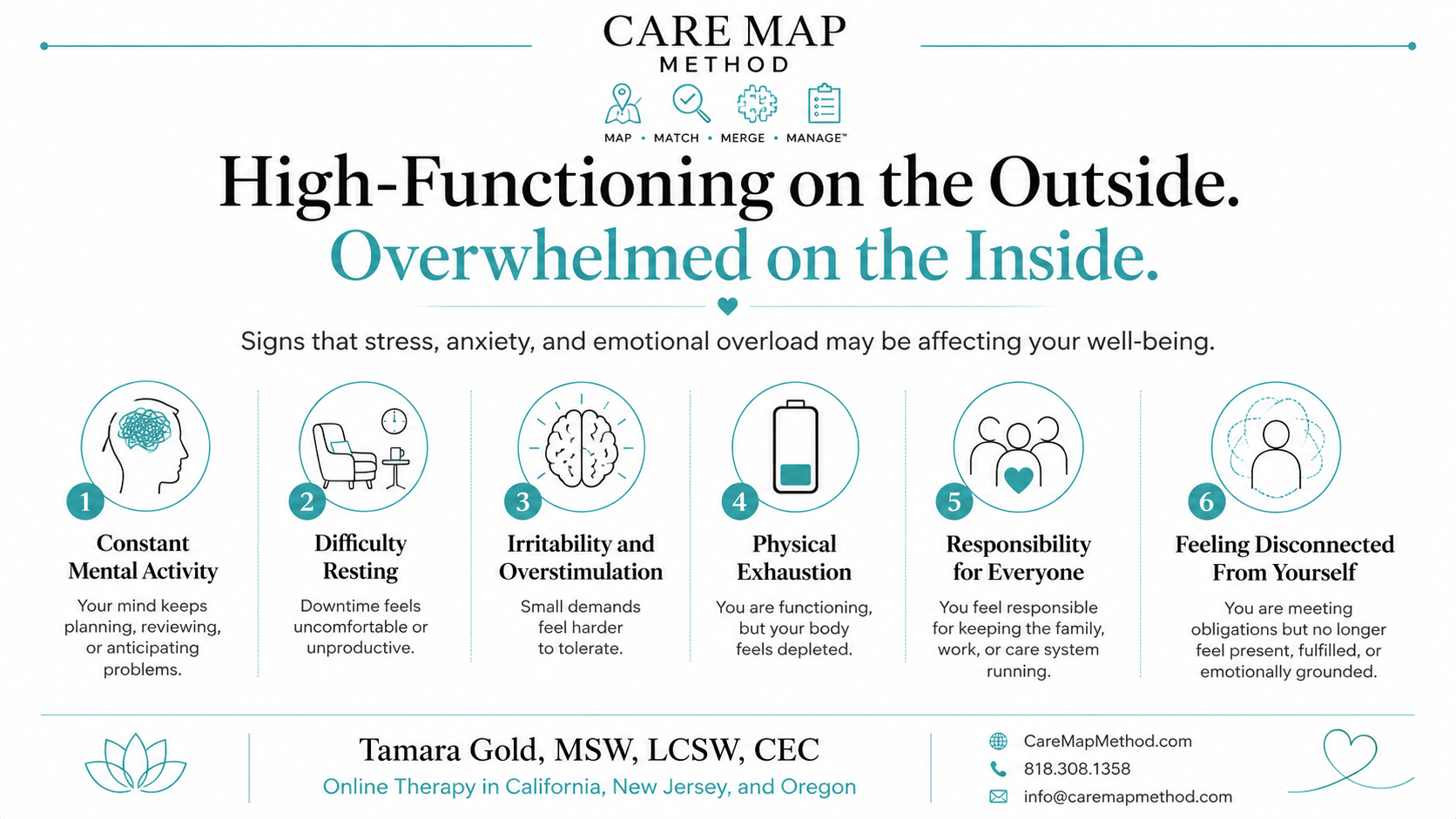
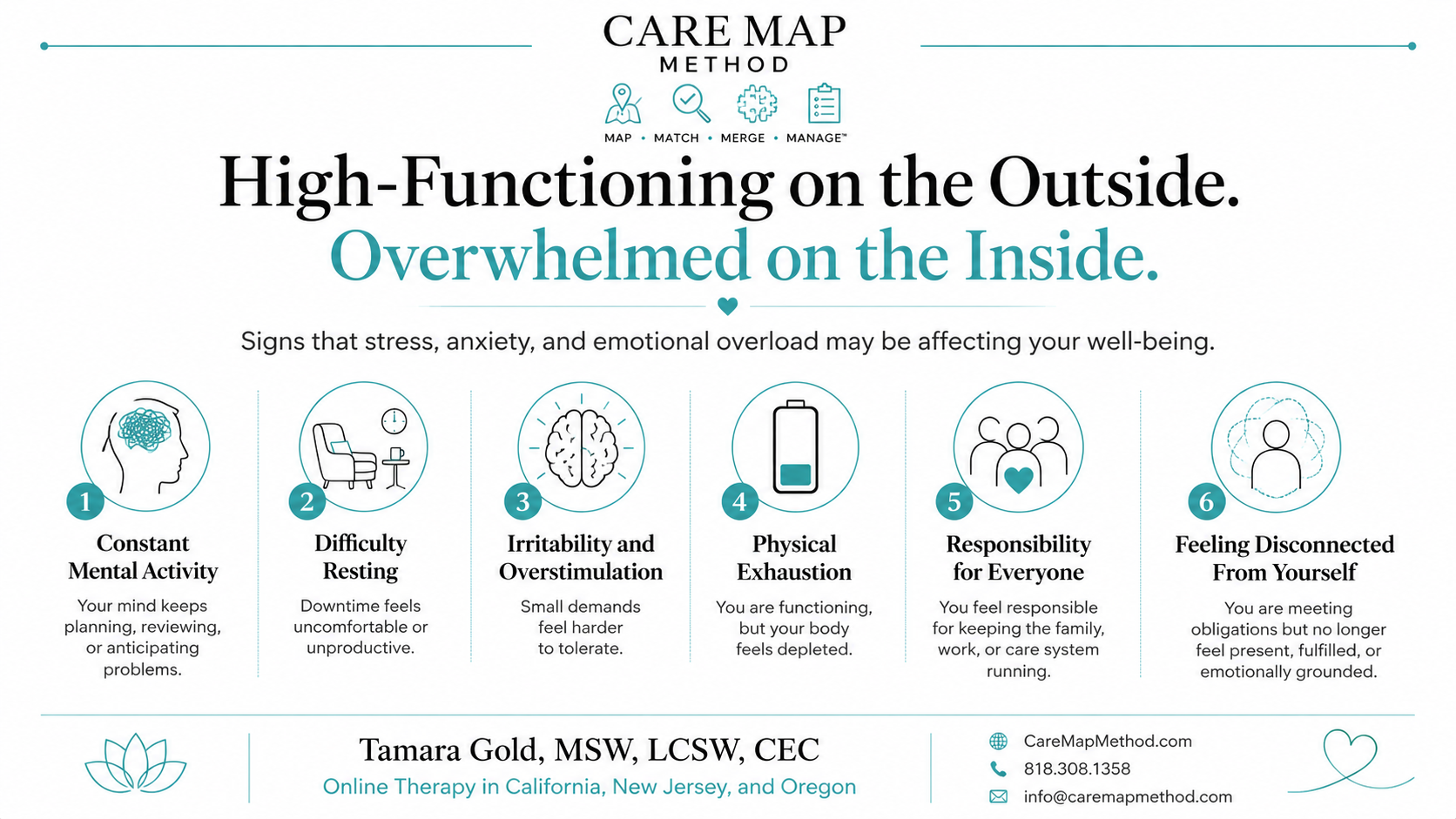
Signs That Emotional Overload May Be Building
Stress does not always appear as panic or visible distress. It may appear through subtle patterns that gradually become your normal way of living.
1. Your mind is rarely quiet
You may constantly plan, rehearse, anticipate, or review.
Even when nothing urgent is happening, your mind may search for the next problem to solve.
2. You cannot fully enjoy downtime
You may sit down to rest but immediately think about unfinished tasks.
Rest may feel uncomfortable, undeserved, or unproductive.
3. Small demands feel disproportionately difficult
A text message, schedule change, interruption, or minor mistake may feel far more upsetting than it once did.
This does not necessarily mean you are overreacting. It may mean your nervous system is already carrying too much.
4. You feel responsible for everyone
You may believe it is your job to manage other people’s emotions, prevent conflict, remember every detail, and keep the family or workplace functioning.
This can leave little space for your own needs.
5. Your body feels exhausted even when you keep going
Chronic stress can show up as muscle tension, headaches, disrupted sleep, stomach discomfort, fatigue, restlessness, or difficulty concentrating.
You may still complete your responsibilities while feeling physically depleted.
6. You are becoming more irritable or emotionally distant
When your emotional resources are exhausted, you may become impatient, withdrawn, numb, or easily overstimulated.
You may care deeply about the people around you while feeling increasingly unable to engage with them.
7. You no longer feel like yourself
You may be accomplishing everything expected of you but feel disconnected from joy, creativity, confidence, or meaning.
Life may begin to feel like one obligation after another.
Why Parenting and Caregiving Can Intensify These Patterns
Parents and caregivers frequently manage both visible and invisible responsibilities.
Visible tasks include appointments, transportation, meals, work, school, medications, paperwork, and household logistics.
Invisible tasks include:
anticipating everyone’s needs
monitoring emotional well-being
preventing conflict
remembering deadlines
researching options
making difficult decisions
managing guilt
worrying about what may happen next
When you are the person everyone relies on, it can feel risky to slow down.
You may fear that asking for help will burden other people or expose areas where you do not feel fully in control.
Therapy can provide a private space where you are not required to care for, organize, or protect anyone else.
High-Functioning Anxiety Versus Burnout
Anxiety and burnout can overlap, but they are not identical.
Anxiety often involves:
persistent worry
fear of mistakes
overpreparation
difficulty tolerating uncertainty
physical tension
trouble turning off thoughts
Burnout often involves:
emotional exhaustion
reduced motivation
irritability
detachment
feeling ineffective
difficulty recovering between demands
Many people experience both.
Anxiety may drive you to keep performing, while burnout gradually reduces your emotional and physical capacity to continue.
How Therapy Can Help
Therapy can help you understand the patterns underneath chronic overwhelm rather than simply giving you another list of tasks to complete.
The work may include:
identifying triggers and recurring stress cycles
understanding perfectionism and over-responsibility
learning to tolerate uncertainty
reducing guilt around rest and boundaries
noticing physical signs of escalation
improving emotional regulation
changing unhelpful relationship patterns
developing more sustainable routines
separating your responsibilities from other people’s responsibilities
reconnecting with your own priorities and identity
The goal is not to make you less capable.
The goal is to help you use your strengths without sacrificing your health, relationships, or sense of self.
You Do Not Have to Wait Until Everything Falls Apart
Many people postpone therapy because they are still working, parenting, caregiving, or meeting their obligations.
But continued performance does not mean the current situation is sustainable.
You do not need to wait for a crisis, panic attack, relationship rupture, or complete exhaustion before seeking support.
Therapy can be useful when you notice that your current way of coping is becoming too costly.
Online Therapy for Anxiety, Overwhelm, and Life Transitions
I work with adults who may appear capable and composed while privately experiencing anxiety, parenting stress, caregiver strain, relationship stress, burnout, or major life transitions.
My approach is warm, practical, and collaborative. We work to understand what is creating distress, identify patterns that are no longer helping, and develop tools that fit your actual life.
Online therapy is available to clients located in:
California
New Jersey
Oregon
Ready to Begin?
You may not need to change everything at once.
A first therapy appointment can help you clarify what is happening, identify the areas creating the most strain, and determine what kind of support would be most useful.
Use the button below to review insurance options and request an appointment through Headway.