

Caregiver Guilt and Boundaries Therapy in Oregon
Do you feel guilty as soon as you plan a break from caring for your parent? Perhaps you cancel your own plans, check repeatedly when care is already arranged, or feel responsible for preventing every uncomfortable moment. In online caregiver guilt and boundaries therapy in Oregon, we can explore what you are responsible for and the standards you expect yourself to meet. Together, we can consider essential care needs, practice communicating your availability, and prepare for the urge to take a reasonable limit back. Care Map Method helps us connect the feelings underneath guilt with a plan that respects your circumstances. I’m Tammy Gold, LCSW. We can work toward decisions that include your needs while making room for grief, family expectations, and the difficult choices that caregiving sometimes requires.
Care about your parent while making room for your own needs
You plan a break, then start wondering whether you should cancel it. You set a limit, then worry that something will happen while you are unavailable. Caregiver guilt can keep you working long after you have reached your limit. Therapy gives us space to understand that guilt and consider what responsibility looks like in the situation you actually face.
Perhaps you compare yourself with a sibling, feel responsible for a parent’s loneliness, or believe that needing rest means you are not doing enough. A parent’s disappointment may feel harder to tolerate than your own exhaustion. We can focus on the emotional meaning of those moments and the choices that remain available to you.
Check benefits and availability
Distinguish a real obligation from an impossible standard
We can examine what your parent needs, what you have agreed to provide, and the expectations you place on yourself. Some responsibilities require a practical plan; others may reflect a belief that you should prevent every difficulty or uncomfortable feeling. Understanding that difference can help us address guilt without dismissing the real demands of caregiving.
Prepare a boundary with a practical plan
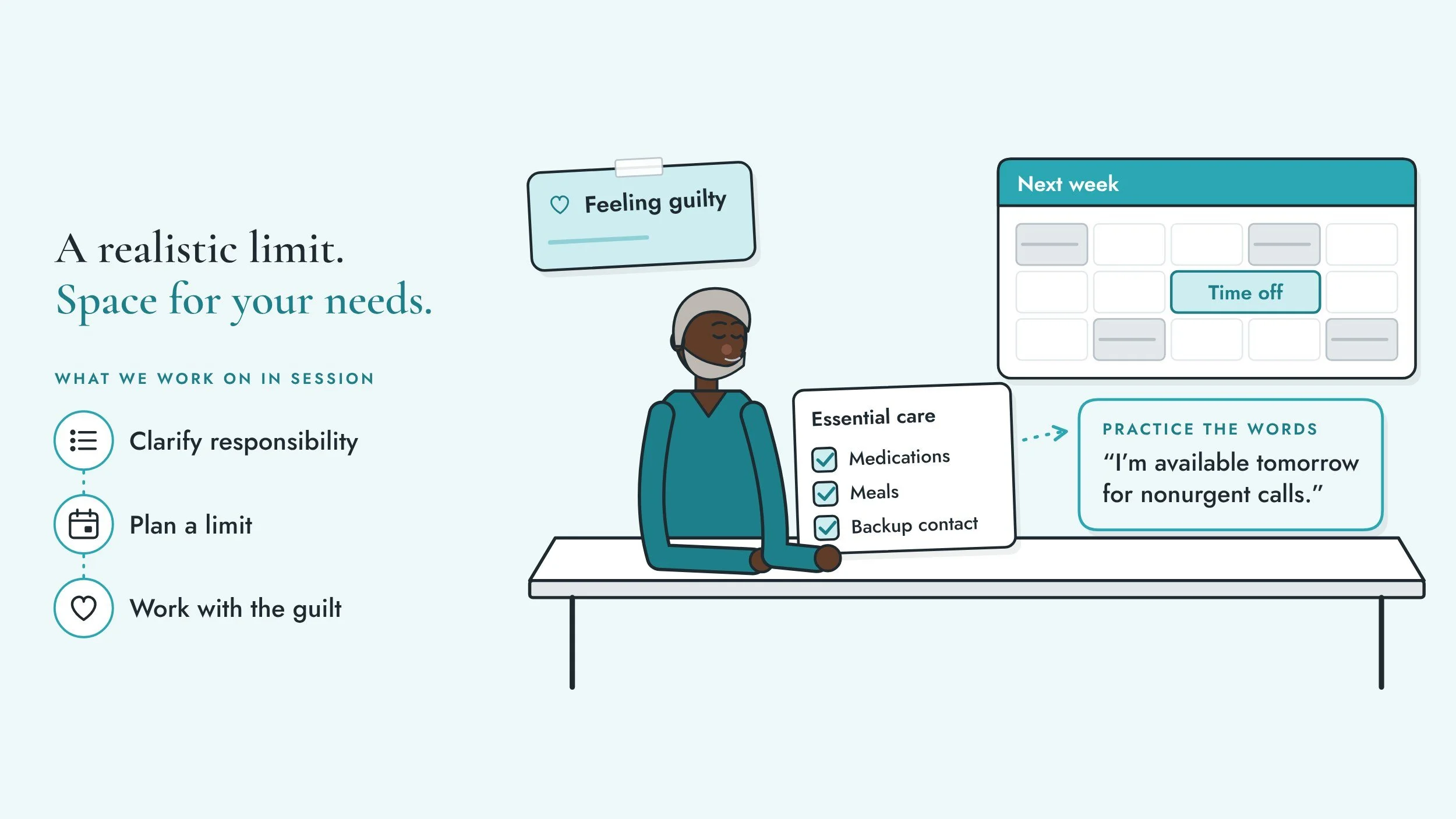
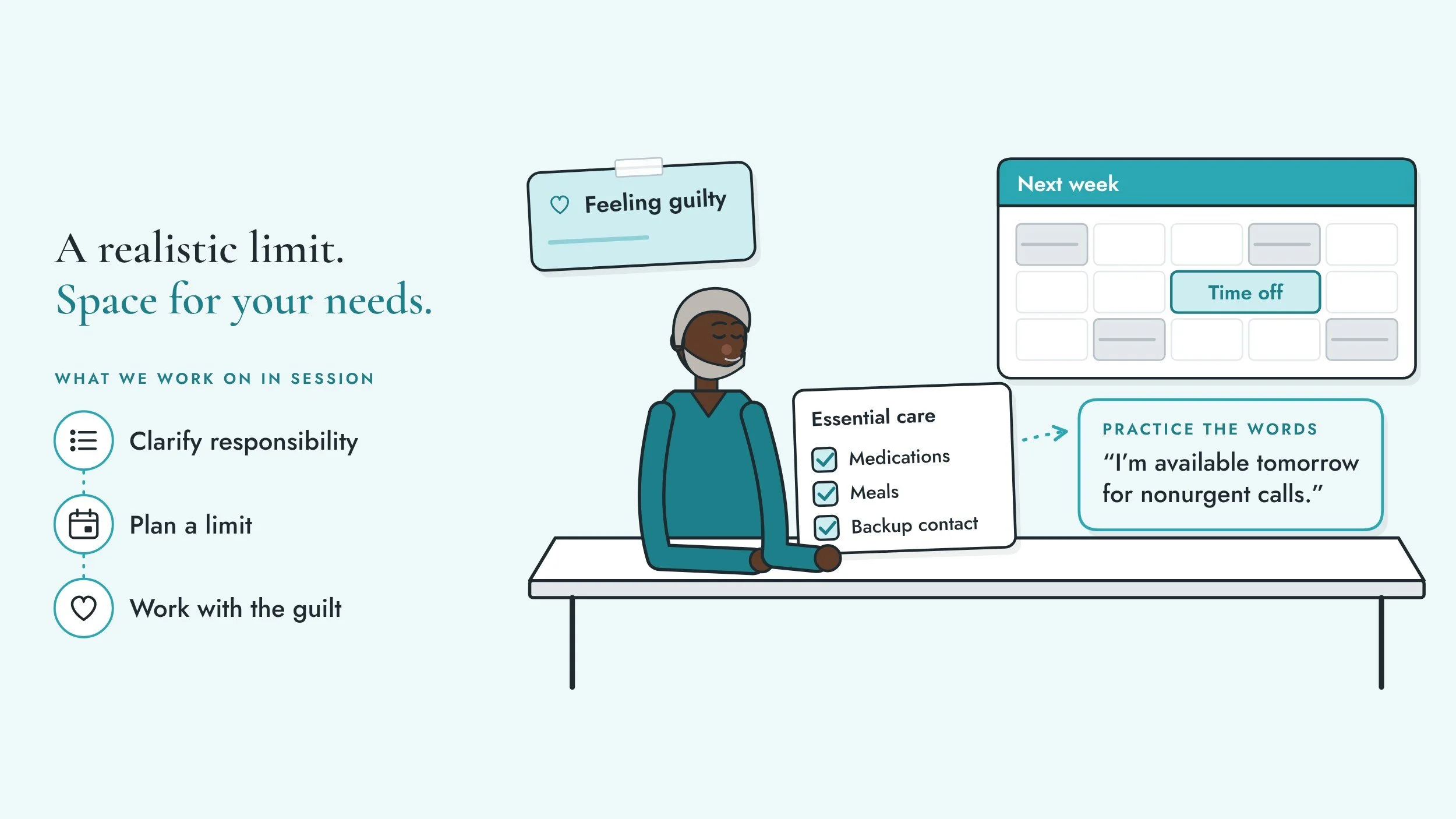
A useful limit needs to account for genuine care needs and available support. We can practice how to communicate a time you are unavailable, identify what counts as urgent, and consider who or what resource can address essential needs. We will avoid suggesting a break that depends on leaving a necessary responsibility unattended. The emotional work and the practical circumstances need to fit together.
Work through the urge to reverse the decision
After setting a limit, you may want to call repeatedly, apologize, or give up your plans. We can explore the fear behind that urge and choose how to respond to it. We can also make room for sadness about what your parent can no longer do and for the discomfort of accepting that care sometimes involves difficult choices rather than a solution everyone likes.
An example of the work
For example, you might want one evening each week without nonurgent calls. We could explore the guilt this brings up, discuss essential care arrangements, and rehearse a message about your availability. After trying it, we could review whether the plan was workable and how you handled the feelings afterward.
What progress can look like
Progress might mean distinguishing urgency from guilt, maintaining a realistic commitment, checking less often when care is arranged, or speaking more honestly about what you can offer. Your parent’s needs and your limits may change, and the plan can change with them.
How Care Map Method supports our work
Map the emotion and trigger. We look at a recent moment and the biological, emotional, social, and environmental pressures around it. The aim is to understand your experience before choosing a response.
Match the need with a strategy. We identify what matters in that moment and select a skill or next step that fits. That might be a clearer request, a pause, a boundary, or space to process a loss.
Merge the skill into daily life. We can rehearse the words and decide when you might use them. Any practice between sessions is chosen together and adjusted to your circumstances.
Manage responses over time. We review what happened, what was difficult, and what needs to change. Therapy includes room for feelings and history as well as practical work.
About Tammy Gold
I’m Tamara “Tammy” Gold, MSW, LCSW, founder of Care Map Method™ and author of Secrets of the Nanny Whisperer. I earned my MSW at Columbia University and my BA at the University of Pennsylvania. My work with families informs a warm, active approach to therapy that makes room for your emotional experience and practical concerns.
Common questions
Is this different from general caregiver burnout therapy? This page focuses specifically on guilt, responsibility, and maintaining limits. If your main concern is overall exhaustion or grief, we can discuss that too and choose the most useful focus.
Does a boundary mean I care less? A limit does not measure the depth of your care. We can examine the meaning you attach to it and whether the plan accounts for real needs and your available capacity.
What if my parent says I am selfish? We can work on how that affects you, practice a response, and consider the history of the relationship. We cannot guarantee your parent will agree with or welcome your limit.
Do you arrange replacement caregivers? This page describes psychotherapy. Staffing, placement, and care coordination are separate services. Therapy can help you address the emotions and communication involved in seeking practical help.
Can I use BCBS of Massachusetts while in Oregon? Your exact product and Oregon network eligibility must be checked through my Alma profile. The carrier name alone does not establish coverage, and your location and benefits both matter.
Can I start even if I cannot change the workload yet? Yes. We can address guilt, grief, expectations, and coping while acknowledging the limits on practical change. We will develop goals that fit the resources you actually have.
Take the next step
If this sounds familiar, you can explore online therapy with me while located in Oregon. Open my Alma profile to check your exact insurance benefits and appointment options. We will discuss your concerns, clinical needs, and goals to determine fit.