

Adult ADHD Therapy for Overwhelm, Focus, and Getting Started
hen important tasks keep getting delayed, the stress can reach work, home, and relationships. Explore adult therapy for ADHD-related overwhelm and follow-through.
You know the task matters. You may have written it down, moved it to tomorrow, and thought about it throughout the day. Still, beginning can feel oddly difficult. Then the pressure builds, you rush to finish, and you wonder why something that looked manageable took so much out of you.
I’m Tammy Gold, LCSW. I provide individual online therapy for adults who want support with ADHD-related stress, overwhelm, relationships, and the emotional impact of feeling behind. Therapy can help you understand the patterns around a task, consider what gets in the way, and build responses that fit your actual life.
Check current insurance and availability via Alma, Headway or Grow Therapy
When knowing what to do is not the same as getting started
Adult ADHD can affect more than attention. You might lose track of time, underestimate how long a task will take, switch between several unfinished projects, or find it difficult to return to something after an interruption. You may be dependable at work and still struggle with household routines, paperwork, appointments, or keeping track of personal plans.
Sometimes the hardest part is not the task itself but what happens around it. You may delay because you expect to do it perfectly. You might avoid opening an email because you worry about what it will ask of you. A missed deadline can bring shame, which makes the next task feel even heavier. If that sounds familiar, you are not required to solve it by criticizing yourself harder.
Look at one real moment, not your whole life at once
In therapy, we can take a recent example and slow it down. What did you need to do? What did you notice when you sat down to begin? Were you tired, unsure where to start, worried about making a mistake, or pulled toward something more immediately rewarding? What happened after you put the task off?
This kind of discussion helps us distinguish different barriers. A task may feel too vague, too large, emotionally loaded, or difficult to fit into the time and energy you have. The next step should follow what we learn, rather than assume that one planner or productivity trick will work for everyone.
We might break a task into a first action small enough to begin, practice asking for clarification, or identify a reminder system you are willing to use. We can then review what happened without treating a difficult week as proof that you failed.
Make room for the feelings that come with ADHD stress
Many adults have spent years hearing that they are careless, lazy, scattered, or not trying. Even when you understand that ADHD affects how you manage attention and tasks, those messages can stay with you. You may hide how much effort ordinary responsibilities take or avoid asking for help because you expect to be judged.
Therapy can give you space to look at those experiences and how they affect your current choices. We can discuss self-criticism, frustration, anxiety, relationship strain, and the pressure to compensate by overworking. The goal is not to excuse every behavior or make another person responsible for your tasks. It is to understand the pattern and find a more workable way to respond.
When ADHD affects relationships or work
You may have a partner who feels they are carrying too much of the household planning. A coworker may interpret a missed detail as a lack of care. You might say yes to a commitment before checking your calendar, then feel trapped when the date arrives. These situations can become painful when the practical problem turns into a judgment about character.
We can identify what needs to be communicated, what routine could reduce friction, and what expectations need to be discussed. Therapy focuses on your own thoughts, feelings, behavior, and goals. It does not require your partner or coworker to participate for you to work on your side of a pattern.
Use the Care Map Method to understand the full picture
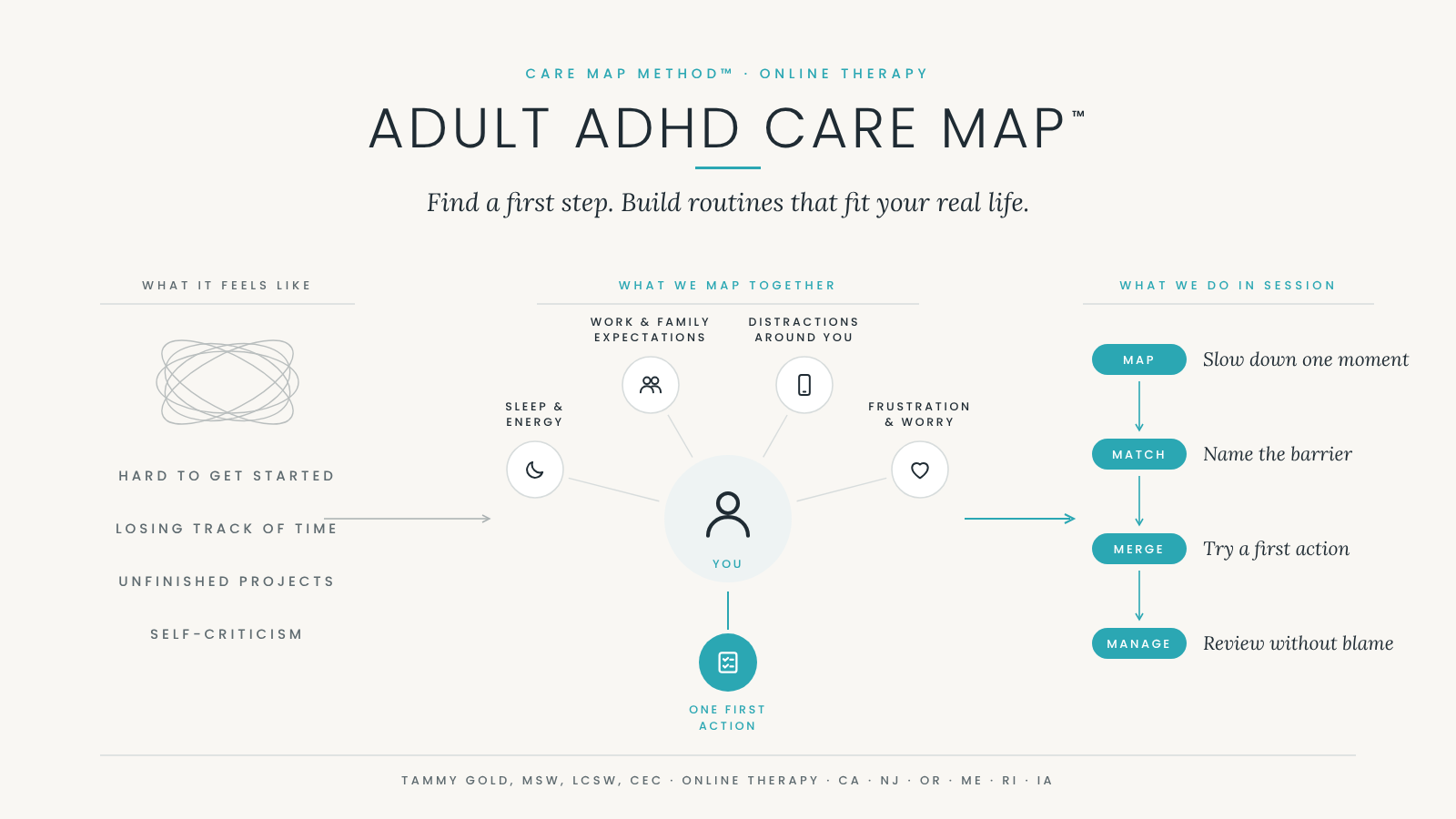
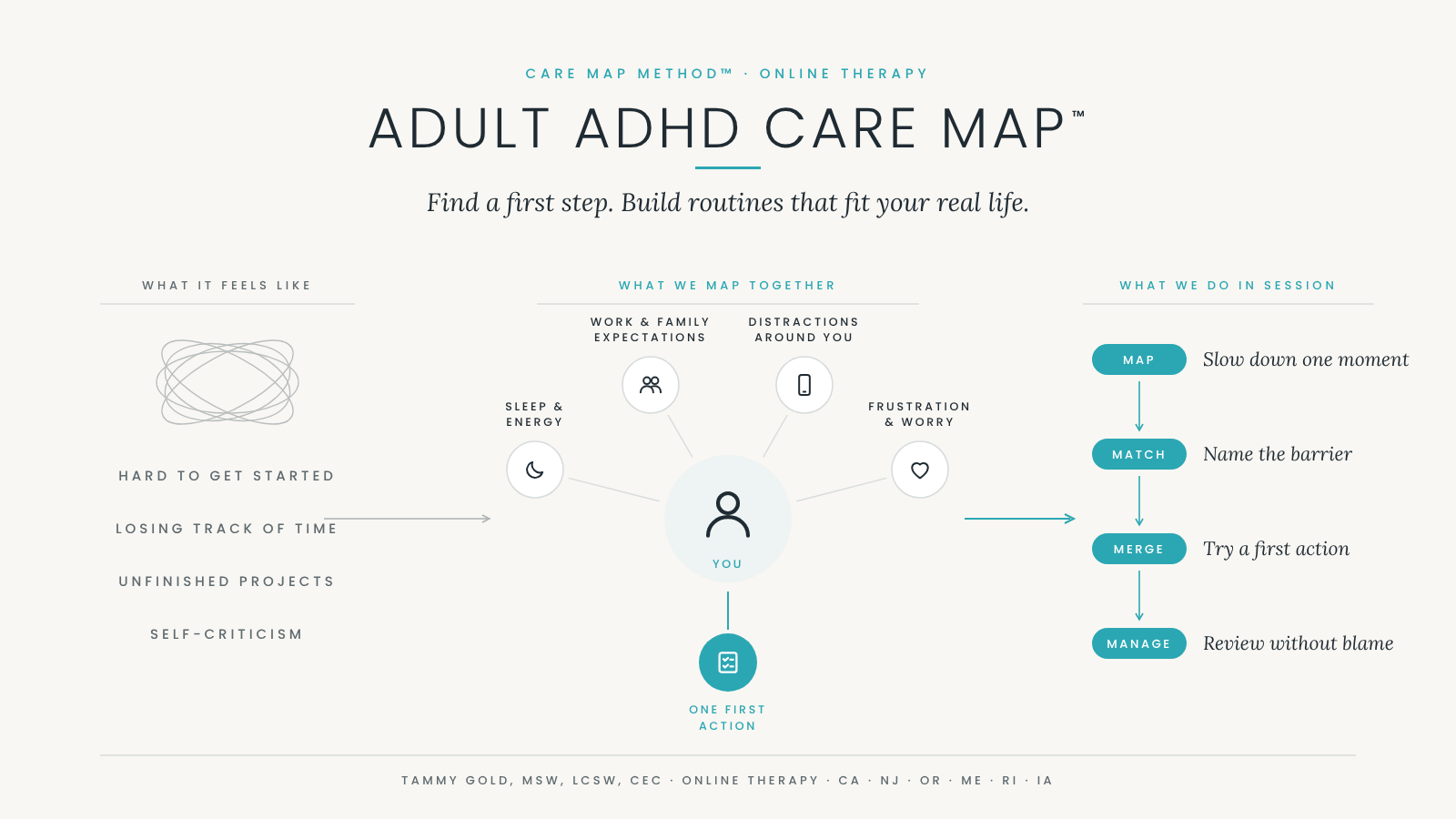
My Care Map Method helps organize Biological, Social, Environmental, and Emotional factors that may be relevant to a concern. With ADHD-related stress, we might consider sleep and energy, family or work expectations, distractions in your environment, and the frustration or worry that has built up around unfinished tasks.
We MAP the situation,
MATCH support to your goals,
MERGE a small change into your routines, and
MANAGE the plan through review. It is a practical framework for our conversations, not a promise of a particular result or a substitute for medical assessment.
What your first therapy session can include
You can bring one situation that has been difficult lately. We will discuss what prompted you to reach out, the effect on daily life, relevant history, and what you hope might change. You do not need to arrive with a perfect explanation or a confirmed diagnosis. If you are unsure whether ADHD is part of the picture, we can talk about what you are experiencing and whether an evaluation with an appropriate health professional may be useful.
I offer online therapy to adults located in California, New Jersey, Oregon, Maine, Rhode Island, and Iowa, subject to current availability. Please be physically located in a state where I am licensed for each session. Use my Headway or Alma profile to check your state, insurance plan, and appointment options.
Frequently asked questions
Can therapy help with adult ADHD even if I already have a diagnosis?
Yes. Therapy can focus on the emotional and relationship concerns connected with ADHD, including overwhelm, shame, planning stress, and follow-through. We can set goals based on your current needs.
Can you test me for ADHD?
This page describes psychotherapy, not neuropsychological testing. If you are seeking a formal evaluation, we can discuss whether referral to an appropriately qualified assessment provider makes sense.
What if I am not sure that I have ADHD?
You can still discuss attention, organization, motivation, and the impact on your daily life. We can explore your concerns without assuming a diagnosis and consider whether another professional assessment is appropriate.
Can therapy help if my partner is frustrated with me?
We can work on your experience of the conflict, your communication, and the routines or expectations you want to address. Individual therapy does not require your partner to attend.
Is online therapy available in my state?
I offer telehealth to clients located in states where I am licensed and currently available. Check my Headway or Alma profile for your state and appointment options.
Does insurance cover therapy for ADHD-related concerns?
Coverage depends on the plan, provider participation, eligibility, and clinical assessment. Use the booking profile to check your exact benefits and expected cost before scheduling.
What if I keep avoiding the same task?
We can examine what happens before, during, and after the avoidance. That can help us choose a more specific next step and understand what support may help you follow through.
Do I have to use a particular planner or system?
No. We can consider tools if they fit your needs, but therapy is not a test of whether you can maintain a particular productivity system. We will look for approaches you can realistically use.
Want to talk through what has been getting in the way? Check current insurance and availability through my Headway or Alma profile.