
Toddler Parenting Support: Create a Personalized Care Map for Your Growing Child
Toddler behavior is communication. The Care Map Method™ Toddler Coaching Session helps parents understand their child’s biological, emotional, social, and environmental needs and create practical strategies for tantrums, sleep, eating, routines, development, childcare, and family life.
The toddler years can be delightful, exhausting, funny, and confusing—sometimes within the same five minutes.
Your toddler may want to do everything independently while still needing help with almost everything. They may understand far more than they can communicate. They can move quickly from excitement to frustration, resist ordinary routines, and have powerful reactions to seemingly small changes.
Parents are often left wondering:
Is this typical toddler behavior?
Why are the tantrums getting worse?
Should my child be talking more?
Why is bedtime suddenly so difficult?
How do I set limits without constantly battling?
Is my child ready for preschool or daycare?
How can all caregivers respond consistently?
Generic parenting advice rarely accounts for the whole child. A strategy that works for one toddler may overwhelm another because children differ in temperament, language, sensory processing, developmental pace, routines, and family circumstances.
The Care Map Method™ Toddler Care Map Coaching Session helps parents understand what is happening beneath the behavior and create a practical plan for their individual child and family.
What is toddler parent coaching?
Toddler parent coaching is a structured, personalized service that helps parents understand their child’s development, behavior, routines, and care needs.
During a Care Map Method™ Toddler Coaching Session, we may address:
Tantrums and emotional regulation
Biting, hitting, throwing, or yelling
Sleep and bedtime struggles
Picky eating and mealtime stress
Toilet-learning readiness
Language and communication
Separation anxiety
Transitions and resistance
Boundaries and discipline
Toddler safety and childproofing
Nanny, babysitter, daycare, or preschool concerns
Parent and caregiver consistency
Sibling adjustment
Parent exhaustion and family stress
The goal is not to eliminate every difficult behavior. Toddlers are still learning how to communicate, wait, transition, tolerate frustration, and manage strong feelings.
The goal is to understand what the behavior may be communicating and teach the child the skills they are developmentally ready to learn.
Toddler behavior is communication
Toddlers do not usually have the language, impulse control, or emotional regulation skills to explain exactly what they need.
A toddler who screams at bedtime may be overtired, frightened by separation, overstimulated, resisting a transition, or reacting to an inconsistent routine.
A child who hits another child may be overwhelmed, frustrated, seeking space, imitating behavior, or unable to say, “I was using that.”
A child who refuses to get dressed may want control, dislike how the clothing feels, struggle with transitions, or simply need more time.
Understanding the reason behind a behavior does not mean allowing unsafe or inappropriate behavior. It helps parents choose a response that addresses both the behavior and the unmet need or developing skill underneath it.
Start with the B/E/S/E Toddler Care Map
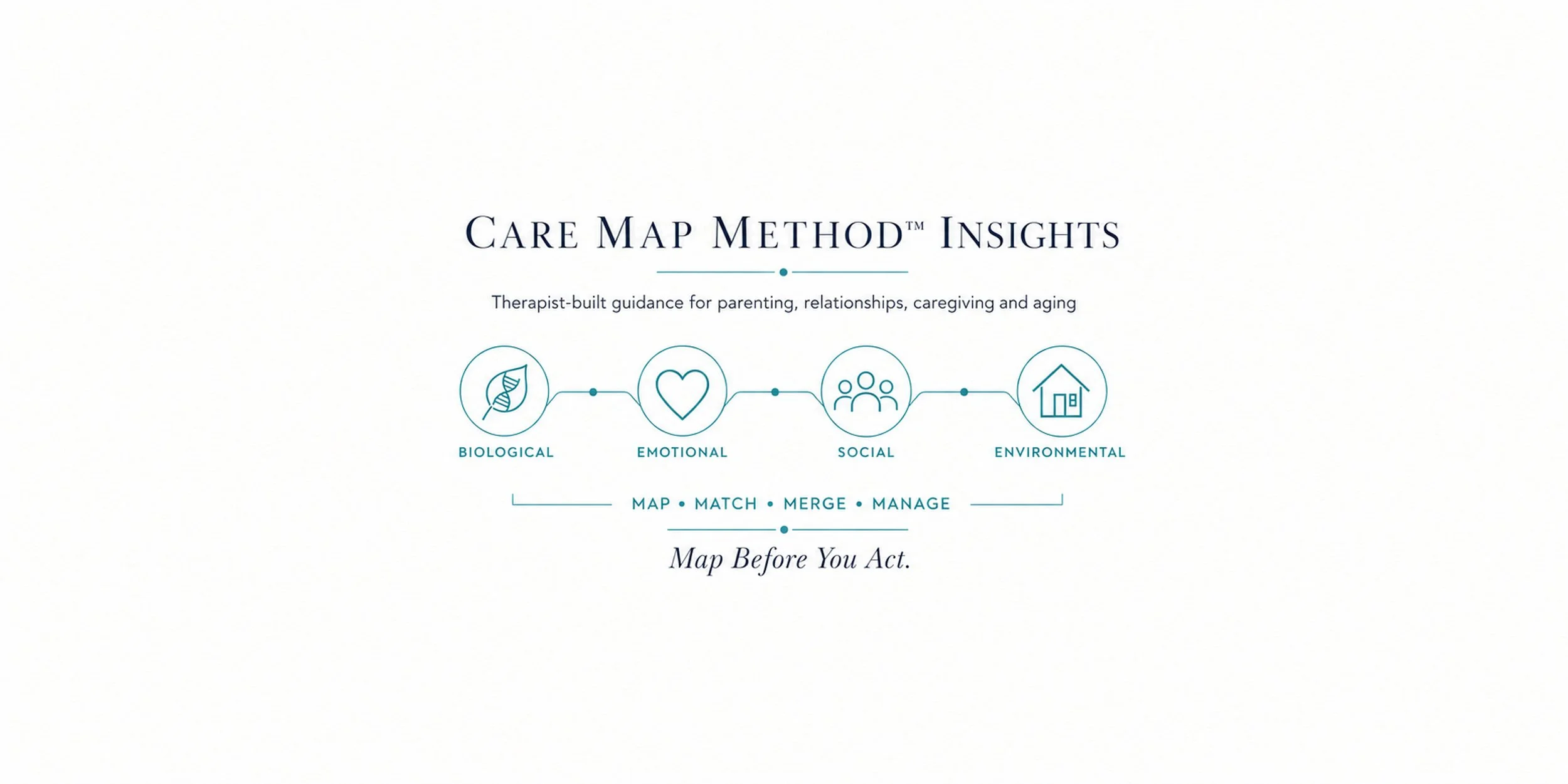
The Care Map Method™ looks at four connected areas of a toddler’s life: Biological, Emotional, Social, and Environmental needs.
Biological needs
A toddler’s physical state has a major influence on behavior.
Biological needs may include:
Sleep and nap patterns
Hunger and eating
Growth and nutrition
Physical activity
Illness, pain, or discomfort
Digestion and toileting
Speech, motor, and developmental progress
Sensory preferences and sensitivities
Medical and dental care
Before labeling a child as “difficult” or “defiant,” it is helpful to consider whether the child is tired, hungry, uncomfortable, overstimulated, or being asked to do something beyond their current developmental ability.
Persistent concerns about feeding, sleep, hearing, speech, movement, growth, toileting, or development should be discussed with the child’s pediatric healthcare provider.
Emotional needs
Toddlers experience strong feelings before they have the skills to manage them.
Emotional care may include:
Helping the child identify feelings
Offering comfort without removing every limit
Creating predictable responses
Supporting secure attachment
Preparing for separations and transitions
Teaching simple calming strategies
Understanding the child’s temperament
Providing choices within appropriate boundaries
Toddlers borrow regulation from the adults around them. This is called co-regulation. A calm, clear adult response helps the child gradually learn how to manage frustration, disappointment, and change.
Social needs
Toddlers are beginning to learn how relationships work.
They may be practicing how to:
Share space and toys
Take turns
Ask for help
Join play
Use words instead of hitting
Separate from a parent
Adapt to different caregivers
Interact with siblings
Follow simple group routines
Recover after conflict
Young toddlers often engage in parallel play—playing near other children rather than cooperatively with them. Social skills develop gradually and require patient teaching, modeling, and repetition.
Environmental needs
The environment can either support toddler success or create unnecessary conflict.
Environmental factors include:
Home safety and childproofing
Toy and activity organization
Noise, lighting, and stimulation
Daily routines
Visual schedules
Transition warnings
Child-accessible choices
Sleep spaces
Mealtime arrangements
Consistency between home and childcare
Sometimes changing the environment is more effective than repeatedly correcting the child.
For example, placing a visual routine near the front door may help with leaving the house. Offering two weather-appropriate outfits may reduce dressing battles. Creating a calm-down space may provide a safe place to recover from overwhelming feelings.
Use MAP, MATCH, MERGE, and MANAGE for toddler care
Once we understand the child’s full care picture, the Care Map Method™ provides a clear path forward.
MAP the Need
We identify the toddler’s biological, emotional, social, and environmental needs while also considering family stress, schedules, caregiver arrangements, and parent concerns.
The care map helps parents look for patterns:
Do tantrums happen before meals?
Is behavior harder after missed naps?
Does the child struggle during rushed transitions?
Is the same behavior happening at home and daycare?
Are different caregivers using different limits?
Does the child have the words needed to express the problem?
A behavior tracker can help parents identify what happens before, during, and after a difficult moment.
MATCH the Care
Next, we determine what kind of support fits each need.
Support may include:
A pediatrician
A speech-language pathologist
An occupational therapist
A developmental specialist
A feeding professional
A licensed mental health professional
A parent coach
A nanny or babysitter
A daycare or preschool program
Early-intervention services
Trusted family support
Not every toddler challenge requires a specialist. Coaching can help parents determine what can be addressed through changes in routines and responses—and what should be evaluated further.
MERGE the Support
Toddlers benefit when the important adults in their lives communicate clearly.
A shared toddler care plan may include:
Daily routines
Sleep and nap expectations
Food preferences and restrictions
Toilet-learning language
Approved discipline and redirection strategies
Comfort and calming methods
Safety expectations
Screen-time boundaries
Medication or health information
Communication between parents and caregivers
Responses to hitting, biting, tantrums, or separation distress
Parents, grandparents, nannies, babysitters, and daycare teachers do not need to respond identically in every situation. However, they should understand the child’s essential needs and the family’s central expectations.
MANAGE the Plan
Toddlers develop quickly. Their language, mobility, interests, sleep, emotions, and social needs can change within months.
Families should regularly ask:
What is improving?
What continues to be difficult?
Has the child developed new skills?
Are our expectations age-appropriate?
Are all caregivers communicating?
Is the environment still safe and supportive?
Do we need additional professional guidance?
Is this care arrangement still the right fit?
A Toddler Care Map is not a permanent set of rules. It is a flexible plan that grows with the child.
Understanding toddler tantrums
Tantrums are a common part of early development. They often occur when a toddler is tired, hungry, overstimulated, frustrated, or unable to communicate a need.
During a tantrum, the child’s thinking and language abilities may be temporarily less available. Long explanations and repeated questions are unlikely to help in the peak of the moment.
A helpful response may include:
Make sure the child and others are safe.
Lower your voice and reduce stimulation.
Use a short statement: “You are upset. I’m here.”
Hold the boundary: “I won’t let you hit.”
Allow time for the child’s body to settle.
Reconnect and teach after the child is calmer.
Parents do not need to fix every feeling. A child can be disappointed and still be safe, supported, and loved.
Discipline should teach—not frighten
Effective toddler discipline focuses on safety, connection, repetition, and skill-building.
Helpful strategies may include:
Clear and brief limits
Consistent follow-through
Redirection
Age-appropriate choices
Predictable routines
Transition warnings
Positive attention for helpful behavior
Modeling the desired behavior
Teaching simple replacement phrases
Repairing the relationship after difficult moments
Instead of only saying, “Stop hitting,” a parent might say:
“I won’t let you hit. Say, ‘My turn,’ or ask me for help.”
The limit remains firm, but the child also learns what to do next time.
Preparing for daycare, preschool, or a new caregiver
Starting daycare, preschool, or care with a nanny can be a major transition for a toddler.
A thoughtful transition plan may include:
Short introductory visits
A simple goodbye ritual
A familiar comfort object when permitted
Consistent pickup and drop-off language
A written description of routines and calming strategies
Gradually increasing care hours when possible
Clear communication between parents and caregivers
Patience with temporary changes in sleep or behavior
A child’s distress during separation does not automatically mean the placement is wrong. What matters is how the child is comforted, how the caregiver responds, and whether the child gradually begins to feel secure.
When might toddler coaching help?
A Care Map Method™ Toddler Coaching Session may be helpful if:
Tantrums are affecting daily family life
You are dealing with hitting, biting, or throwing
Bedtime or naps have become difficult
Meals feel like a constant battle
You are unsure how to set effective boundaries
You and your partner disagree about discipline
Your child is having difficulty separating
You are preparing for daycare or preschool
You are hiring or onboarding a nanny
Different caregivers use conflicting approaches
Your toddler is adjusting to a new sibling, home, or family routine
You want to understand whether a concern may require additional evaluation
You do not have to wait until family life feels unmanageable. Parent coaching can help you create a plan before ordinary toddler challenges become ongoing patterns of stress.
What happens during a CMM Toddler Care Map Coaching Session?
The session is personalized to the child, the family, and the current concerns.
Together, we can:
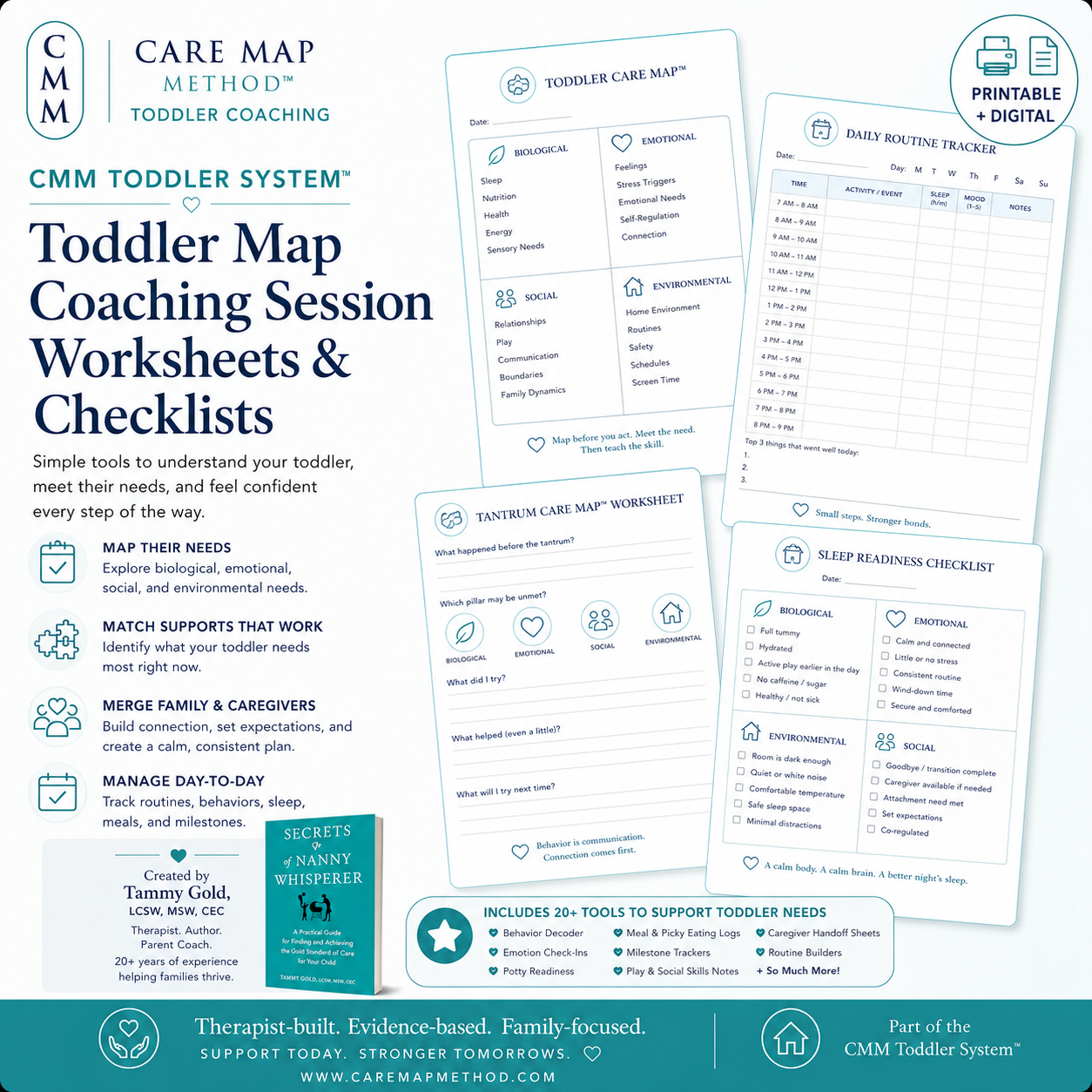
Complete a B/E/S/E Toddler Care Map
Identify possible triggers behind difficult behavior
Review sleep, eating, play, toileting, and daily routines
Explore temperament and sensory needs
Create age-appropriate behavior strategies
Develop scripts for tantrums, transitions, and limit-setting
Clarify responsibilities between parents and caregivers
Prepare for a nanny, daycare, preschool, or other transition
Identify areas that may need professional evaluation
Create a practical family action plan
Parents leave with clear priorities, personalized scripts, and concrete next steps they can begin using at home.
Frequently asked questions about toddler coaching
Is toddler coaching only for serious behavior problems?
No. Many parents use coaching for common developmental challenges such as tantrums, sleep, picky eating, separation anxiety, transitions, and limit-setting.
Can toddler coaching help with tantrums?
Yes. Coaching can help parents identify possible triggers, create a consistent response, teach replacement skills, and adjust routines or environments that may be contributing to the tantrums.
Can you help us prepare our toddler for preschool?
Yes. A Toddler Care Map can help parents evaluate readiness, prepare for separation, communicate with teachers, and create consistent routines between home and school.
Can both parents or caregivers participate?
Yes. Including both parents or other central caregivers can help create clearer expectations and more consistent responses.
Does toddler coaching replace medical or developmental evaluation?
No. Coaching provides education, planning, and parenting support. Medical, speech, feeding, hearing, sensory, or developmental concerns should be evaluated by an appropriately qualified professional.
Your toddler does not need a perfect parent
Toddlers need adults who are curious, responsive, consistent, and willing to adjust as the child grows.
You do not have to stop every tantrum or have the perfect routine. You need a clearer understanding of your child and a practical plan that your family can actually follow.
Map before you act.
Care Map Method™ Toddler Care Map Coaching Session
The Care Map Method™ Toddler Care Map Coaching Session helps parents understand what may be driving their toddler’s behavior and develop an individualized plan for home, childcare, and family life.
Your session may include:
A personalized B/E/S/E Toddler Care Map
Tantrum and behavior-trigger assessment
Sleep, mealtime, toileting, and routine review
Toddler communication and regulation strategies
Parent scripts for limits and transitions
Daycare, preschool, or nanny preparation
Parent and caregiver communication tools
A personalized action plan and next steps
Built by a therapist. Backed by science. Designed for real family life.
Schedule a Care Map Method™ Toddler Coaching Session
Care Map Method™ coaching provides education, care planning, and parenting support. It does not replace pediatric, medical, developmental, feeding, speech, occupational-therapy, or mental-health evaluation and treatment.