

School-Aged Child Support: Create a Personalized Care Map for Home, School, and Everyday Life
The school-aged years bring increasing expectations.
Children are expected to manage longer school days, academic work, friendships, activities, household responsibilities, technology, and stronger emotions. At the same time, the skills needed to meet those expectations—planning, organization, flexibility, impulse control, and emotional regulation—are still developing.
A child may be bright and capable but forget assignments. Another may behave well at school and fall apart at home. A social child may suddenly feel excluded. A child who once enjoyed learning may begin complaining of headaches or refusing school.
Parents may wonder:
Why does my child resist homework every night?
Is this behavior, anxiety, ADHD, a learning issue, or exhaustion?
Why can my child follow directions at school but not at home?
How much should I help without doing everything for them?
Should I contact the teacher or request an evaluation?
How do we set appropriate limits around screens?
What support does my child actually need?
These questions cannot always be answered by looking at one symptom.
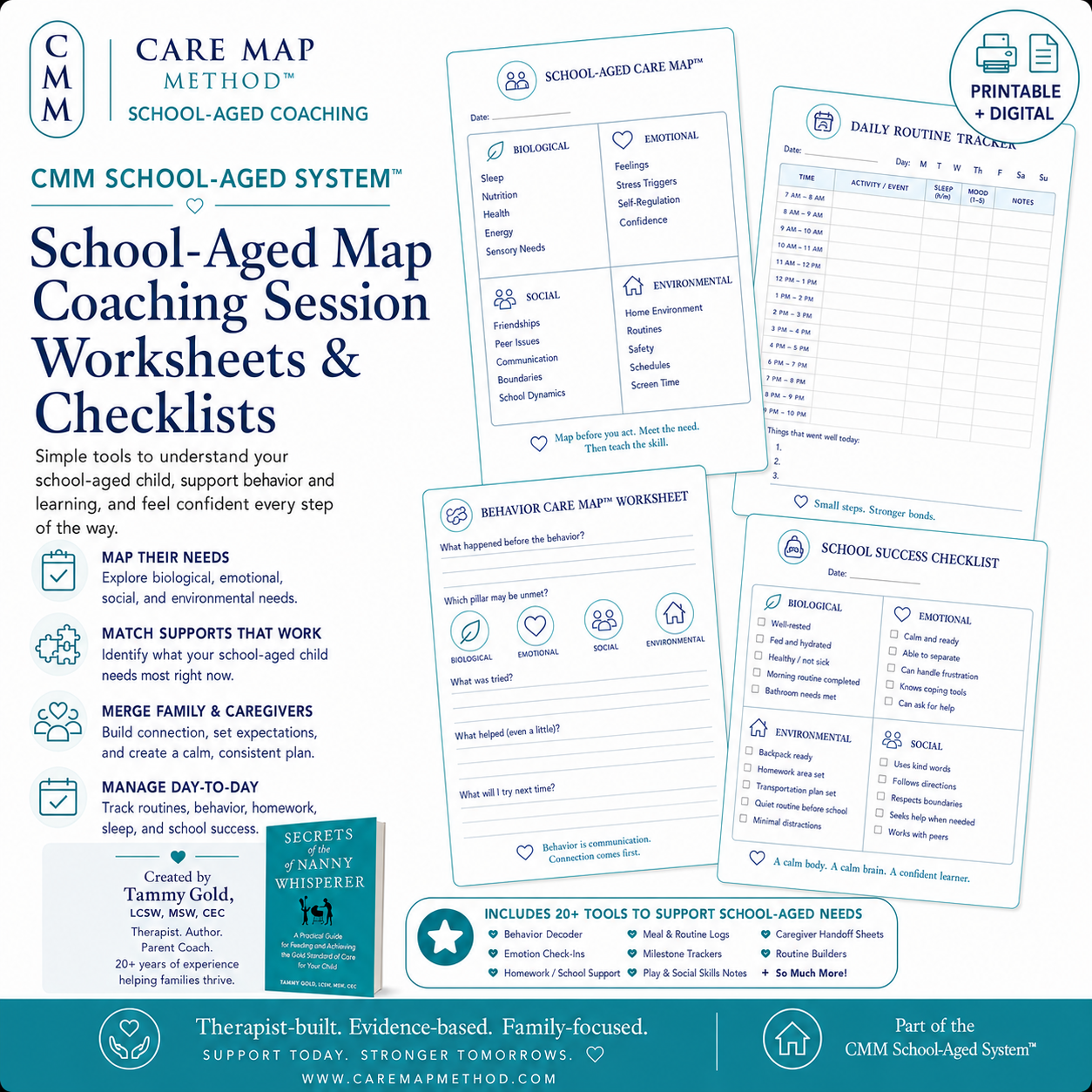
The Care Map Method™ School-Aged Coaching Session helps parents understand the whole child—their biological, emotional, social, and environmental needs—and create a coordinated plan for home, school, caregivers, and everyday life.
What is school-aged parent coaching?
School-aged parent coaching is a structured, personalized service that helps families understand a child’s behavior, development, routines, relationships, and learning needs.
A Care Map Method™ School-Aged Coaching Session may address:
Homework battles
School avoidance
Anxiety and perfectionism
Emotional outbursts
Difficulty following directions
ADHD or executive-function challenges
Organization and time management
Learning or developmental concerns
Friendship problems or bullying
Sibling conflict
Sleep and morning routines
Screen-time boundaries
After-school meltdowns
Parent-child communication
Coordination between parents, teachers, tutors, and caregivers
The goal is not to blame the child, the parent, or the school. The goal is to understand what is happening, identify what may be contributing to it, and determine the next useful step.
Behavior is information
School-aged children usually have more language than younger children, but they may still be unable to explain why something feels difficult.
A child who refuses homework may be mentally exhausted, confused by the material, afraid of making mistakes, distracted, overwhelmed by the number of steps, or seeking connection after a long day.
A child who argues every morning may be anxious about school, struggling with transitions, missing sleep, or lacking a predictable routine.
A child who says, “I don’t care,” may actually feel embarrassed, discouraged, excluded, or afraid of failing.
Understanding what is driving a behavior does not mean removing expectations. It helps parents choose an intervention that addresses the cause instead of repeatedly reacting to the symptom.
Start with the B/E/S/E School-Aged Care Map
The Care Map Method™ examines four interconnected areas: Biological, Emotional, Social, and Environmental needs.
Biological needs
A child’s physical well-being affects attention, learning, mood, and behavior.
Biological factors may include:
Sleep quality and duration
Hunger and nutrition
Physical activity
Illness, pain, or discomfort
Vision and hearing
Medication and medical care
Sensory sensitivities
Growth and puberty
Attention and energy
Learning or developmental differences
Before assuming that a child is lazy or oppositional, consider whether the child is tired, hungry, anxious, physically uncomfortable, overstimulated, or unable to complete the task independently.
Persistent concerns about health, sleep, attention, learning, hearing, vision, development, or physical symptoms should be discussed with the child’s pediatric healthcare provider or another qualified professional.
Emotional needs
School-aged children are developing greater self-awareness, but they still need adult support to manage strong emotions.
Emotional needs may include:
Feeling safe and understood
Identifying and naming emotions
Managing anxiety or frustration
Building confidence
Recovering from mistakes
Coping with disappointment
Developing flexible thinking
Practicing calming strategies
Receiving connection before correction
Having appropriate choices and autonomy
Children do not need adults to remove every difficult feeling. They need help learning that uncomfortable emotions can be tolerated and managed.
A child who says, “I’m stupid,” may not need an immediate lecture about positive thinking. The child may first need to hear:
“That assignment felt really hard, and I can see how discouraged you are. Let’s figure out which part is getting you stuck.”
Social needs
Friendships and peer acceptance become increasingly important during the school-aged years.
Social needs may include:
Making and maintaining friendships
Joining groups
Handling teasing or exclusion
Understanding social cues
Resolving conflict
Setting boundaries
Managing competition
Asking adults for help
Coping with friendship changes
Developing a sense of belonging
Parents should avoid treating every friendship problem as either a crisis or something the child must handle alone. Some situations require coaching, some need school involvement, and others require time and practice.
Bullying, threats, discrimination, harassment, or ongoing social exclusion should be addressed directly with the appropriate adults and school personnel.
Environmental needs
Children function differently depending on the demands and support within their environment.
Environmental factors may include:
Classroom structure
Teacher-child fit
Academic expectations
Homework volume
Noise and distractions
Family schedules
Transportation
After-school activities
Technology access
Workspace organization
Transitions between two homes
Consistency among parents and caregivers
Sometimes the child needs to build a skill. Other times, the environment needs to change.
A child who cannot begin homework in a noisy kitchen may need a quieter workspace. A child overwhelmed by a long verbal instruction may benefit from a written checklist. A child melting down after school may need food, movement, and decompression before beginning homework.
Use MAP, MATCH, MERGE, and MANAGE for school-aged support
The Care Map Method™ turns scattered concerns into a coordinated plan.
MAP the Need
We begin by identifying what is happening across the child’s biological, emotional, social, and environmental life.
Questions may include:
When did the difficulty begin?
Does it happen at home, school, activities, or everywhere?
What happens before and after the behavior?
What does the child say about the problem?
Have sleep, health, family circumstances, or school demands changed?
What is the child able to do independently?
Where does the child consistently become stuck?
What strategies have already been attempted?
This whole-child assessment helps families separate the visible behavior from the needs or missing skills beneath it.
MATCH the Care
Next, we determine what kind of support fits each identified need.
Support may include:
A pediatrician
A classroom teacher
A school counselor
A tutor
A speech-language pathologist
An occupational therapist
A psychologist or neuropsychologist
A licensed mental health professional
An educational specialist
A parent coach
An after-school caregiver
School-based accommodations or services
Not every difficulty requires every professional. The goal is to match the child with the right level and type of support.
MERGE the Support
Families often receive separate recommendations from teachers, therapists, doctors, tutors, and caregivers. Without coordination, parents may be left managing several disconnected plans.
A shared School-Aged Care Map may include:
Home and school priorities
Homework routines
Emotional-regulation strategies
Communication scripts
Screen-time expectations
Morning and bedtime routines
School accommodations
Responsibilities for each adult
Approved behavior strategies
A home-school communication plan
Steps for responding to social concerns
Emergency and safety information
The child should also have an age-appropriate voice in the plan. Children are more likely to participate when they understand the purpose and help select realistic strategies.
MANAGE the Plan
Children’s needs change as school demands, friendships, family circumstances, and developmental stages change.
Families can regularly review:
What is improving?
What remains difficult?
Is the current support producing meaningful change?
Are expectations realistic?
Is the child becoming more independent?
Are home and school communicating effectively?
Does the plan need to be simplified?
Is a new evaluation or referral appropriate?
Is the child’s own perspective being heard?
The goal is not to manage the child. It is to manage the plan surrounding the child.
Why children may fall apart after school
Some children use enormous energy holding themselves together during the school day.
They may spend hours:
Sitting still
Following instructions
Managing distractions
Navigating friendships
Coping with noise and stimulation
Moving between subjects and teachers
Trying not to make mistakes
Hiding confusion or worry
Once home, the child may release the tension they have been carrying.
This can look like irritability, crying, arguing, sibling conflict, hyperactivity, withdrawal, or refusal to complete homework.
Before beginning questions and demands, consider offering:
Food and water
A warm greeting
Quiet time
Physical movement
Limited conversation
Time outdoors
A predictable transition routine
A decompression period is not a reward for poor behavior. It can be a preventive strategy that helps the child regain the capacity to participate in family routines.
Reducing homework battles
Homework struggles are not always about motivation. The child may have difficulty with attention, planning, transitions, understanding the assignment, tolerating mistakes, or knowing how to begin.
A more effective homework plan may include:
Provide a clear transition from school to home.
Address hunger, movement, and rest first.
Choose a predictable homework time and location.
Break assignments into smaller steps.
Use a written or visual checklist.
Allow brief movement breaks.
Help the child begin without completing the work for them.
Contact the teacher when the workload or difficulty appears consistently unmanageable.
Instead of saying, “You have to finish all your homework,” try:
“Let’s look at what you have, choose what comes first, and make a plan for each step.”
The long-term goal is greater independence—not immediate perfection.
Supporting executive-function skills
Executive functions help children start tasks, remember instructions, organize materials, manage time, shift attention, control impulses, and complete multistep activities.
Children are not born with fully developed executive-function skills. They build these abilities gradually with structure and practice.
Helpful supports may include:
One consistent place for school materials
Morning and evening checklists
Timers and visual reminders
Breaking tasks into smaller parts
Preparing bags and clothing the night before
Limiting the number of verbal directions
Teaching the child how to estimate time
Reviewing completed work without shaming mistakes
Gradually transferring responsibility to the child
A support is not “babying” a child when it helps them practice a skill they cannot yet manage independently.
Friendship concerns, exclusion, and bullying
Friendship problems can be deeply painful for school-aged children.
Parents can begin by listening before immediately contacting another parent or telling the child what to do.
Try asking:
“What happened from the beginning?”
“Has this happened before?”
“How did you respond?”
“What would you like to happen next?”
“Do you feel safe?”
“Would you like help thinking through what to say?”
Ordinary peer conflict may provide an opportunity to practice communication and repair. Repeated targeting, threats, humiliation, physical aggression, or coordinated exclusion requires adult intervention.
A care plan can clarify when the child should use a script, when a parent should contact the teacher, and when school administrators or outside professionals need to become involved.
Creating healthier screen-time boundaries
Screens can support learning, connection, creativity, and entertainment. They can also interfere with sleep, homework, physical activity, and family communication when boundaries are unclear.
A workable technology plan should define:
When screens may be used
Which devices and platforms are allowed
Where devices are stored overnight
What must happen before recreational use
How adults will supervise online activity
What happens when a limit is ignored
How parents will model technology boundaries
Whenever possible, establish expectations during a calm moment—not in the middle of a conflict.
When might school-aged coaching help?
A Care Map Method™ School-Aged Coaching Session may help if:
Homework creates nightly conflict
Your child struggles with organization or routines
Your child is anxious, perfectionistic, or easily overwhelmed
School avoidance or frequent physical complaints have developed
Your child has friendship problems or is being bullied
Your child behaves differently at home and school
You are concerned about attention, learning, or executive functioning
Screens are causing ongoing family conflict
Parents disagree about discipline or expectations
Teachers, tutors, therapists, and caregivers need better coordination
Your child is navigating divorce, relocation, loss, or another family transition
You are unsure which professional or school support to pursue
You do not need to wait until a child is failing academically or the entire family is in crisis.
What happens during a CMM School-Aged Coaching Session?
The session is personalized to the child’s age, strengths, needs, school experience, and family circumstances.
Together, we can:
Complete a B/E/S/E School-Aged Care Map
Identify patterns behind behavior or school struggles
Review sleep, routines, homework, activities, and technology use
Explore emotional-regulation and executive-function needs
Develop parent-child communication scripts
Create practical home and school strategies
Improve coordination among parents, teachers, tutors, and caregivers
Identify questions for the school or healthcare professionals
Determine whether additional evaluation may be appropriate
Build a personalized family action plan
Parents leave with clearer priorities, useful tools, and next steps based on their actual child—not a generic parenting formula.
Frequently asked questions about school-aged coaching
What ages are appropriate for school-aged coaching?
School-aged coaching is generally designed for families with children in elementary and early middle school. The session is tailored to the child’s developmental level rather than relying on age alone.
Can coaching help with homework and school refusal?
Yes. Coaching can help identify patterns contributing to homework battles or school resistance and create a plan for routines, communication, school collaboration, and appropriate professional support.
Can coaching help if my child has ADHD?
Parent coaching can help families create structure, routines, communication strategies, and executive-function supports. It does not diagnose or treat ADHD. Diagnosis and clinical treatment require appropriately licensed healthcare professionals.
Can you communicate with my child’s teacher?
The session can help parents prepare questions, organize concerns, and develop a home-school communication plan. Any direct coordination would require appropriate consent and a clearly defined service arrangement.
Should my child participate in the session?
That depends on the child’s age, concerns, and goals. Parents may begin independently, while older children may benefit from contributing their perspective to appropriate parts of the plan.
Does school-aged coaching replace therapy or an educational evaluation?
No. Coaching provides education, planning, and parenting support. Mental health, medical, learning, developmental, and educational concerns should be evaluated by the appropriate qualified professionals.
Children need coordinated support—not another label
When a child is struggling, it is tempting to focus on the most visible behavior. But homework refusal, emotional outbursts, school anxiety, and family conflict often reflect several connected factors.
A clear care map helps families understand those connections, prioritize what matters, and put the right support in place.
Map before you act.
Care Map Method™ School-Aged Coaching Session
The Care Map Method™ School-Aged Coaching Session helps parents understand their child’s behavior, emotions, learning needs, friendships, routines, and environment—and turn that understanding into a practical plan.
Your personalized session may include:
A complete B/E/S/E School-Aged Care Map
Behavior and pattern assessment
Homework and executive-function strategies
Emotional-regulation and communication tools
Morning, bedtime, and after-school routine planning
Friendship, bullying, or school-adjustment support
Screen-time and family-boundary planning
Home, school, and caregiver coordination
Questions for teachers or other professionals
A personalized action plan and next steps
Virtual School-Aged Care Map Coaching Sessions are available to parents and families nationwide. Tamara Gold also provides virtual therapy to clients located in California, New Jersey, and Oregon.
Built by a therapist. Backed by science. Designed for real family life.
Schedule a Care Map Method™ School-Aged Coaching Session
Care Map Method™ coaching provides education, care planning, and parenting support. It does not replace medical, mental health, developmental, educational, or emergency services.